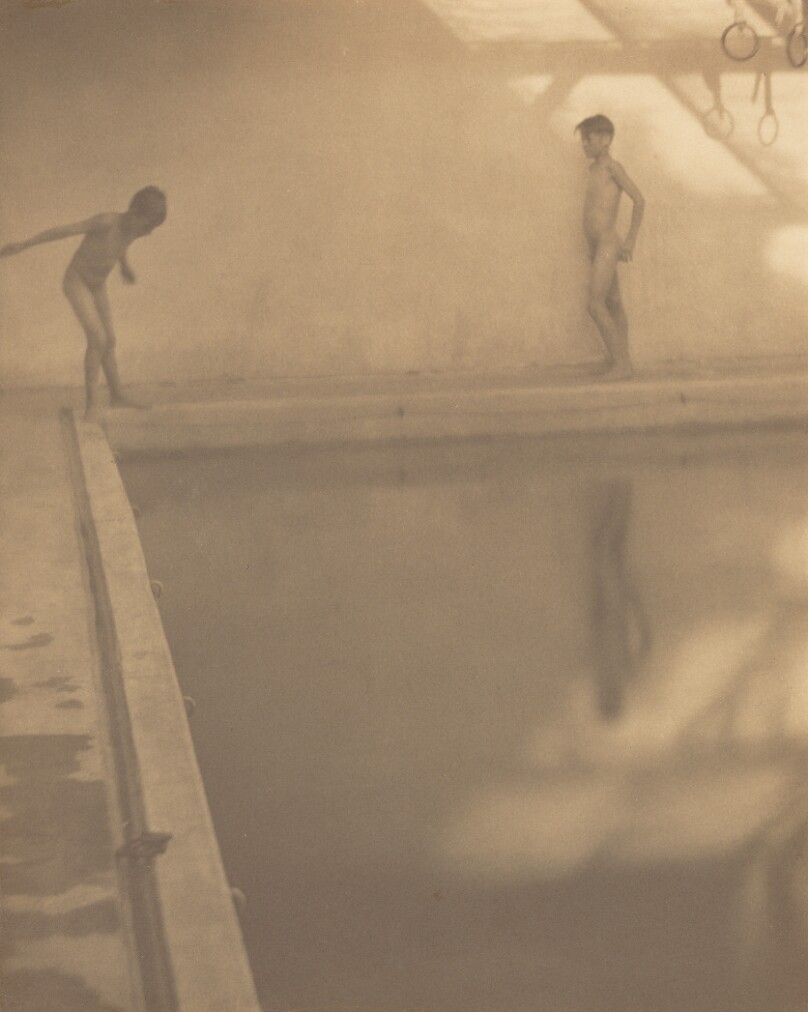
Bathers (85.XM.257.1)

Getty Museum

Bathers (85.XM.257.1)

Creator

Edward Weston

American Photographer · 1886–1958

All works by this person →
Artist

> To clearly express my feeling for life with photographic beauty, present objectively the texture, rhythm, form in nature, without subterfuge or evasion in technique or spirit, to record the quintessence of the object or element before my lens, rather than an interpretation, a superficial phase, or passing mood--this is my way in photography. It is not an easy way. > > --Edward Weston In the spri

More on Getty ULAN

Object Description · Getty Museum

> The years 1915 to 1920 were ones of great change for photography in America. As examples of Cubist, Dadaist, and Futurist paintings were shown in greater numbers and with greater frequency through publications and exhibitions, like the Panama­ Pacific International Exposition of 1915, American photographers began to respond to the aesthetics of international art. The East Coast photographer Paul Strand (1890-1976), for example, started using his camera to transform ordinary household items into abstract compositions. Strand's prints, published in Camera Work in 1916 and 1917, were probably familiar to Edward Weston through that periodical. Another contemporary, the photographer and painter Charles Sheeler (1885-1965), was experimenting too, in his case with the aesthetics of Cubism. Weston was acutely aware of these developments, and his own creations from 1916 through the early 1920s began to show more angular compositions and fewer literary allusions.Here Weston balanced a careful geometry of form with human subjects. The picture is composed around the strong lines of the pool's edge and a complementary shaft of light, which reflects on the surface of the water. The boy at left, poised with arms outstretched and knees bent on the brink of diving into the pool and disrupting the intricate balance of reflections, infuses the highly controlled composition with a sense of imminent instability. > > Weston made this picture while visiting the Claremont home of Paul Jordan-Smith (1895-1971), a friend who is portrayed in another Weston photograph in the Getty collection (see [84.XP.904.7](http://www.getty.edu/art/collection/objects/45267/edward-weston-paul-jordan-smith-american-1922/)). The boys are likely Weston's two eldest children, Brett and Chandler, who would have been about eight and nine years old, respectively. Those closest to Weston—his family, friends, colleagues, and lovers—were commonly the subjects of the photographer's experimentations in the medium. > > Brett Abbott. *Edward Weston*, In Focus: Photographs from the J. Paul Getty Museum (Los Angeles: J. Paul Getty Museum, 2005), 18. ©2005, J. Paul Getty Trust.

Getty Museum’s catalogue record

produced_by.carried_out_by[0].id
https://data.getty.edu/museum/collection/person/88e62337-eb0d-4610-8d8b-c4182d45c16d
Artist/Maker
Edward Weston
subject_of[Homepage].id
https://www.getty.edu/art/collection/object/104DC7
Date
1919
Medium
Platinum print
Culture
American
Object Type
Print

Taken from LinkedCulture’s stored copy of Getty Museum’s record. A fresh capture of the museum’s own record has not been made for this object yet.

The authoritative record is held by Getty Museum. LinkedCulture surfaces this object and its connections; it does not alter institutional metadata. The fields above are the museum’s, under its own labels. LinkedCulture’s derived fields are listed separately below and marked as ours.

Get printable QR codes

Open QR codes for this object page and the museum record. They stay collapsed until needed.

Open this page QR destination: https://linkedculture.org/q/q1.FL9ZKHvriXXdW5bG.4LEjVtuH_lefTYrn1II53-2qulm_PkJspPg7jOFJnee09u2wVlYd9sHAkpQZfT3DcxXTL3b6B5SAq-grnZPoL598kX_B1MDu8j9bvLgEuR2xGqnHA0KDAriwuobTOwnvOrgxIgg-apU0clmOMZkR5Ngp9wJktb2jMSjfxPpQMkfxD0HpW75Poju5tN18lA864LWFtJNpmqZ2bLskIf0149D9AP-R59pYYm7q_VpGaSGkq2IP3GwD9L0ZHMcU0vhGRzZZCVHMD3mvodKDbCyXyB6p47mFgAyG2NmeetCeoi4k8TQikX0ixvZ4rel8DJRlqHLwrgwqsWF9hFfJGirrsLXGIqoVGYykJDsU7kbAccv9wuLftAXAtcjQU6GUFgPEHJCwY60LMt1nqhRabTkNSee at Getty Museum QR destination: https://linkedculture.org/q/q1.9Bi26b_ocQtBT3kX.v_2wNDp4vvKtFar04KhLMcEtA4_xL6vD3EtHBp98EvS4PAI53jpEKaGHmASGPMD4c1poALwKpSD18HoiPlLHi8e7vcRzKPMd2Hu6Siq7_pYQPLq-qGNQL4gYtpt1QxVUGG_CEgWzL9EzLD6QmEEBTlwy0ZkauAJjaauib03fzUXGDXyYmyDSgB1_8SFe1AqfbNQena7EYVwBCMghMVdFfLom_qKkNKUZpyMSavgFcsmOUXp_e9roAREulwiZJA3p3oiXKYdqLreNLP2bm24zF5KV0IVHhWkT8r-wFXu-nbFjFablstkiAQApLv4YDz2tewhNWlswk97VDDWJ_wL3Oif-zzVB6sChPI-noSsV87Th99FR8oQ8TkL3GTs
Open this page
See at Getty Museum
How LinkedCulture maps this record

To search objects from different museums together, LinkedCulture reads each museum’s record into a common set of fields. The values below are LinkedCulture’s, under LinkedCulture’s names. They are not Getty Museum’s wording; the museum’s own record is shown above under its own labels.

Object ID
d20bf375-c278-42c4-8bf1-78b7374c88d2
Object Type
Print
  • Getty Museum field “Object Type” · copied as is
Creator
Edward Weston
  • Getty Museum field “Artist/Maker” · copied as is
Culture
American
  • Getty Museum field “Culture” · copied as is
Medium
Platinum print
  • Getty Museum field “Medium” · copied as is
Department
Photographs
  • Getty Museum field “Department” · derived by LinkedCulture from the museum field · Getty's classification category is stored as department.
Credit Line
The J. Paul Getty Museum, Los Angeles
  • Getty Museum field “Standard Credit Line” · the first available of several museum fields
  • Getty Museum field “Source Credit Line” · the first available of several museum fields
Date
1919
  • Getty Museum field “Date” · copied as is
Begin Year
1919
  • Getty Museum field “produced_by.timespan.begin_of_the_begin” · derived by LinkedCulture from the museum field
End Year
1919
  • Getty Museum field “produced_by.timespan.end_of_the_end” · derived by LinkedCulture from the museum field

The museum’s own record has not been captured for this object yet, so the museum fields shown above are limited to values LinkedCulture stored unchanged.

Related across collections

Semantically similar works from Getty Museum and other institutions.