Getty Museum
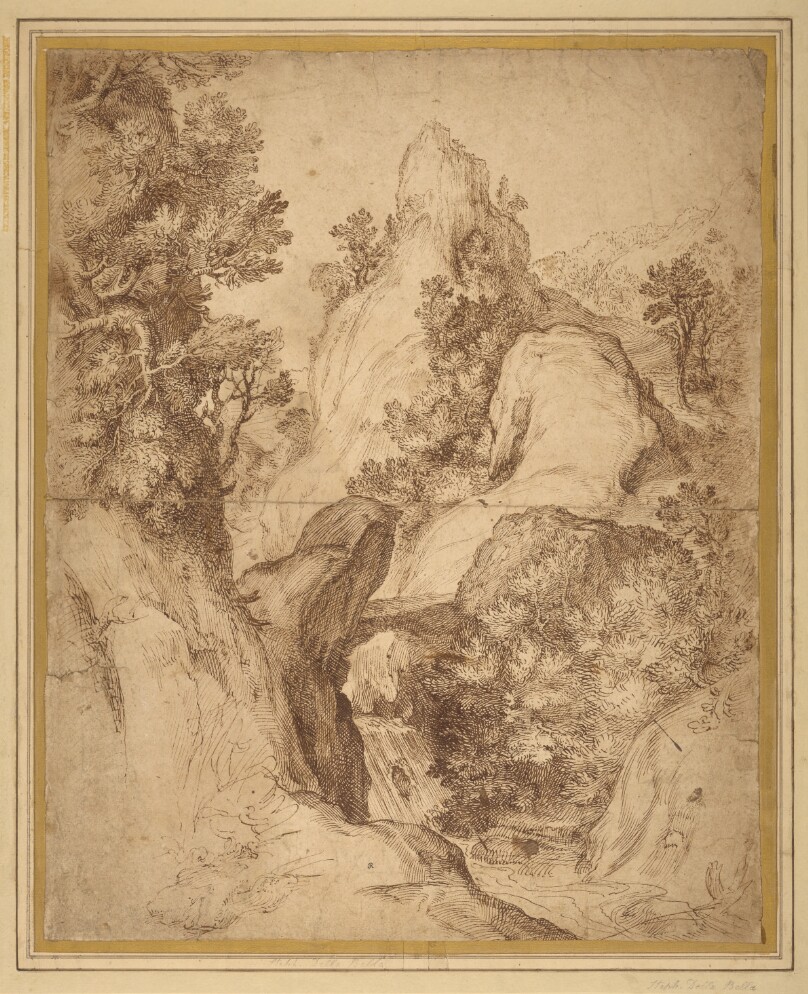
Rocky Landscape with a Waterfall
Creator
Girolamo MuzianoItalian Artist · 1528–1592
All works by this person →A devout Catholic, Girolamo Muziano created art appropriate for the pious mood of the Counter-Reformation while at the same time reinvigorating Roman landscape painting. After training in Venice and Padua, Muziano arrived in Rome in 1549 and shaved his head to avoid amorous distractions. From Padua, Muziano brought awareness of Lambert Sustris's and Domenico Campagnola's art; from Venice, he absor
More on Getty ULAN- Date
- about 1570–1575
- Medium
- Pen and brown ink
- Culture
- Italian
- Department
- Drawings
- Institution
- Getty Museum
- Object ID
- d276938a-2530-4048-ae94-98f3318cc9e8
From the Getty Museum record
Girolamo Muziano used a number of devices to weave together the elements of this mountain landscape. A protruding rock extends from the left across the stream, leading the eye across the bridge and along a ridge on the far bank and on to a craggy peak in the distance. The small stream descending in a waterfall provides another compositional axis. Muziano used the paper's blank areas to provide his brightest highlights and further capture the viewer's attention. As this drawing shows, Muziano's precise technique and cross-hatched shadows were readily translatable to the engraved line. He often supplied compositional drawings for engravings, and this sheet may have been a preparatory study for a print. The three variations on this composition in other collections indicate that this drawing may also have originally been intended as part of a series on the penitent saints. One shows a saint in the bottom left corner, while the other two have empty spaces there; perhaps Muziano left the spot open for that purpose.
The authoritative record is held by Getty Museum. LinkedCulture surfaces this object and its connections; it does not alter institutional metadata.
Get printable QR codesHide QR codes
Open QR codes for this object page and the museum record. They stay collapsed until needed.
Related across collections
Semantically similar works from Getty Museum and other institutions.