Getty Museum
Mars and Venus
Creator
Abraham BloemaertDutch Artist · 1564–1651
All works by this person →Despite being the son of an architect and sculptor, Abraham Bloemaert's artistic training was fragmented. He worked under six masters, for one of whom he was also a houseboy. He absorbed the Mannerism of the School of Fontainebleau, which stayed with him for life. Except for a short period in Amsterdam, he lived in Utrecht, becoming so important that Peter Paul Rubens visited him in 1627. Around 1
More on Getty ULAN- Date
- about 1592
- Medium
- Pen and brown ink, brown wash, white heightening over traces of black chalk
- Culture
- Dutch
- Department
- Drawings
- Institution
- Getty Museum
- Object ID
- d2ac1bfa-4f5f-4502-9723-e3ef49f86524
From the Getty Museum record
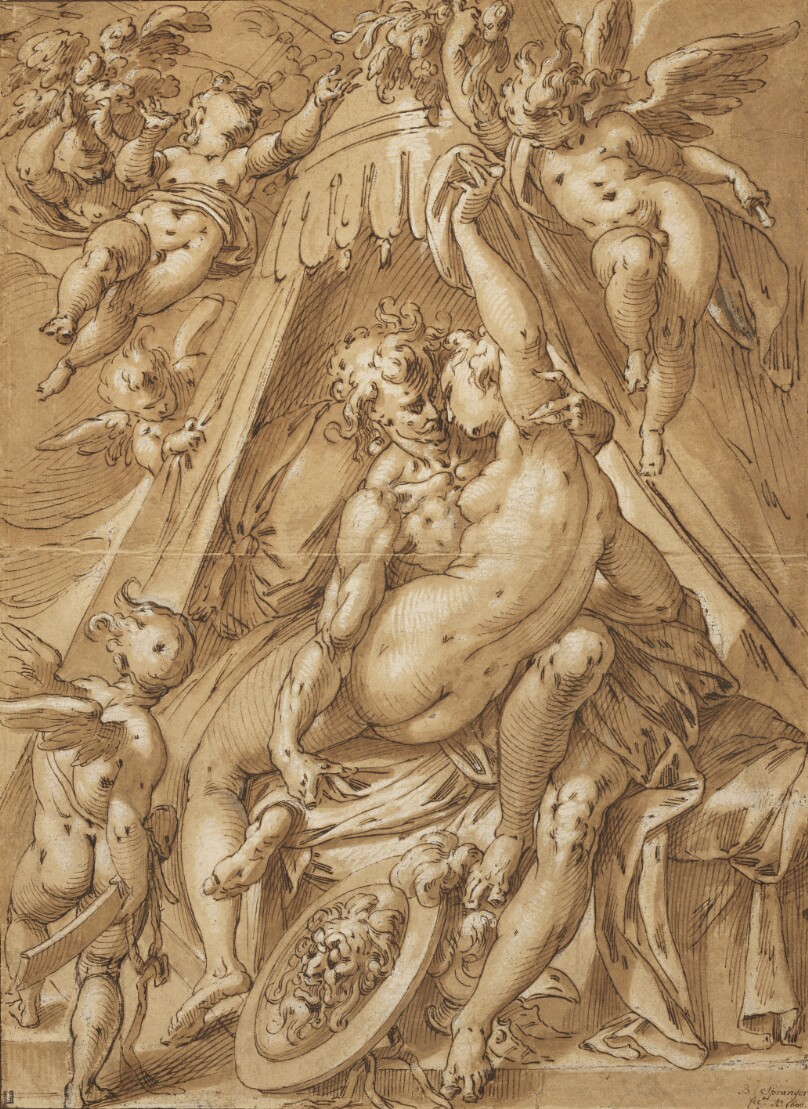
Under a lavish, tasseled canopy, the gods Mars and Venus make love on a bed surrounded by flying putti carrying decorative bunches of fruit. Mars, the god of war, has thrown down his elaborate shield and feathered helmet at the foot of the bed, while a putto plays with his sword. A fifth putto peers around the curtain to observe the adulterers. Abraham Bloemaert used the body of Venus as the drawing's central feature. As she curves around Mars, her body forms a grand diagonal sweep that flows up through the drawing, leading the viewer's eye up to the top of the canopy. Bloemaert's deft handling of his materials and his technique give the scene immediacy and vigor. By varying the length and the curve of the same strokes of parallel hatching, he indicated both the lighting and the volume of the forms. The white bodycolor heightening adds to the sense of animation. The high degree of finish suggests to scholars that Bloemaert made this drawing as a model for an engraving that was never completed or as a presentation sheet for a patron.
The authoritative record is held by Getty Museum. LinkedCulture surfaces this object and its connections; it does not alter institutional metadata.
Get printable QR codesHide QR codes
Open QR codes for this object page and the museum record. They stay collapsed until needed.
Related across collections
Semantically similar works from Getty Museum and other institutions.