Getty Museum
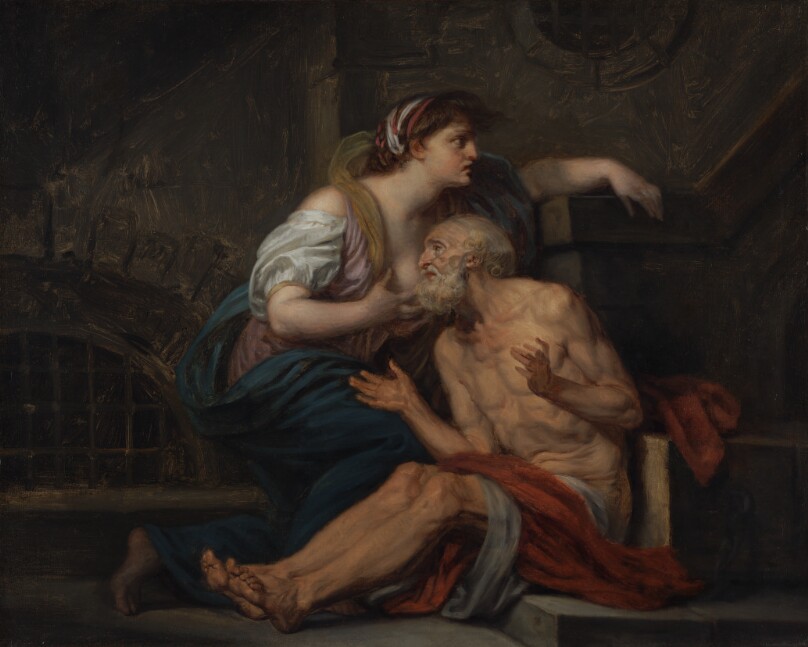
Cimon and Pero: "Roman Charity"
Creator
Jean-Baptiste GreuzeFrench Artist · 1725–1805
All works by this person →> Courage, my friend Greuze, go ahead and moralize with your paintbrush, and always continue in this manner! > > --Denis Diderot After training in Lyon, Jean-Baptiste Greuze arrived in Paris in 1750, where he sporadically attended the Académie Royale. His 1755 Salon debut was a triumph, but the acclamation turned his head. He antagonized everyone, including fellow artists, which later proved disas
More on Getty ULAN- Date
- about 1767
- Medium
- Oil on canvas
- Culture
- French
- Department
- Paintings
- Institution
- Getty Museum
- Object ID
- d3937a6d-6d3c-4f92-8871-64f077a8556e
From the Getty Museum record
When the aged Cimon was forced to starve in prison before his execution, his devoted daughter Pero secretly visited her father to nourish him at her own breast. In his *Memorable Acts and Sayings of the Ancient Romans*, the ancient Roman historian Valerius Maximus presented Pero's selfless devotion as the highest example of honoring one's parent. In the 1600s, major artists painted dramatic versions of the popular subject, which Jean-Baptiste Greuze and other artists revived a century later. Closely basing the setting and arrangement of figures on Peter Paul Rubens's version, Greuze probably made this oil sketch as the final stage of preparation for an unexecuted, large-scale painting. Contemporaries admired the rapid execution, vibrant colors, and lively paint handling in Greuze's oil sketches. The critic Denis Diderot lavishly praised his combination of genre and history painting and his public, moralizing purpose.
The authoritative record is held by Getty Museum. LinkedCulture surfaces this object and its connections; it does not alter institutional metadata.
Get printable QR codesHide QR codes
Open QR codes for this object page and the museum record. They stay collapsed until needed.
Related across collections
Semantically similar works from Getty Museum and other institutions.