Getty Museum
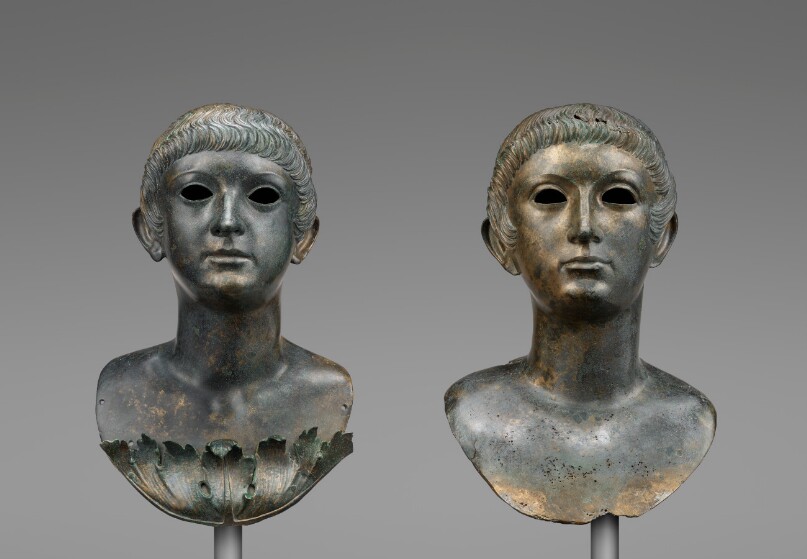
Pair of Portrait Busts of Youths and an Unrelated Pair of Marble Eyes
Creator
UnknownAll works by this person →More on Getty ULAN- Date
- A.D. 60–70
- Medium
- Bronze and marble
- Culture
- Roman
- Department
- Sculpture
- Institution
- Getty Museum
- Object ID
- d4c7d8e9-8c9c-488a-8550-265e38745f4d
From the Getty Museum record
Who do these two bronze portrait busts represent? They are very similar in appearance, although one appears slightly older than the other. Both boys have a hairstyle with a distinctive wave across the forehead, which was popular during the reign of the Roman emperor Nero. The busts originally had long, separately made locks of hair, which were attached to the back of the heads. Their long locks may indicate that they represent a pair of attendants in a youth organization called the Iuventus, which held special favor under Nero. If so, these busts are the only known portraits of such attendants in the Iuventus and were probably created to be displayed in one of the organization's shrines. One bust has an acanthus band at the bottom; while this feature is missing on the other bust, traces of solder may indicate its original presence. Also missing from both heads are the original inlaid eyes made of colored stone or glass paste. The emphasis on the front view, the simplistic treatment of the back of the head, and the overall style indicate that this pair of busts was made in the Roman province of Gaul. These busts were found in France in a hoard that also included the *Offering Box* ([95.AC.29][1]) and the *Statuette of Mars/Cobannus* ([96.AB.54][2]). [1]: https://www.getty.edu/art/collection/object/10406Q [2]: https://www.getty.edu/art/collection/object/10402K
The authoritative record is held by Getty Museum. LinkedCulture surfaces this object and its connections; it does not alter institutional metadata.
Get printable QR codesHide QR codes
Open QR codes for this object page and the museum record. They stay collapsed until needed.
Related across collections
Semantically similar works from Getty Museum and other institutions.