Getty Museum
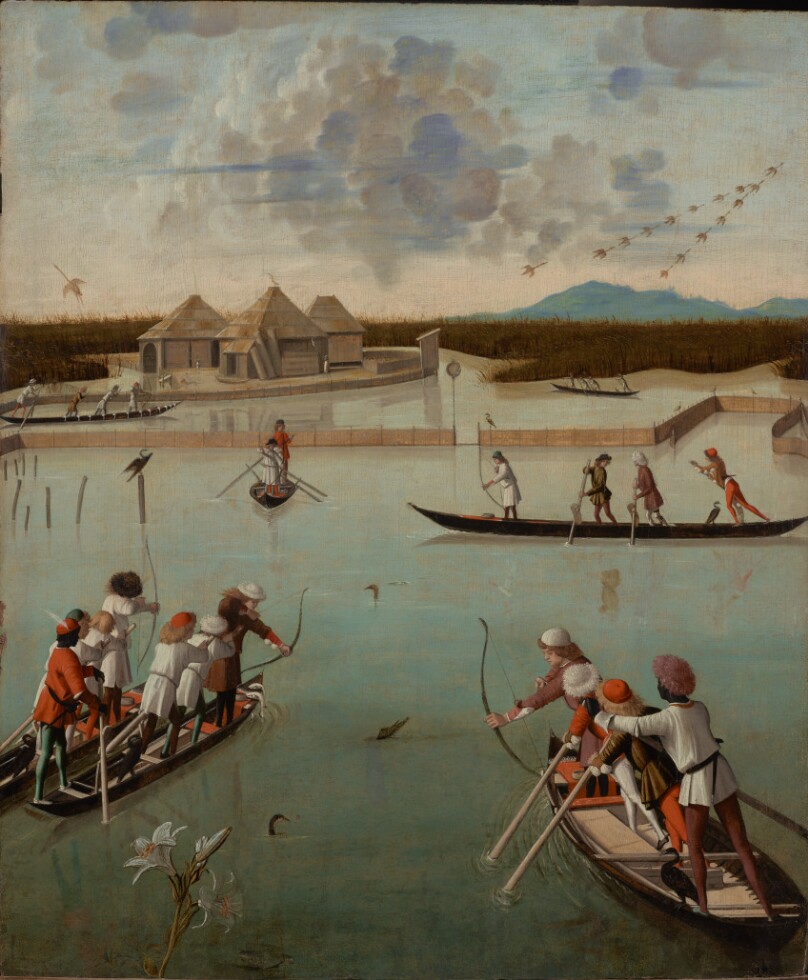
Hunting on the Lagoon (recto); Letter Rack (verso)
Creator
Vittore CarpaccioItalian Artist · 1–1465
All works by this person →Vittore Carpaccio always managed to depict Venice in his painting. Britain and Brittany were transformed into the canal city in one of his most famous cycles, *The Legend of Saint Ursula,* commissioned by Venice's Scuola of Saint Ursula, a fraternity of merchants and craftsmen, for their meeting hall adjacent to a Dominican church. When he completed the cycle in 1498, Venetians delighted in the pa
More on Getty ULAN- Date
- about 1490–1495
- Medium
- Oil on panel
- Culture
- Italian
- Department
- Paintings
- Institution
- Getty Museum
- Object ID
- d4e6a115-18aa-4205-abc4-4086c1669042
From the Getty Museum record
The hinges and latch on this two-sided panel suggest that it was used as a decorative window shutter or a door to a cabinet. The front depicts a scene of Venetian bird hunters, and the reverse shows a *trompe-l'oeil* (deceive the eye). Contemporary viewers looking at the front of the panel had the illusion of looking into the lagoon, as is evident in this reconstruction of how the panel once appeared. Groups of three rowers and archers stand in shallow-bottomed boats and hunt cormorants, glossy black water birds. The archers use clay pellets rather than arrows in order to stun the birds and not damage their plumage. A pellet, seen in mid-air, has just been fired by an archer in the boat in the lower right-hand corner and is about to strike the bird in the foreground. The lily blossom at the bottom left of the painting is out of scale with the rest of the image. Recent examination indicates that the hunting scene served as the background for a scene of two women sitting on a balcony overlooking the lagoon, a panel that is now in the Correr Museum in Venice. That painting has an empty stem in a vase sitting on a balustrade that matches up with the blossom in the Getty Museum's painting. The identical wood grain of the two panels confirmed that they were once a single panel. The two parts were probably sawed apart before the nineteenth century.
The authoritative record is held by Getty Museum. LinkedCulture surfaces this object and its connections; it does not alter institutional metadata.
Get printable QR codesHide QR codes
Open QR codes for this object page and the museum record. They stay collapsed until needed.
Related across collections
Semantically similar works from Getty Museum and other institutions.