Getty Museum
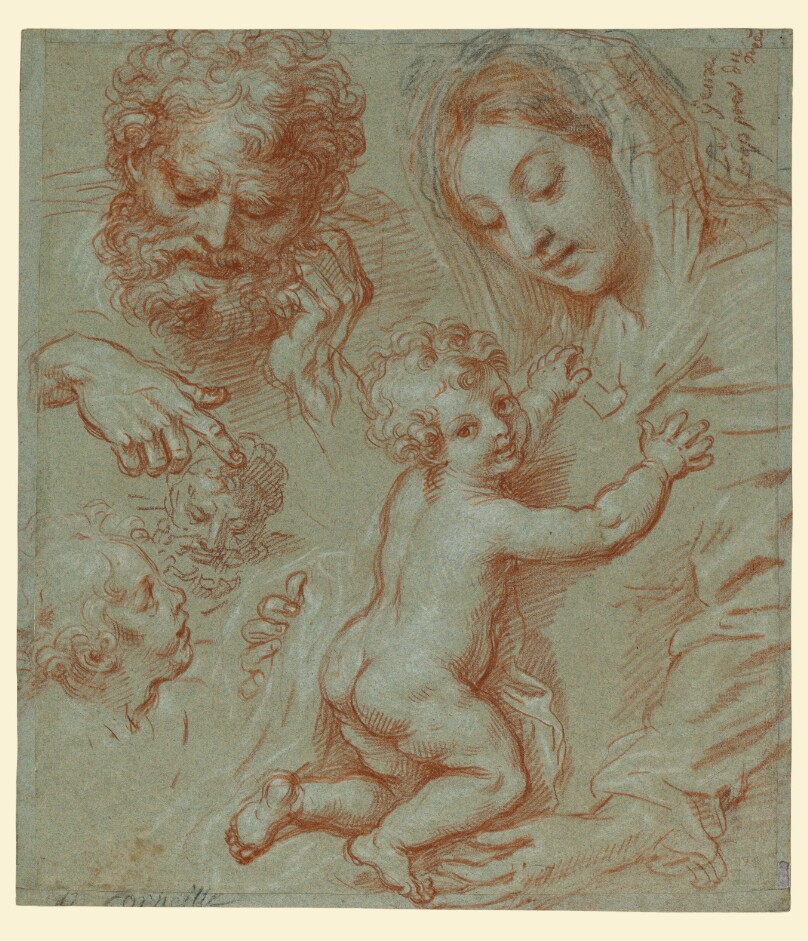
Studies of the Madonna and Child and of Heads (recto); Madonna and Child with Saint John Seated in a Landscape (verso)
Creator
Michel Corneille the YoungerFrench Artist · 1641–1708
All works by this person →Primarily a decorator, Michel Corneille the Younger worked at Louis XIV's residences, including Versailles and Fontainebleau. He also decorated government buildings and painted religious works for French churches. Unfortunately, many of his paintings have been destroyed, so today he is known chiefly through his many drawings and engravings. Corneille, whose younger brother was also a successful pa
More on Getty ULAN- Date
- about 1670–1690
- Medium
- Red, black, and white chalk (recto); Pen and brown ink and brown wash over black chalk (verso), on blue paper
- Culture
- French
- Department
- Drawings
- Institution
- Getty Museum
- Object ID
- d9418cf1-44b8-4fbf-b998-412218acae37
From the Getty Museum record
On one side of this sheet, the recto, Michel Corneille the Younger described the faces and bodies of the Madonna and Child and additional heads, possibly Saint Joseph and the infant Saint John the Baptist, in red chalk. Red chalk had long been popular for drawing the human figure and for rendering pinkish-tan flesh tones because of its rosy color. By liberally laying in white chalk, Corneille created a sensuous play of light over the Christ Child's skin and described the diaphanous fabric loosely draped around the fleshy infant's body. To further heighten the brilliance of the red and white chalks, he chose blue paper as his support. The combination of red, white, and black chalk is a technique known by French term coined in the 1700s, *aux trois crayons*. On the verso, Corneille drew the *Madonna and Child with Saint John Seated in a Landscape* in pen and ink, suggesting tonal areas with brown wash and black chalk. The copying of figures from the recto and the more complete nature of the composition suggest that the verso drawing was made after the recto. The interior framing lines and the precise outlined figures suggest that this drawing was made in preparation for an engraving.
The authoritative record is held by Getty Museum. LinkedCulture surfaces this object and its connections; it does not alter institutional metadata.
Get printable QR codesHide QR codes
Open QR codes for this object page and the museum record. They stay collapsed until needed.
Related across collections
Semantically similar works from Getty Museum and other institutions.