Getty Museum
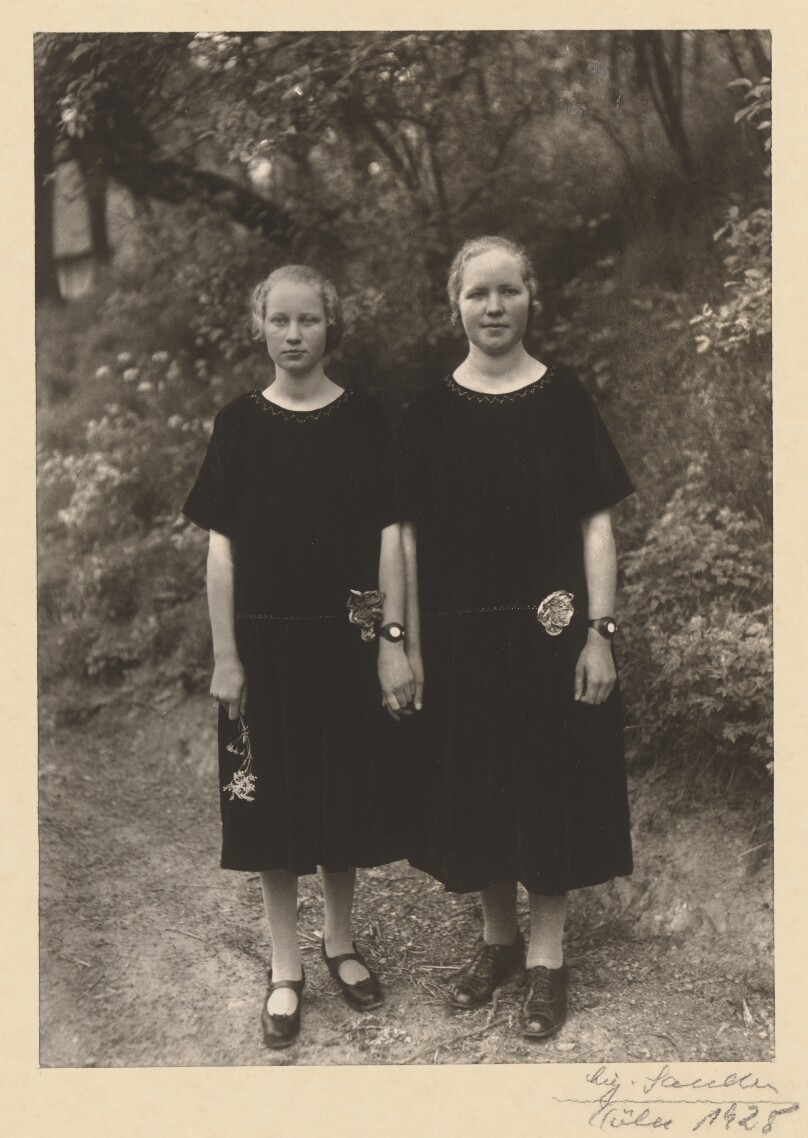
Country Girls
Creator
August SanderGerman Photographer · 1876–1964
All works by this person →During military service, August Sander was an assistant in a photographic studio in Trier; he then spent the following two years working in various studios elsewhere. By 1904 he had opened his own studio in Linz, Austria, where he met with success. He moved to a suburb of Cologne in 1909 and soon began to photograph the rural farmers nearby. Around three years later Sander abandoned his urban stud
More on Getty ULAN- Date
- 1925
- Medium
- Gelatin silver print
- Culture
- German
- Department
- Photographs
- Institution
- Getty Museum
- Object ID
- dcc04235-5aa3-4398-9ac1-e6b2f41e71cc
From the Getty Museum record
> August Sander considered a successful photograph only a preliminary step toward the intelligent use of his art. “Photography,” he wrote in a letter to the Cologne painter Peter Abelen (1884-1962) in 1951, “is like a mosaic that becomes a synthesis only when it is presented en masse!” He intended his portraits to be seen as a series, each image building and commenting on the other. It is not from the individual pictures that the meaning of Sander's typological project flows, but from the carefully orchestrated relationships among them. > > His project “Citizens of the Twentieth Century” was to be a physiognomic portrait of the German people, a comprehensive cultural history and social analysis in pictures. Physiognomy, the study of systematic correspondence between a person’s facial features or body structure and his/her psychological character, gained in popularity in the nineteenth century and has served as disturbing justification for racial profiling, discrimination, and genocide in the twentieth and twenty-first centuries. > > In 1929 Sander published *Face of the Time*, a book of sixty photographs intended as a preview of his larger effort. He included this image of two farm girls, taken in 1928. The teenagers, identified on the negative as sisters, are shown on a narrow country road in front of a diffuse backdrop of foliage. The uniformity of their outfits—the identical black dresses, wristwatches, and decorative rosettes—is matched by their listless, almost sagging poses. The absent-minded stare of the girl on the left and the drooping flower in her hand set the emotional tone of the picture. An intense psychological ambiguity hovers darkly about the scene, as if the flow of time had suddenly thickened and caught the girls in a trance—sleepwalkers in an uncanny twilight zone. > > While it is not known how Sander came to take this picture or whether he saw in it a deeper philosophical message, it is noteworthy that he positioned the image in *Face of the Time* immediately following that of the three young farmers en route to a dance (see [84.XM.126.294](https://www.getty.edu/art/collection/objects/34449/august-sander-young-farmers-jungbauern-german-summer-1914/)), thereby suggesting an intimate connection between the two. Striking different registers of the same emotional chord, both photographs convey a pervasive sense of uncertainty, displacement, and loss—a melancholy comment, perhaps, on the bruising encounter of the peasant with the urban industrial machine. > > Adapted from *August Sander*, In Focus: Photographs from the J. Paul Getty Museum by Claudia Bohn-Spector (Los Angeles: J. Paul Getty Museum, 2000), 34. ©2000, J. Paul Getty Trust.
The authoritative record is held by Getty Museum. LinkedCulture surfaces this object and its connections; it does not alter institutional metadata.
Get printable QR codesHide QR codes
Open QR codes for this object page and the museum record. They stay collapsed until needed.
Related across collections
Semantically similar works from Getty Museum and other institutions.