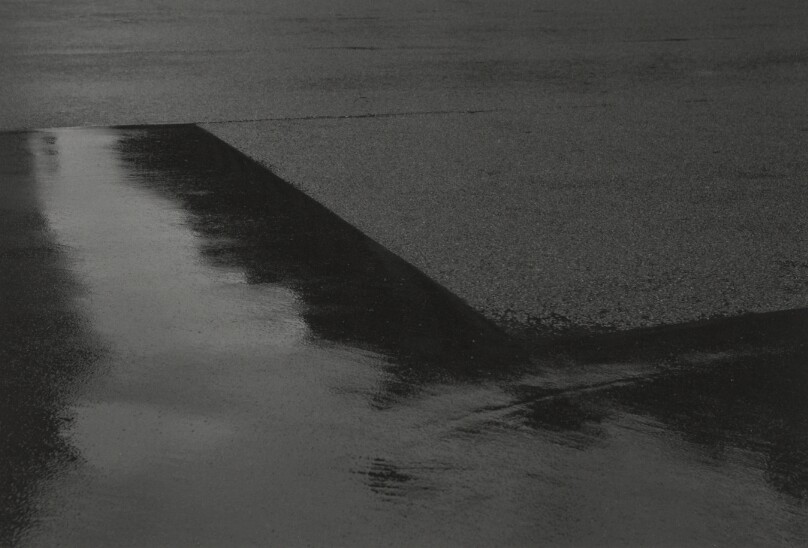
Getty Museum
Vie d’Alphonse Bertillon #14
Creator
Stéphanie SolinasFrench Photographer · 1978–present
All works by this person →- Date
- negative 2012; print 2023
- Medium
- Gelatin silver print and digital sound files
- Culture
- French
- Department
- Photographs
- Institution
- Getty Museum
- Object ID
- dd129018-907b-47cf-8937-28fba1e80fac
From the Getty Museum record
> One day when he was thinking similar thoughts on the Rue de Rivoli, the road his was born in, he was going to cross the Rue des Pyramides when he heard a very faint voice asking him: “Monsieur, could you please be so kind as to help me cross the road, I'm very short-sighted and I’m afraid of cars.” He turned around and saw a young lady who appeared to be extremely embarrassed and shy to have been so audacious. Alphonse was also shy, especially with women. He prayed her to take his arm, and, once on the other side, he took a look at his new acquaintance. He saw a small, pink, fresh blonde who smiled kindly at him with little neatly arranged teeth; unfortunately she wore a pince-nez and was slightly cross-eyed, but silky locks showed beneath her hat and for the moment they made him forget about the pince-nez. […] And that is how he met Amélie Notar who was to play such an important role in his life. > > Transcript of the audio that accompanies this photograph. The excerpt is from Suzanne Bertillon, *Life of Alphonse Bertillon: Inventor of Anthropometry* (Paris: Gallimard, 1941) as translated by Emmelene Landon and published in Stéphanie Solinas, *Sans Titre, M. Bertillon* (Paris: RVB Books, 2011). Text © Suzanne Bertillon, Gallimard. All rights reserved. In the 1880s Frenchman Alphonse Bertillon (1853-1914), an employee at the Paris Prefecture of Police, developed a method to identify repeat criminals that involved photographing and taking measurements of the individuals. He also introduced photography as a crucial tool in crime scene investigations. His theories and techniques have evolved into the multitude of methods of identification that are used on us all today. For the series Untitled (M. Bertillon), Stéphanie Solinas turned the tables on Bertillon by photographing sites of importance from his life as if she were studying crime scenes. Each of the twenty-three photographs has an audio component—an excerpt from Bertillon’s biography written by his niece Suzanne Bertillon (see the excerpt above). Solinas describes this series as “spoken pictures.” She also ran two mugshot-type portraits of Bertillon’s face and profile through facial analysis software to re-create a three-dimensional photographic sculpture [2023.55] that captures his piercing gaze. Carolyn Peter, J. Paul Getty Museum, Department of Photographs, 2024
The authoritative record is held by Getty Museum. LinkedCulture surfaces this object and its connections; it does not alter institutional metadata.
Get printable QR codesHide QR codes
Open QR codes for this object page and the museum record. They stay collapsed until needed.
Related across collections
Semantically similar works from Getty Museum and other institutions.