Getty Museum
The Story of Joseph
Creator
Biagio d'AntonioItalian Artist · 1446–1516
All works by this person →Biagio d'Antonio was trained in Florence, where he was first influenced by the elegant, linear style of Fra Filippo Lippi. By 1476 he had established himself as an independent painter in Faenza, where he remained for at least thirty years and built a large *bottega,* or workshop. He continued to work in other parts of Italy as well. Biagio collaborated with Domenico Ghirlandaio, considered the bes
More on Getty ULAN- Date
- about 1485
- Medium
- Tempera and gold leaf on panel
- Culture
- Italian
- Department
- Paintings
- Institution
- Getty Museum
- Object ID
- df7f03df-a770-4378-b087-3186e8fa6fcb
From the Getty Museum record
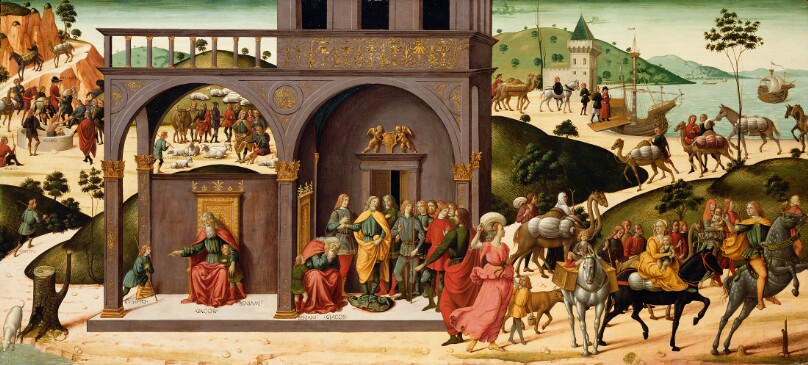
Drawn from the Old Testament, a series of continuous narratives depicts episodes from the life of Joseph, the favorite son of the Hebrew patriarch Jacob. To make the story easier to follow, Biagio d'Antonio included inscriptions identifying the principal characters. In the left-hand loggia, Jacob, seated on a throne, sends Joseph to his half-brothers tending sheep in the field. In the far left corner, the brothers, jealous of their father's love for Joseph, strip him of his jacket and throw him into a pit. Passing merchants purchase the young boy from his brothers for twenty pieces of silver. In the background to the right, the merchants board the ship that will take them and their cargo to Egypt. In the right-hand loggia, the brothers show a blood-smeared coat to their father as evidence that Joseph is dead. With his head in his hand, Jacob mourns his son, whom he believes to be dead. A companion panel in the Metropolitan Museum of Art depicts the next sequence of events in Joseph's life. Originally framed next to one another, these two panels would have been inserted into the paneling of a room in a Tuscan family's home.
The authoritative record is held by Getty Museum. LinkedCulture surfaces this object and its connections; it does not alter institutional metadata.
Get printable QR codesHide QR codes
Open QR codes for this object page and the museum record. They stay collapsed until needed.
Related across collections
Semantically similar works from Getty Museum and other institutions.