Getty Museum
Scarab
Creator
UnknownAll works by this person →More on Getty ULAN- Date
- second half of 5th century B.C.
- Medium
- Cornelian
- Culture
- Etruscan
- Department
- Jewelry
- Institution
- Getty Museum
- Object ID
- dfdbfe45-b78b-4fb8-b63c-774583b3aca7
From the Getty Museum record
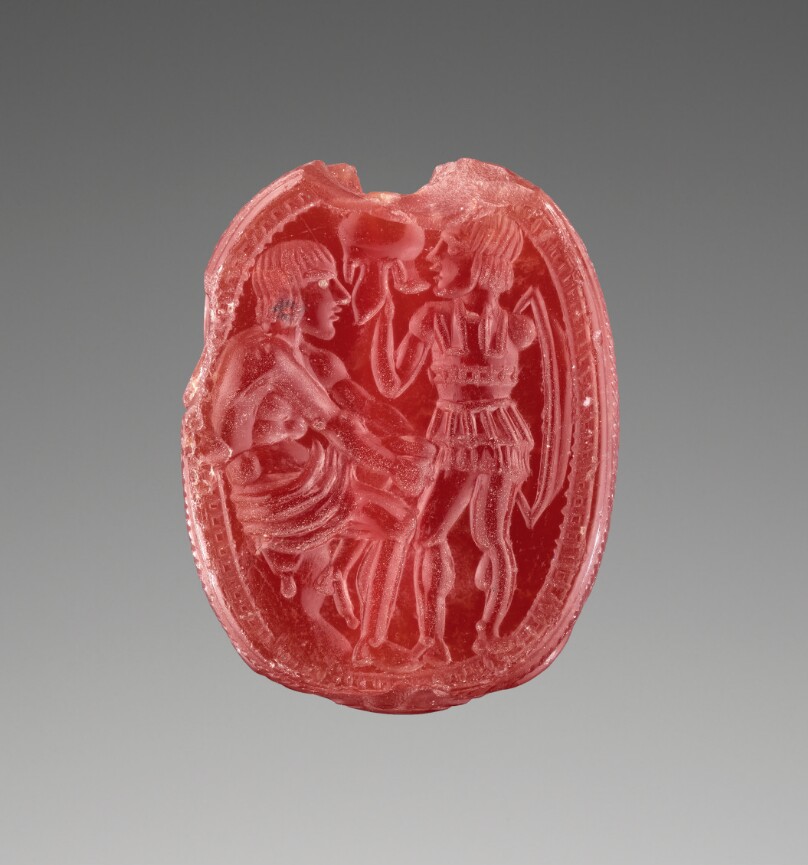
A warrior in a leather corselet and holding a shield and a Chalcidian helmet stands in front of a youth who sits on a rock, clasping one knee. The knee-clasping posture began to appear in Greek art shortly before 550 B.C., and its appearance on this gem shows gem carvers' awareness of developments in other media. The precise identity of the figures is unclear: they could be Achilles seated, watching Patroklos go off to battle for the last time--or simply two young men. Scarabs were introduced to Etruria in the later 500s B.C., first through Greek imports and then through emigrant Greek artists. In this period many Ionian artists, including gem carvers, fled Persian aggression in their homeland. Some went to Etruria, which was a stable and wealthy region. The jewelry aspect of the scarab was emphasized in Etruria: the beetle sits on a decorated plinth, and its anatomy is carved in detail, usually with incised winglets and stippled heads.
The authoritative record is held by Getty Museum. LinkedCulture surfaces this object and its connections; it does not alter institutional metadata.
Get printable QR codesHide QR codes
Open QR codes for this object page and the museum record. They stay collapsed until needed.
Related across collections
Semantically similar works from Getty Museum and other institutions.