Getty Museum
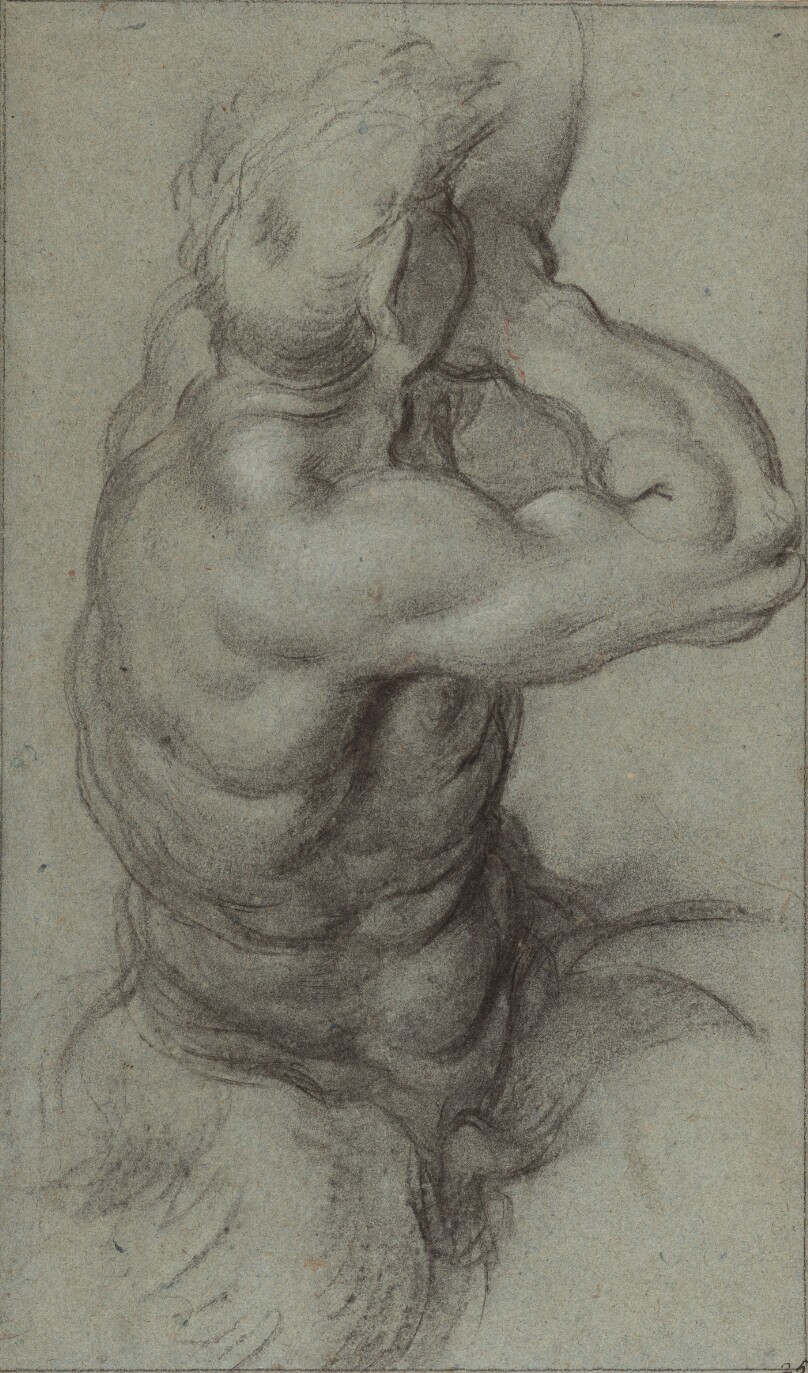
Study of Triton Blowing a Conch Shell (recto); Partial Study of an Arm (verso)
Creator
Annibale CarracciItalian Artist · 1560–1609
All works by this person →"Neither clean nor well-dressed, with his collar askew, his hat jammed on any old way and his unkempt beard, Annibale Carracci seemed to be like an ancient philosopher, absent-minded and alone," wrote an early biographer. A tailor's son, Carracci considered himself a craftsman, not a courtier, but the Romans buried him in the Pantheon beside Raphael. Along with his older brother Agostino and his c
More on Getty ULAN- Date
- about 1600
- Medium
- Charcoal with traces of white chalk (recto); black chalk (verso), on blue paper
- Culture
- Italian
- Department
- Drawings
- Institution
- Getty Museum
- Object ID
- dff75e58-f8b9-4507-8ab7-5d948451dea7
A nude triton displays his rippling, muscular figure as he turns to blow a conch shell announcing a special event. His powerful sculptural form and sense of monumentality derive from ancient Roman sculpture and Renaissance art, especially Michelangelo's Sistine Chapel *ignudi*, while the use of black and white chalks on blue-gray paper reflects Annibale Carracci's interest in Venetian art of the 1500s. Annibale made this drawing as a study for a triton for Agostino Carracci’s fresco, *Thetis Borne to the Wedding Chamber of Peleus*, also known as Galatea. The Carracci brothers began work on the decoration of the Galleria Farnese in Rome, including this fresco, in 1597. For centuries, this cycle of paintings influenced artists as much as Michelangelo's Sistine ceiling. Beginning with drawing from life and understanding anatomy, the Carracci focused on painting the human figure. Their drawings of the nude maintained monumental proportions while broadly sketching the body's essential structure; combining robust energy with soft, rhythmic contours. The fragment of an arm on the verso of this drawing was trimmed from a study of a triton now in the Metropolitan Museum of Art, proving that this sheet was once part of a larger one.
The authoritative record is held by Getty Museum. LinkedCulture surfaces this object and its connections; it does not alter institutional metadata.
Get printable QR codesHide QR codes
Open QR codes for this object page and the museum record. They stay collapsed until needed.
Related across collections
Semantically similar works from Getty Museum and other institutions.