Getty Museum
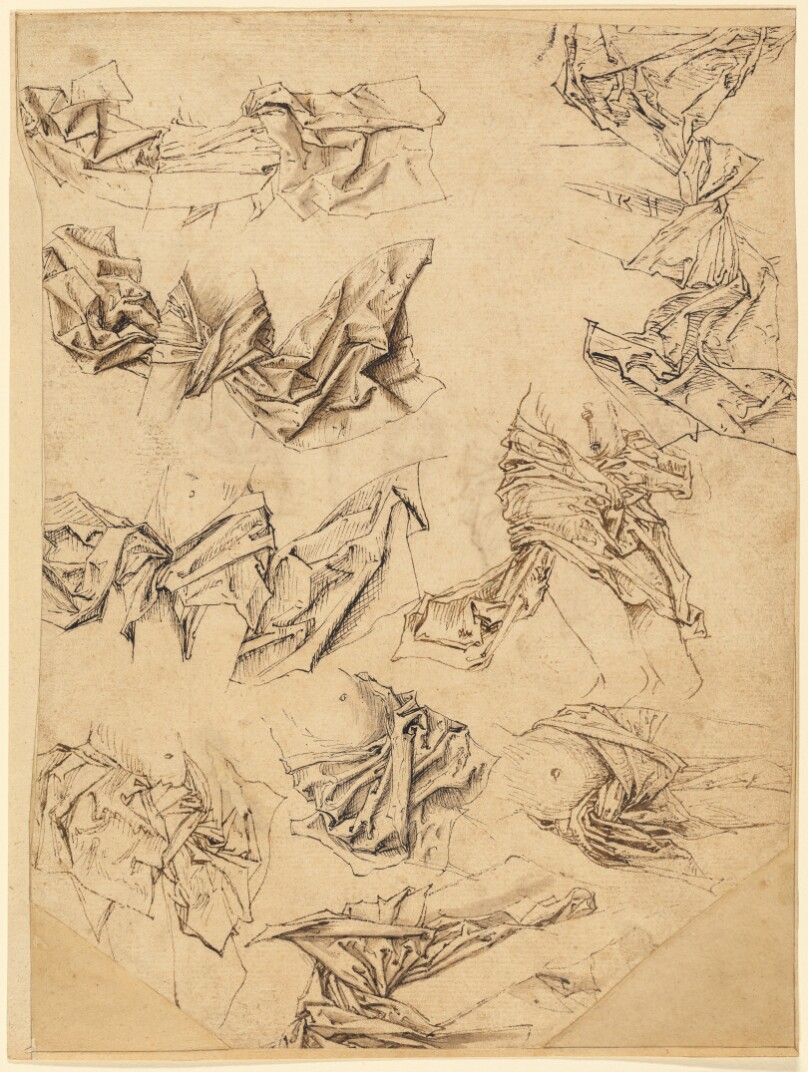
Studies of Christ's Loincloth (recto); Studies of Bookbindings and of Christ's Loincloth (verso)
Creator
Master of the Coburg RoundelsGerman Artist · 1470–1500
All works by this person →This artist's identity remains a mystery. Scholars named him the Master of the Coburg Roundels after two sketches for roundels from about 1485 in Coburg, which are considered cornerstones of the artist's stylistic development. Some scholars have also called him the Master of the Drapery Studies, because so many of his drawings represent folds of clothing such as sleeves, loincloths, or even whole
More on Getty ULAN- Date
- about 1490
- Medium
- Pen and brown and black ink, brown and gray wash (recto); pen and brown and black ink, brown and gray wash, heightened with white gouache (verso)
- Culture
- German
- Department
- Drawings
- Institution
- Getty Museum
- Object ID
- e011322c-bdc8-456c-8ef5-3fa10d384ba8
From the Getty Museum record
Nine interlocking studies of Christ's loincloth create an effect of restless movement across the surface of this sheet. The artist, known only as the Master of the Coburg Roundels, experimented with showing Christ's torso from various angles and wrapping the loincloth in various ways around his body. He built up the folds of most of the draperies with quick hatching and added points of visual interest by modeling four of them in wash. The verso demonstrates a similarly lively visual interplay among its various elements. The artist first lightly sketched the two studies of book bindings, then later added two, more heavily modeled drapery studies in the center and a brass corner fitting in the upper right corner, illusionistically modeled with wash and bodycolor. The delicately drawn bookbindings are so carefully rendered that scholars can identify them as southern German, possibly made in the town of Augsburg in the late 1400s.
The authoritative record is held by Getty Museum. LinkedCulture surfaces this object and its connections; it does not alter institutional metadata.
Get printable QR codesHide QR codes
Open QR codes for this object page and the museum record. They stay collapsed until needed.
Related across collections
Semantically similar works from Getty Museum and other institutions.