Getty Museum
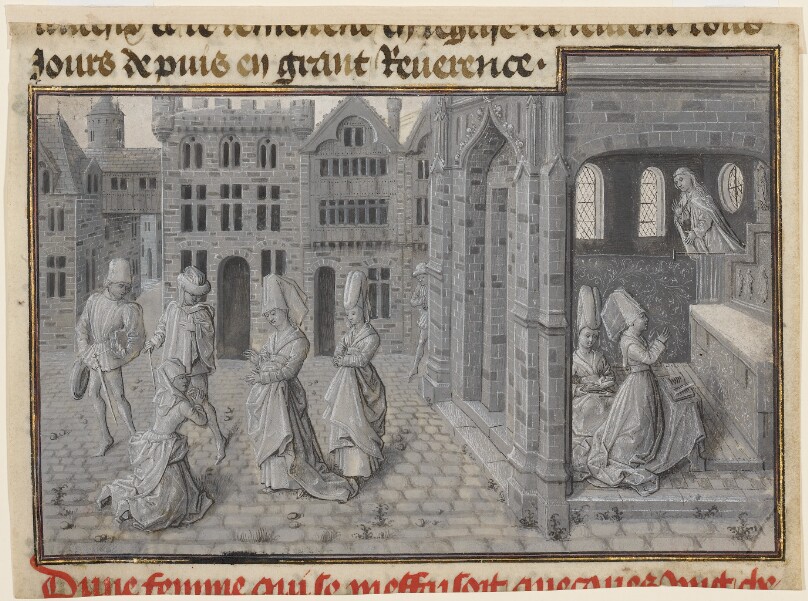
Miniature from The Miracles of Our Lady
- Date
- about 1460
- Medium
- Tempera colors and gold paint
- Culture
- Flemish
- Department
- Manuscripts
- Institution
- Getty Museum
- Object ID
- e1a908d4-c227-4209-948e-66902ec4eccd
From the Getty Museum record
This miniature originally appeared in a manuscript expressly created for Philip the Good, the duke of Burgundy that consists of a compilation of accounts of the miracles of the Virgin Mary. Philip was a highly successful political leader of his day as well as an important and influential patron of manuscript illumination. The witty scene illustrates a noblewoman's endeavor to deal with her husband's Christian mistress. In the chapel at right, the wife of the adulterous knight prays for the Virgin Mary to avenge her by punishing the mistress. However, Mary refuses the request on account of the adulteress's deep devotion to her. Subsequently when wife and mistress encounter one another in the street the mistress is so embarrassed--she falls to her knees--she promises to give up the husband. Meanwhile the wayward husband cowers behind the chapel. Given the duke's own serial philandering--he fathered several dozen children outside his marriage and relatively few within it--one cannot help but wonder how he responded to this moralizing tale. The miniature is painted entirely in grey tones, a technique called grisaille, popular in the later Middle Ages. Despite the lack of color, the illuminator, Lieven van Lathem, vividly evokes the buildings and cobblestone streets of a prosperous Netherlands town such as Ghent where van Lathem, the court painter of Philip the Good, resided.
The authoritative record is held by Getty Museum. LinkedCulture surfaces this object and its connections; it does not alter institutional metadata.
Get printable QR codesHide QR codes
Open QR codes for this object page and the museum record. They stay collapsed until needed.
Related across collections
Semantically similar works from Getty Museum and other institutions.