Getty Museum
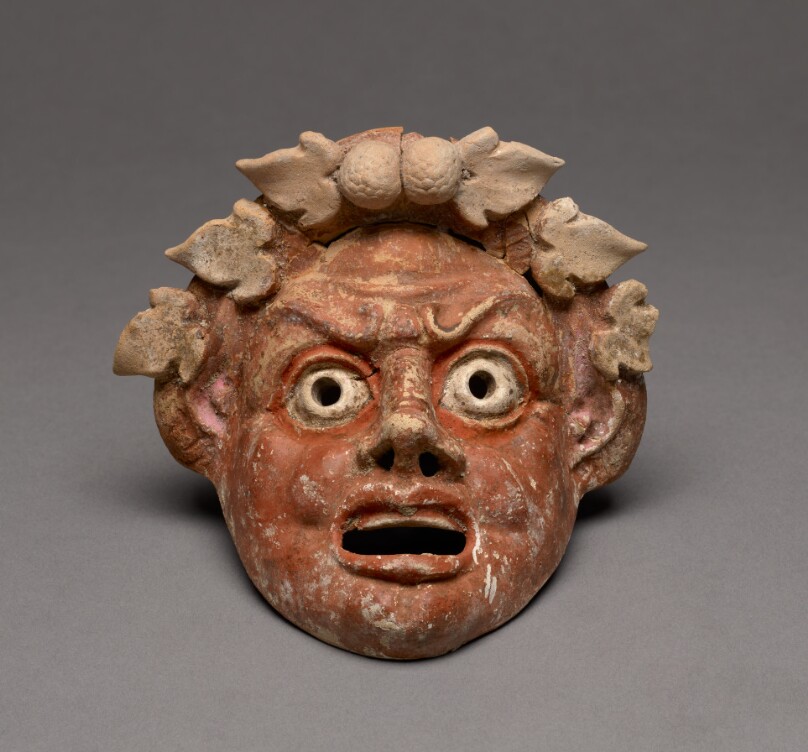
Mask of a Satyr
Creator
UnknownAll works by this person →More on Getty ULAN- Date
- 200–100 B.C.
- Medium
- Terracotta with polychromy (brownish red, orange red, white, black, pink, sky blue)
- Culture
- Greek (Sicilian)
- Department
- Sculpture
- Institution
- Getty Museum
- Object ID
- e1a97b8e-918c-4cb5-810e-d7cbd085fca1
From the Getty Museum record
The mask depicts a young satyr wearing a wreath. The face has a powerful jaw, full cheeks, a short, rounded chin with a dimple in the center, and a wide-open mouth. The eyes are staring and hollowed out with convex eyeballs and perforated irises, surrounded by heavy eyelids. The forehead has a bump in the upper portion and is furrowed by a horizontal crease. The ears are pointed, and the hair rises up over the forehead. The wreath - worked by hand and applied before firing - is decorated with six ivy leaves and two round pieces of fruit at the center. There are two suspension holes in the lower part of the nape of the neck. The ancient polychromy is extensively preserved - brownish red (hair and face), orange red (orbital arch and mouth), white (interior of the orbital arch, teeth, and wreath), black (eyebrows), pink (ears), and sky blue (leaves of the wreath). The mask is produced as though a scale model of originals that were worn onstage by actors. It is most closely comparable with the production of Centuripe, in Sicily, in the second century BC.
The authoritative record is held by Getty Museum. LinkedCulture surfaces this object and its connections; it does not alter institutional metadata.
Get printable QR codesHide QR codes
Open QR codes for this object page and the museum record. They stay collapsed until needed.
Related across collections
Semantically similar works from Getty Museum and other institutions.