Getty Museum
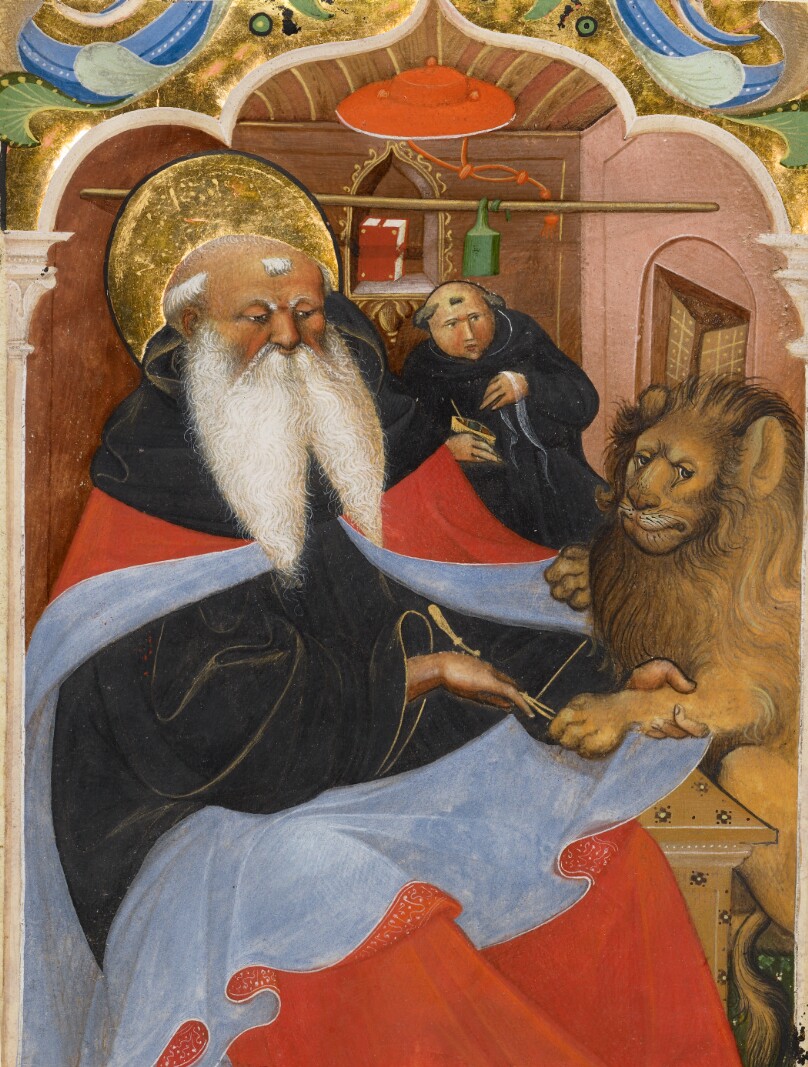
Saint Jerome Extracting a Thorn from a Lion's Paw
Creator
Master of the Murano GradualItalian Illuminator · 1430–1460
All works by this person →The Master of the Murano Gradual takes his name from a gradual (a type of choir book containing the sung portions of the mass) that was disbound at some point in the past and now exists only as a series of cuttings and leaves in several collections. The gradual may have originally come from the Camaldolese monastery of San Michele in Murano. The Master of the Murano Gradual is one of the most dist
More on Getty ULAN- Date
- second quarter of 15th century
- Medium
- Tempera and gold leaf
- Culture
- Italian
- Department
- Manuscripts
- Institution
- Getty Museum
- Object ID
- e31a54bb-27f0-4d64-a5a3-334ed3e8011b
From the Getty Museum record
This leaf depicts a story from the life of Saint Jerome (about 341 - 420), one of the four doctors of the Church. One day, a lion entered the monastery where Jerome resided, causing his fellow monks to flee, but Jerome recognized that the beast was injured and he cured it by removing a thorn from its paw. The saint's monumental form fills the foreground of the composition, setting off the delicate gold tweezers Jerome uses to extract the thorn. In the background, a monk approaches with a pot of ointment and a bandage. The encounter between man and animal, in which Jerome comes to the lion's aid, is poignant, showing the moment when the lion submits to the saint, the saint's concentration as he removes the thorn, and the apprehensiveness of the attendant monk. This cutting likely represents a large miniature or initial from a gradual probably commissioned for the Camaldolese monastery of San Mattia in Murano. This manuscript was one of the most lavish and elaborately illuminated Lombard choir book commissions of the fifteenth century. The artist responsible for its decoration it is known as the Master of the Murano Gradual. This illuminator likely worked between the regions of Lombardy and the Veneto and he is notable for his originality and his imposing figures clothed in voluminous drapery, their faces strongly modeled and expressive.
The authoritative record is held by Getty Museum. LinkedCulture surfaces this object and its connections; it does not alter institutional metadata.
Get printable QR codesHide QR codes
Open QR codes for this object page and the museum record. They stay collapsed until needed.
Related across collections
Semantically similar works from Getty Museum and other institutions.