Getty Museum
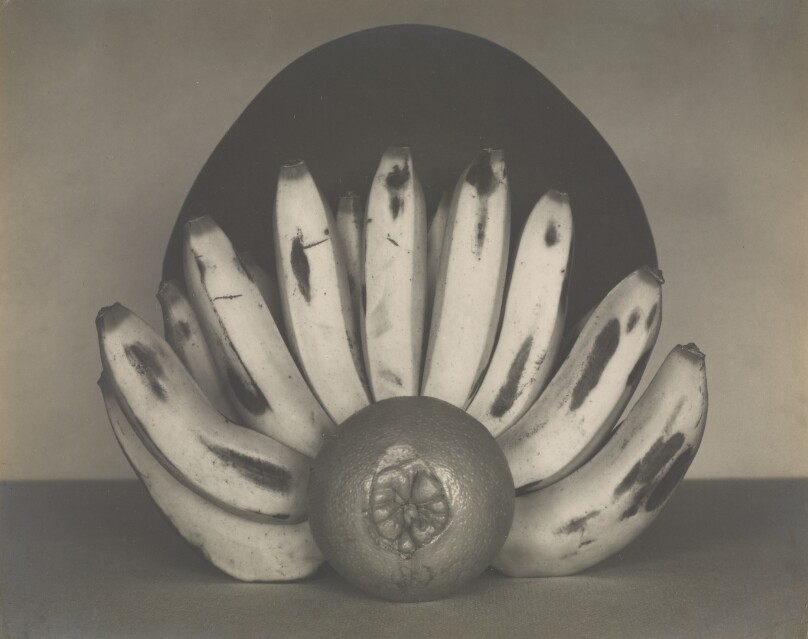
Bananas and Orange (84.XM.860.4)
Creator
Edward WestonAmerican Photographer · 1886–1958
All works by this person →> To clearly express my feeling for life with photographic beauty, present objectively the texture, rhythm, form in nature, without subterfuge or evasion in technique or spirit, to record the quintessence of the object or element before my lens, rather than an interpretation, a superficial phase, or passing mood--this is my way in photography. It is not an easy way. > > --Edward Weston In the spri
More on Getty ULAN- Date
- April 1927
- Medium
- Gelatin silver print
- Culture
- American
- Department
- Photographs
- Institution
- Getty Museum
- Object ID
- e32f946b-9c8c-41fd-ace7-f7b1fb532568
From the Getty Museum record
> Simultaneous with his work on shells and nudes, Edward Weston began photographing bananas, gourds (see [89.XM.74](http://www.getty.edu/art/collection/objects/59141/edward-weston-gourd-american-1927/)), and other still-life subjects. He was staying close to his studio in 1927, partly because he found his growing Los Angeles surroundings unappealing and partly to be available for portrait commissions. But he also realized during this time that art could be modern without depicting industrial themes. As he wrote in his daybook, “Are not shells, bodies, clouds as much of today as machines? Does it make any difference what *subject matter* is used to express a feeling toward life!”. > > In 1928 Weston moved to San Francisco and opened a portrait studio with his son Brett (1911-1993), who had chosen to become a photographer himself. In December of that year the two packed up and moved to Carmel, a small town along the coast with a significant population of artists. It was there that Weston began focusing attention on peppers (see [88.XM.68.1](http://www.getty.edu/art/collection/objects/55385/edward-weston-pepper-american-july-19-1930-or-earlier/)), which he typically ate after photographing them. Those who followed his output commonly saw sexual content in his still-life compositions, although he repeatedly denied having directly intended such allusions. He resented those who pigeonholed his work in this way, calling them “the sexually unemployed belching gaseous irrelevancies from an undigested Freudian ferment!” He wrote in his daybook that he photographed peppers because “of the endless variety in form manifestations, because of their extraordinary surface texture, because of the power, the force suggested in their amazing convolutions!” At the same time, however, Weston was aware that the simplified, heightened reality of his presentations, whether they be of nudes, vegetables, fruits, or his later dunes, could conjure up other associations. He was keenly interested in the idea that “all basic forms are so closely related as to be visually equivalent!” > > Weston's work during the late 1920s and early 1930s was well received. Arthur Millier, an avant-garde critic, reviewed it frequently in the *Los Angeles Times*, and it was exhibited in modern art galleries in Los Angeles, San Francisco, and Carmel. > > Brett Abbott. *Edward Weston*, In Focus: Photographs from the J. Paul Getty Museum (Los Angeles: J. Paul Getty Museum, 2005), 56. ©2005, J. Paul Getty Trust.
The authoritative record is held by Getty Museum. LinkedCulture surfaces this object and its connections; it does not alter institutional metadata.
Get printable QR codesHide QR codes
Open QR codes for this object page and the museum record. They stay collapsed until needed.
Related across collections
Semantically similar works from Getty Museum and other institutions.