Getty Museum
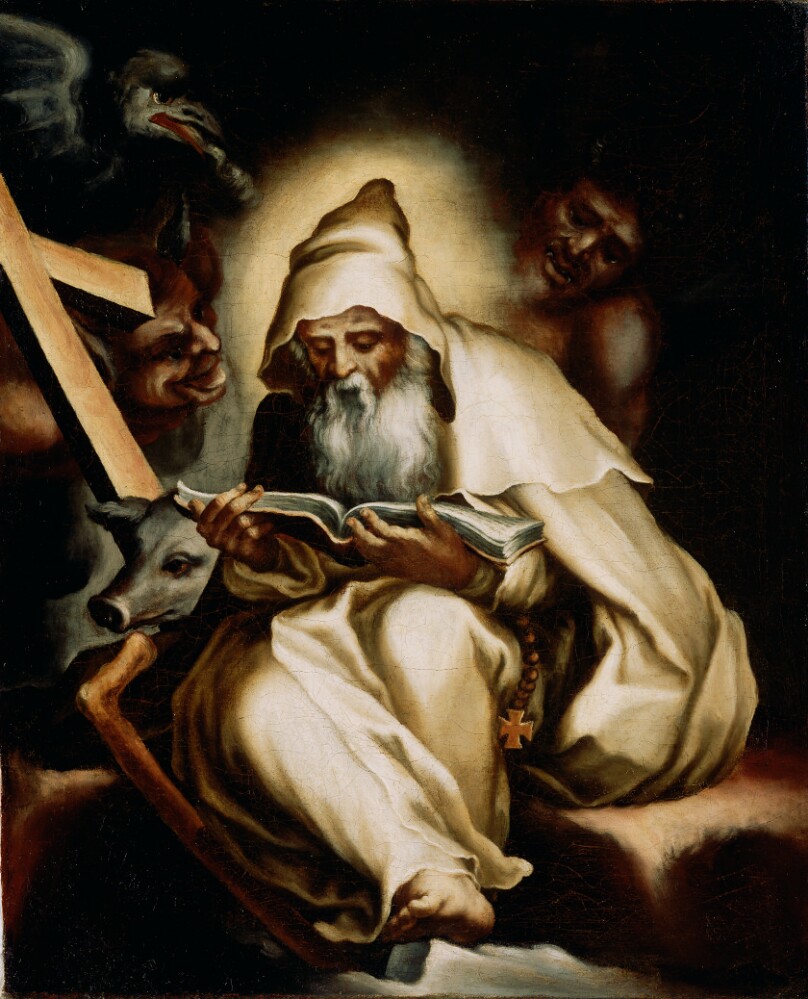
The Temptation of Saint Anthony
Creator
Lelio OrsiItalian Artist · 1511–1587
All works by this person →Lelio Orsi studied with his painter father, but very early on he incorporated into his polished, illusionistic style the two influences that remained primary throughout his life: Giulio Romano's exaggerated movement and excitability and Correggio's poignant passion and vibrant way of seeing. By 1538 Orsi had moved to a larger nearby town, Reggio Emilia, where he painted many architectural facades
More on Getty ULAN- Date
- 1570s
- Medium
- Oil on canvas
- Culture
- Italian
- Department
- Paintings
- Institution
- Getty Museum
- Object ID
- e3741a9e-2ae3-46ed-ad8e-a9067a06f898
From the Getty Museum record
Lurking in the shadows, grotesque monsters emerge to taunt Saint Anthony, attempting to impede his meditation. Grinning with satanic delight, the demons take human and raptor-like animal forms. Unperturbed, Saint Anthony continues to read his meditations. Divine light illuminates his figure, forming a bright halo around his head. He is identified by his three principle attributes: a tau cross (T), the pig behind him, and the crutch at his side. The tau, a symbol of immortality in ancient Egypt, was adopted by Alexandrian Christians and became known as the Egyptian cross. Anthony was born in Egypt in 251 AD. After his parents' death, he distributed his property among the poor and retired to the Egyptian desert to contemplate God in solitude. He remained there for fifteen years, during which time he began his legendary combat against the devil, withstanding a series of temptations, which according to Anthony's biographer, Saint Athanasius, took the form of demonic apparitions and erotic visions. Orsi shows the venerable saint, serene and resolute in his devotions, as an exemplum for all Christians in their meditations. Having successfully resisted evil, Saint Anthony emerged from the desert to instruct a group of hermits who sought to imitate his example. Thus he became the father of Christian monasticism, for which he is called Saint Anthony the Great or Saint Anthony Abbot. Lelio Orsi depicted this struggle between good and evil vividly using strong chiaroscuro (starkly contrasting light and shadow), and by rendering the grotesque features of the demons in loose, painterly brushstrokes, emphasizing their lack of humanity.
The authoritative record is held by Getty Museum. LinkedCulture surfaces this object and its connections; it does not alter institutional metadata.
Get printable QR codesHide QR codes
Open QR codes for this object page and the museum record. They stay collapsed until needed.
Related across collections
Semantically similar works from Getty Museum and other institutions.