Getty Museum
Statuette of Venus (Venus de Clercq)
Creator
UnknownAll works by this person →More on Getty ULAN- Date
- A.D. 175–200
- Medium
- Marble with polychromy
- Culture
- Roman
- Department
- Sculpture
- Institution
- Getty Museum
- Object ID
- e590756a-ed73-4ad4-82e3-1c23b4371ca0
From the Getty Museum record
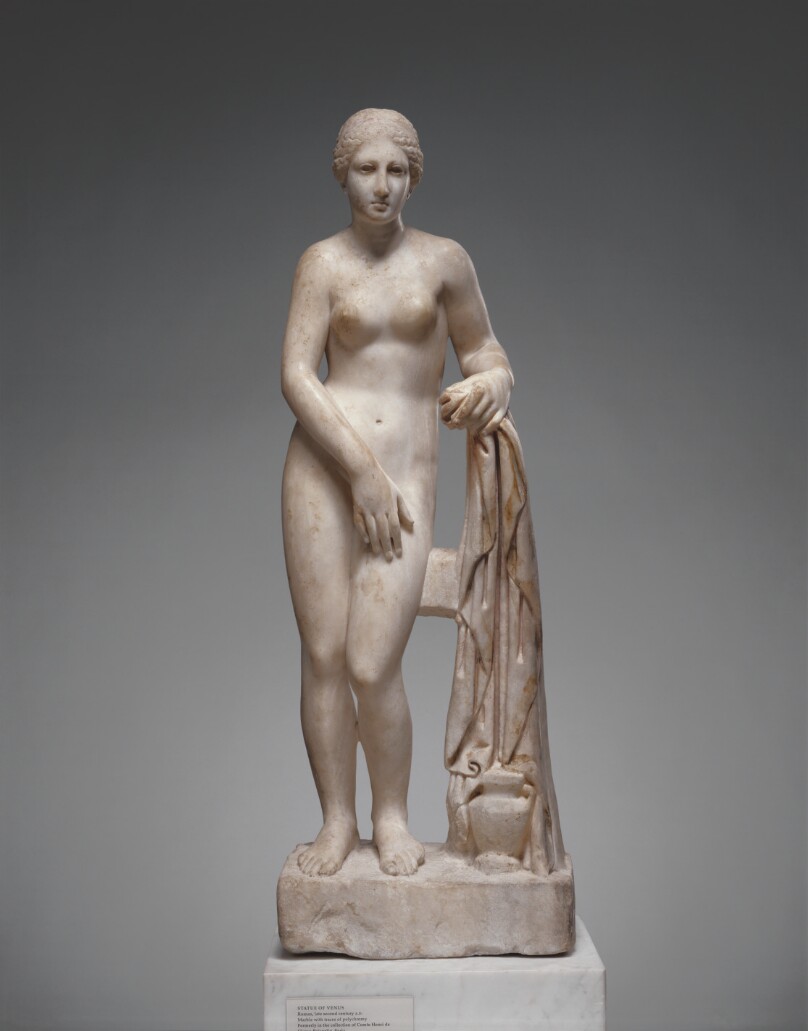
Venus, the goddess of love, is shown naked, undressing for her bath. She stands with her right hand modestly covering her pubic area while her left hand drops her garment on a vase. Her eyes were originally inlaid in a contrasting material, and she would have worn earrings. This Roman statuette copies on a smaller scale one of the most famous Greek statues ever made. About 350 B.C. the Greek sculptor Praxiteles carved a cult statue of the goddess Aphrodite, the first full-scale female nude in Greek art. Praxiteles' statue became extremely popular, especially in the Hellenistic and Roman periods, capturing the attention of both writers and artists. Although the original statue does not survive, its popularity led to a huge production of copies and variations on the theme, so that today more nude Aphrodites survive than any other single ancient statue type. The idea of the goddess caught in a private moment follows a certain voyeuristic tradition in Hellenistic art, and part of the statue's appeal was clearly erotic. The gesture of the goddess's right hand is ambiguous, drawing attention to her pubis and concealing it at the same time. Roman writers such as Pliny did not hesitate to point out the overtly sexual reaction that Praxiteles' statue produced in viewers. Recent research, including technical imaging and analysis using x-ray fluorescence spectroscopy (XRF), has shown that traces of color are still present on the surface of the Venus de Clercq, including yellow, pink, red, blue, and gilding. These pigments are preserved on the statue's hair, face, and body, as well as on the garment and vase by her side. Evidence of blue pigment on the chest suggest she wore a necklace, and on the taenia (headband) in her hair, there are traces of pink and gilding (gold leaf). This technical study of ancient polychromy is ongoing.
The authoritative record is held by Getty Museum. LinkedCulture surfaces this object and its connections; it does not alter institutional metadata.
Get printable QR codesHide QR codes
Open QR codes for this object page and the museum record. They stay collapsed until needed.
Related across collections
Semantically similar works from Getty Museum and other institutions.