Getty Museum
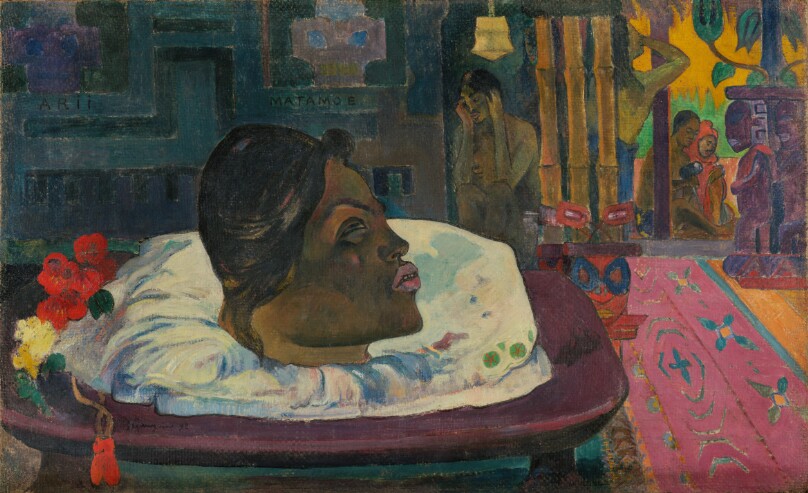
Arii Matamoe (The Royal End)
Creator
Paul GauguinFrench Artist · 1848–1903
All works by this person →> May the day come soon when I'll be myself in the woods of an ocean island! To live there in ecstasy, calmness and art.... There in Tahiti I shall be able to listen to the sweet murmuring music of my heart's beating in the silence of the beautiful tropical nights. > > --Paul Gauguin > > Writing to his wife in 1887, Paul Gauguin expressed his desire to seek an earthly paradise in the South Seas. H
More on Getty ULAN- Date
- 1892
- Medium
- Oil on coarse fabric
- Culture
- French
- Department
- Paintings
- Institution
- Getty Museum
- Object ID
- e5e3d8a2-48bc-4df4-a6e9-75857f155d95
From the Getty Museum record
>I have just finished a severed kanak [Pacific Islander] head, nicely arranged on a white cushion, in a palace of my invention and guarded by women also of my invention. > >--Paul Gauguin Writing to his friend Daniel de Monfreid, Paul Gauguin referenced in an almost offhand way this startling painting of a decapitated human head, which he made during his first stay in Polynesia in the early 1890s. Real events, from Tahitian King Pomare V's death soon after Gauguin's arrival, to the artist having witnessed a public execution by guillotine several years earlier, likely influenced its dark subject matter. Gauguin added the Tahitian words "Arii" and "Matamoe" in the canvas' upper left. The first means "noble;" the second, "sleeping eyes," a phrase that implies "death." The notion of a human head ritually displayed in an ornate interior suggests the formality of a ruler lying in state, supported by the presence of sorrowful figures in the background. However, this scene doesn't correspond to actual accounts of Pomare V's funeral because the body wasn't decapitated. Gauguin was just as apt to fantasize about life in Polynesia as he was to document it. Bright reds, yellows, and pinks are juxtaposed with muted browns and purples to evoke a tropical sensibility. The rough, burlap-like canvas also hints at an exotic "primitivism." In his collage-illustrated book *Noa Noa*--which he began after his first trip to Tahiti--he included a copy of this painting and a comment that he thought of Pomare's death as a metaphor for the loss of native culture due to European colonization. Symbolist artists, including Gauguin, had a predilection for images of decapitated heads and any associated figures, such as Orpheus and John the Baptist. But in a more general sense, Gauguin also freely mixed Eastern and Western imagery. His obsession with the theme of death, which appears throughout his Tahitian paintings, is less a reference to spiritual beliefs or to what he saw around him than perhaps more significantly, how he viewed himself. Gauguin thought of himself as a martyr victimized by modern society, which compelled him to escape to a "primitive" culture.
The authoritative record is held by Getty Museum. LinkedCulture surfaces this object and its connections; it does not alter institutional metadata.
Get printable QR codesHide QR codes
Open QR codes for this object page and the museum record. They stay collapsed until needed.
Related across collections
Semantically similar works from Getty Museum and other institutions.