Getty Museum
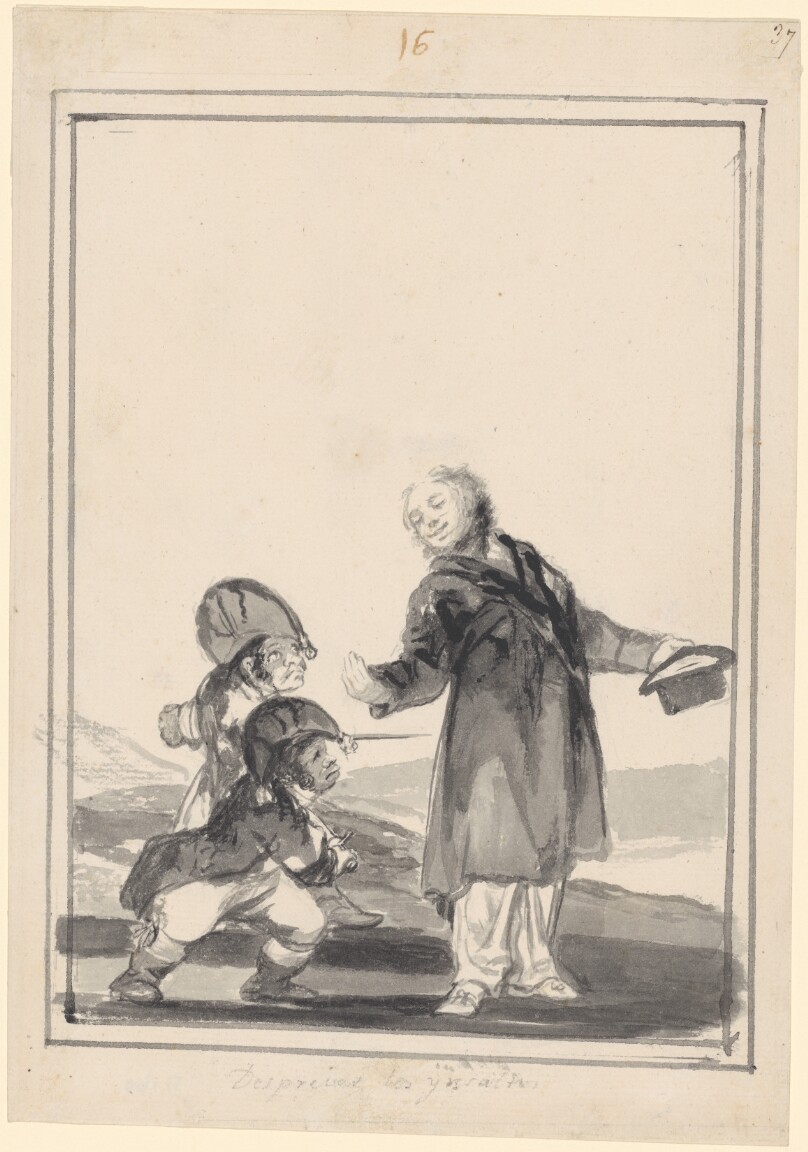
Contemptuous of the insults
Creator
Francisco José de Goya y Lucientes (Francisco de Goya)Spanish Artist · 1746–1828
All works by this person →Francisco José de Goya y Lucientes welcomed and received official honors and worldly success with enthusiasm. At the same time he left a ruthlessly penetrating record of his patrons and private expressions of introspection, moral objectivity, and caustic commentary on his times. By the 1780s Goya was Spain's leading painter, specializing in religious pictures and portraits. He acknowledged three m
More on Getty ULAN- Date
- about 1816–1820
- Medium
- Brush and india ink and gray wash
- Culture
- Spanish
- Department
- Drawings
- Institution
- Getty Museum
- Object ID
- e6301358-6801-4475-b73b-203876fdb46b
From LinkedCulture
Goya drew this for no one but himself, which makes it one of his most honest moments. In brush and india ink with gray wash, a tall, composed figure, almost certainly the artist, makes an obscene dismissive gesture at two tiny Napoleonic figures crouched below him, daggers drawn, looking more ridiculous than fearsome. Inscribed "Despreciar los ynsultos," despise the insults, this private sketch from around 1816 to 1820 captures Goya's defiance toward the French occupation of Spain in its rawest, most unguarded form.
Written by LinkedCulture for its video on this object. Machine-generated (claude-sonnet-4-6), not yet reviewed by a person. It is not part of the museum’s record.
From the Getty Museum record
An urbane Spaniard--probably a self-portrait of the artist--makes an obscene gesture at the Napoleon-like dwarfs threatening him with daggers. The title inscribed below the image, *Despreciar los ynsultos* (Despise the insults), seems to signify Francisco José de Goya y Lucientes's defiance toward the French military occupation of Spain. The difference of scale between the tall, patronizing Spaniard and his squat, gloomy oppressors reinforces the point. Often politically motivated, Goya's art presented private exploits and tragedies with both satire and an awareness of the human condition that made his observations timeless and universal. He began to use the more intimate mediums of drawings and prints for his purposeful and serious satires after 1792. Goya made this sketch, sixteenth of about fifty drawings in the "Black Border" album, for his own amusement and interest rather than for sale or other purposes.
The authoritative record is held by Getty Museum. LinkedCulture surfaces this object and its connections; it does not alter institutional metadata.
Get printable QR codesHide QR codes
Open QR codes for this object page and the museum record. They stay collapsed until needed.
Related across collections
Semantically similar works from Getty Museum and other institutions.