Getty Museum
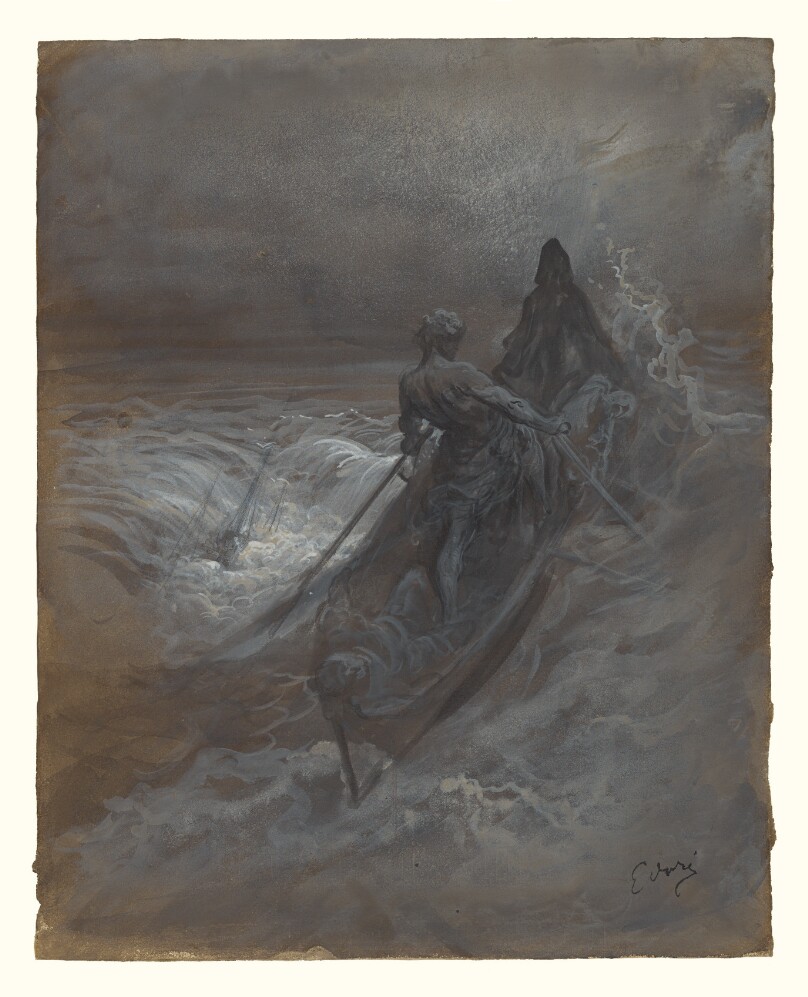
After the Shipwreck - Design for an Illustration of Coleridge's The Rime of the Ancient Mariner
Creator
Gustave DoréFrench Artist · 1832–1883
All works by this person →An Alsatian, Gustave Doré was born in Strasbourg near the Rhine. He was the second of three sons in a wealthy, musically talented family, and began drawing caricatures of others at a young age. While his mother was immediately convinced of the young Doré's talent, his father, an engineer, pushed the boy to pursue a more practical education. While on a trip to Paris at age fifteen, he was impressed
More on Getty ULAN- Date
- about 1875
- Medium
- Gouache
- Culture
- French
- Department
- Drawings
- Institution
- Getty Museum
- Object ID
- e715a776-f544-4516-b0f5-ed339ac9c2eb
From the Getty Museum record
>I took the oars: the Pilot's boy, >Who now doth crazy go, >Laughed loud and long, and all the while >His eyes went to and fro >"Ha! Ha!" quoth he, "full plain I see, >The Devil knows how to row." > >--Samuel Taylor Coleridge, from *The Rime of the Ancient Mariner*. Samuel Taylor Coleridge's poem *The Rime of the Ancient Mariner* recounts the tale of a young mariner's supernatural adventures at sea. This watercolor is a study for one of thirty-eight images that artist Gustave Doré created to illustrate editions of the poem published in 1875 and 1876. This scene takes place near the end of the poem (lines 564-569), after the Mariner is forever cursed for shooting an albatross. This slaughter triggers a curse that causes the death of the Mariner's entire crew, forcing him to navigate the seas alone for seven days and nights. This image illustrates the moment the masts of Mariner's ship disappear into a mighty white froth, shown at the center left. A pilot and his son have just rescued the Mariner, but thought him dead. When the Mariner instead takes the oars, as seen here at center, the men think he is the Devil and go insane. Doré depicts one of them slumped at the base of the picture frame, behind the Mariner. The other lolls over the right side of the boat. The dark, austere figure of the Holy Hermit, looms at the top right of the boat, perhaps signaling the misery awaiting the Mariner on shore, where he will be doomed to wander the earth for eternity to tell his story as penance. Doré's varied watercolor techniques and the work's large size both serve the drama of the poem.
The authoritative record is held by Getty Museum. LinkedCulture surfaces this object and its connections; it does not alter institutional metadata.
Get printable QR codesHide QR codes
Open QR codes for this object page and the museum record. They stay collapsed until needed.
Related across collections
Semantically similar works from Getty Museum and other institutions.