Getty Museum
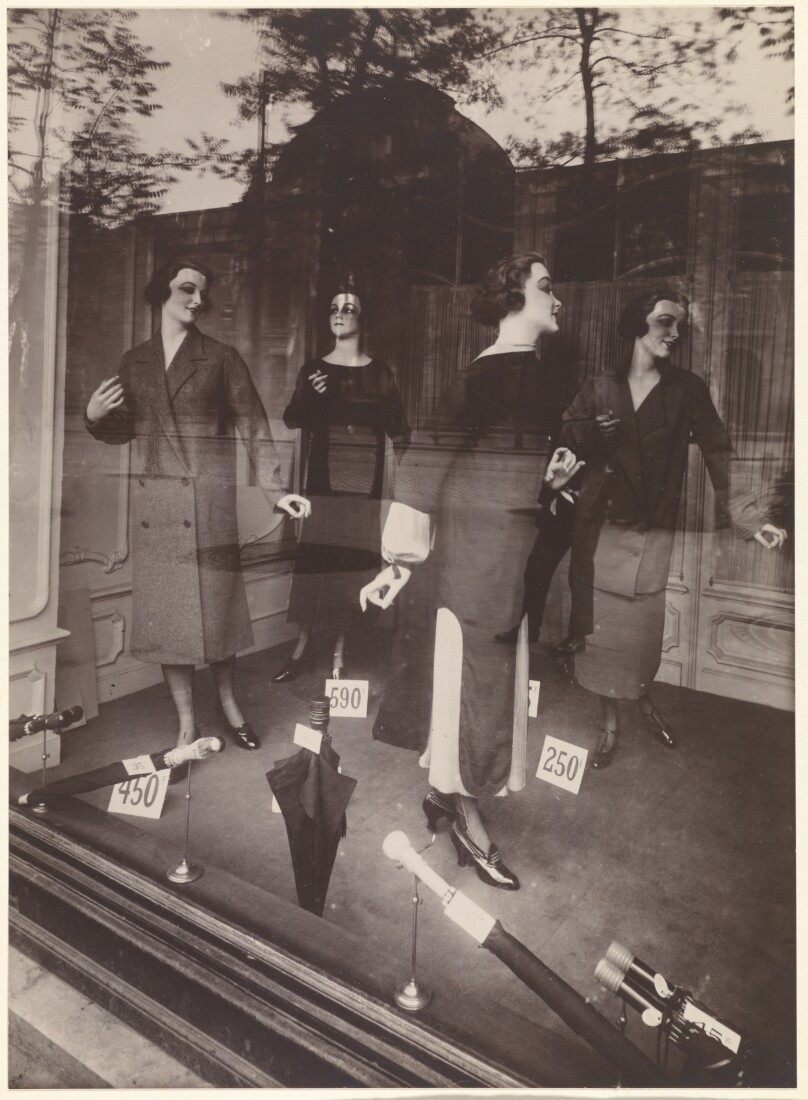
Storefront, avenue des Gobelins
Creator
Eugène AtgetFrench Photographer · 1857–1927
All works by this person →Eugène Atget never called himself a photographer; instead he preferred "author-producer." A private, almost reclusive man, Atget first tried his hand at painting and acting, then began to photograph *vieux Paris* (Old Paris) in 1898. He photographed in part to create "documents," as he called his photographs, of architecture and urban views, but he supported himself by selling these photographs to
More on Getty ULAN- Date
- 1925
- Medium
- Gelatin silver print
- Culture
- French
- Department
- Photographs
- Institution
- Getty Museum
- Object ID
- ea483194-b37a-4f6e-b6b2-a46f987cc758
From the Getty Museum record
> Eugène Atget's vibrant study of this display of women's apparel, a tableau of a stylish, if frozen and partnerless, minuet being danced on the other side of a row of tightly furled umbrellas, is one of a series of at least four pictures that he made of the same clothing store. He moved his camera along the sidewalk so as to show each of the establishment's display windows. This one exhibited garments for women; another, clothing for men; and a third, attire for children. The dramatic quality of this image derives from the exaggerated poses of the mannequins and the reflected silhouettes of the trees and the domed structure across the avenue des Gobelins. (Today, the building houses the museum of the [Gobelins tapestry works](https://en.wikipedia.org/wiki/Gobelins_Manufactory).) This avenue still has emporia devoted to the sale of clothes. > > The calculated interplay between what is seen through and reflected by the glass distinguishes Atget's later views of storefronts. Reflections in his earlier studies of shop windows were less precisely thought out (see, for example, [90.XM.64.20](https://www.getty.edu/art/collection/objects/63455/eugene-atget-boulevard-de-strasbourg-french-1912/)), but, by the time this picture was produced, Atget's long experience as a photographer had made him fully conscious of what his finished plate would show. The juxtapositions created by the mixture of internal and external elements transform the ordinary into the unexpected, a quality prized by the Surrealist artists, who discovered Atget's work at about this time (see also [90.XM.64.21](https://www.getty.edu/art/collection/objects/63456/eugene-atget-salon-de-coiffure-hairdresser's-shop-french-1926/)). > > Adapted from *Eugène Atget*, In Focus: Photographs from the J. Paul Getty Museum by Gordon Baldwin (Los Angeles: J. Paul Getty Museum, 2000), 72. ©2000, J. Paul Getty Trust.
The authoritative record is held by Getty Museum. LinkedCulture surfaces this object and its connections; it does not alter institutional metadata.
Get printable QR codesHide QR codes
Open QR codes for this object page and the museum record. They stay collapsed until needed.
Related across collections
Semantically similar works from Getty Museum and other institutions.