Getty Museum
Attic Red-Figure Cup
Creator
Foundry PainterPainter
All works by this person →The Foundry Painter decorated pottery using the red-figure technique in Athens during the early fifth century B.C. As with most vase-painters, his real name is unknown, and he is identified only by the stylistic traits of his work. He received the name *Foundry Painter* because one of his vases, now in Berlin, shows a foundry in which bronze workers are making statues. The Foundry Painter probably
More on Getty ULAN- Date
- about 480 B.C.
- Medium
- Terracotta
- Culture
- Greek (Attic)
- Department
- Vessels
- Institution
- Getty Museum
- Object ID
- ea6de115-8767-4300-9659-7259760da508
From the Getty Museum record
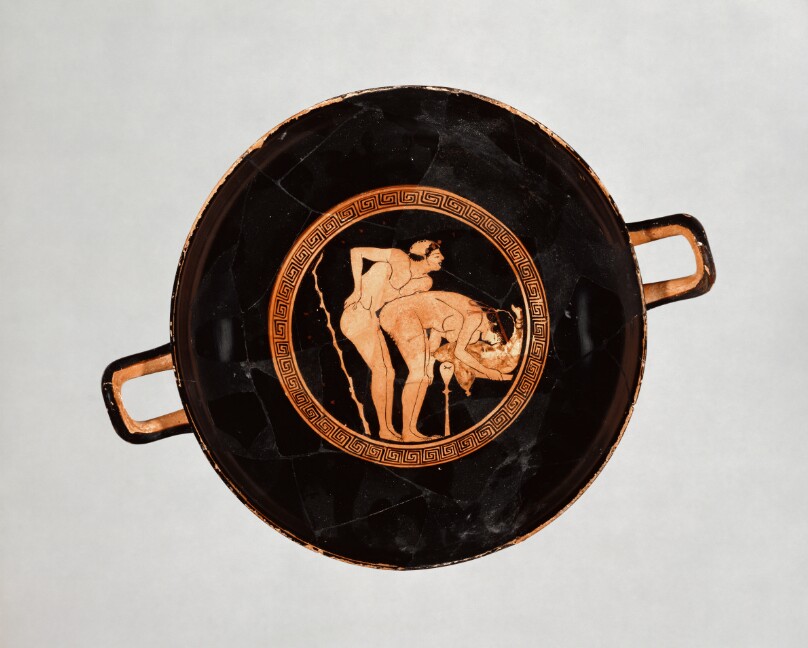
In the scene on the interior of this cup, a man has sex with a woman. He stands behind her, with one hand on his hip and the other clasping the back of her thigh. The woman bends over, supporting herself on a stool, her face pressed into a full wine-skin. The wine-skin and the young man’s wreath, as well as the shape of the cup itself, associate this scene with a symposium - an all-male drinking party - and the staff at left is a marker of the youth’s leisured status. The symposium was an integral part of Athenian society, a social gathering at which men ate, drank, played party games, sang songs, recited poetry, and were entertained with music and dance. Sex and the fulfilment of physical desires also played a part, and the woman on this cup, nude, save for a small amulet around her thigh, is likely to be a prostitute or a hetaera, a woman of independent means, sought after for her desirability. The scene presents what a young Athenian man might expect – or hope for – in attending a symposium. Where known, however, most vases with explicit sex scenes have been discovered at Etruscan sites in Italy, and so may reveal as much about the marketing of ancient pottery as they do about Athenian behavior.
The authoritative record is held by Getty Museum. LinkedCulture surfaces this object and its connections; it does not alter institutional metadata.
Get printable QR codesHide QR codes
Open QR codes for this object page and the museum record. They stay collapsed until needed.
Related across collections
Semantically similar works from Getty Museum and other institutions.