Getty Museum
Attic Red-Figure Pelike, Kerch Style
Creator
Painter of the Wedding ProcessionPainter
All works by this person →Working in Athens in the 300s BC, the Painter of the Wedding Procession decorated pottery primarily in the red-figure technique. As with most vase-painters, his real name is unknown, and he is identified only by the style of his work. He decorated mostly large vases, such as hydriai and lebetes. He was also one of the many vase-painters who received a commission for Panathenaic amphorae, which wer
More on Getty ULAN- Date
- about 360 B.C.
- Medium
- Terracotta; polychromy; gilding
- Culture
- Greek (Attic)
- Department
- Vessels
- Institution
- Getty Museum
- Object ID
- ebbce2f1-2dff-4576-b8df-6b78fc89f410
From the Getty Museum record
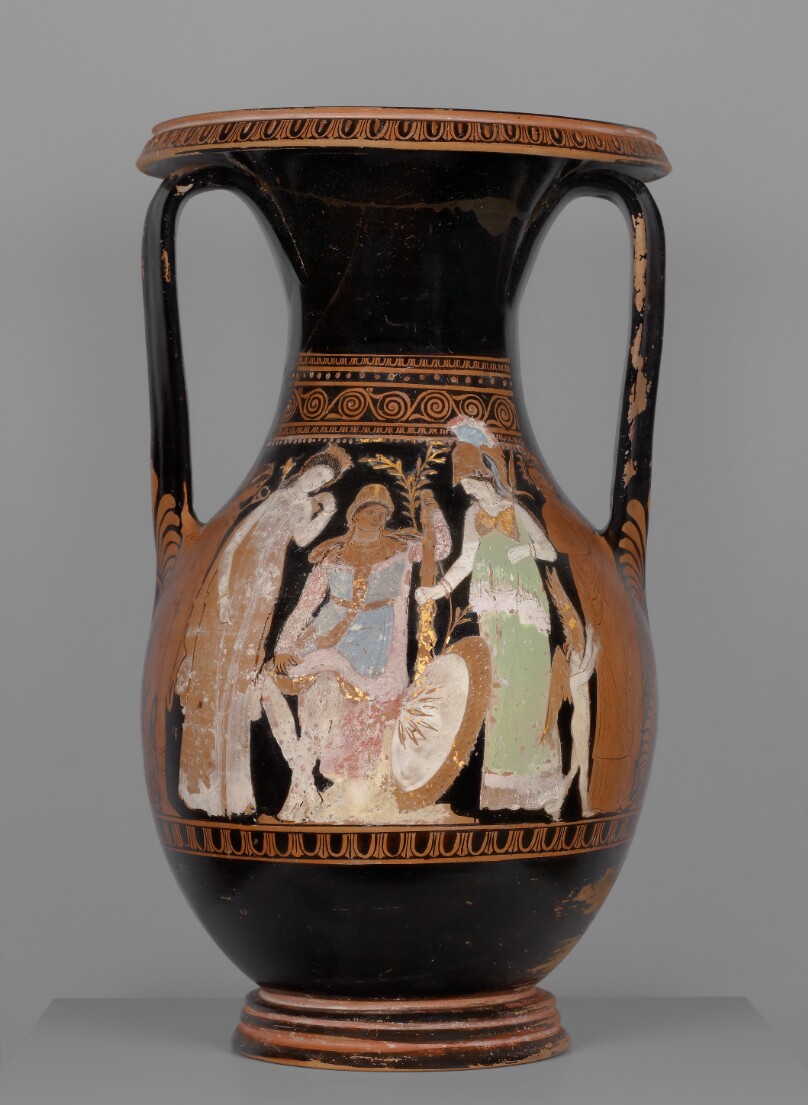
One side of this vase shows the Judgment of Paris, a myth with a long history in Greek art. The young Trojan prince Paris sits amid three goddesses and their guide Hermes, god of travelers. On the left, Hera plucks at her drapery. Her jewelry, dress pins, crown and scepter are rendered in gilded relief and her dress was painted with a thick white pigment. Paris sits on a rock, holding a club. His hands and face are rendered in red-figure, but his Phrygian cap and club, as well as the olive tree next to him, were delineated with lines and dots of extruded clay. His clothing is colored with Egyptian blue (tunic), cinnabar red (sleeves and trousers) and a mixture of red and white to create pink (the drapery on his lap). The cloth of his garments is studded with raised clay dots that much once have been gilded. To the right, Athena wears a green peplos, embellished with relief dots. Her shield, aegis and helmet have gilding and relief dots. Aphrodite at the far right is attended by Eros (white; gilding on the wings). Aside from her wreath and earrings (gilded raised clay), she is entirely red-figure. She wears her himation such that she is almost entirely swathed. Paris's task was to decide which goddess is the most beautiful: Hera, queen of the gods; Athena, goddess of wisdom; or Aphrodite, goddess of love. But this was no mere beauty contest. Paris chose Aphrodite because her bribe was the best: He could have whomever among mortal women he thought most beautiful. His choice of Helen, queen of Sparta, was the ultimate cause of the Trojan War. The other side of the vase depicts a battle of Greeks and Amazons, a favorite theme for vase painters in this period. The bold use of color, raised relief areas, and gilding on this vase is typical of the Kerch Style of Athenian red-figure vase painting, named for an area on the Black Sea coast where many of these vases were found. The pelike was a favorite shape for Athenian vase painters of the 300s B.C.
The authoritative record is held by Getty Museum. LinkedCulture surfaces this object and its connections; it does not alter institutional metadata.
Get printable QR codesHide QR codes
Open QR codes for this object page and the museum record. They stay collapsed until needed.
Related across collections
Semantically similar works from Getty Museum and other institutions.