Getty Museum
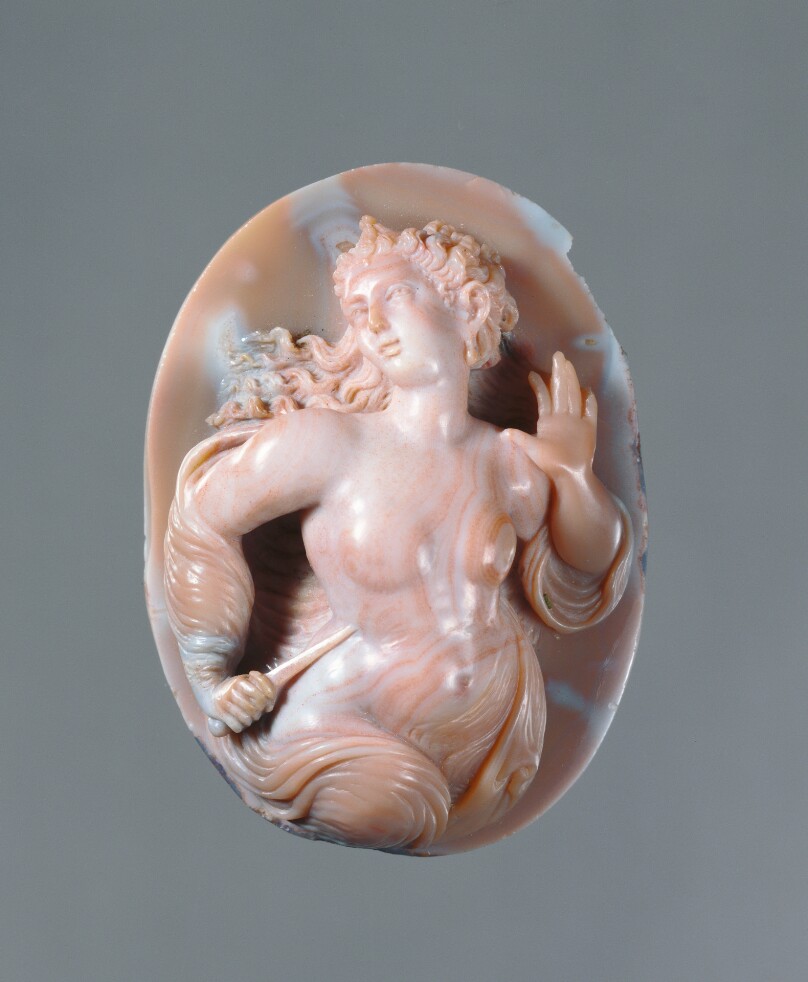
Cameo of Lucretia
Creator
UnknownAll works by this person →More on Getty ULAN- Date
- about 1600
- Medium
- Chalcedony
- Culture
- Bohemian
- Department
- Sculpture
- Institution
- Getty Museum
- Object ID
- ed08c229-42a0-4d21-ab76-0e5a399dec19
From the Getty Museum record
On a small chalcedony cameo, Lucretia, the legendary heroine of ancient Rome, prepares to plunge a dagger into her side. The beautiful and virtuous wife of a nobleman, Lucretia was raped by Sextus Tarquinius, the son of the Etruscan king, Lucius Tarquinius Superbus (Tarquin the Proud). After extracting a promise from her father and husband that they would exact revenge on her transgressors, she killed herself. The ensuing outcry and revolt drove the tyrannical Tarquins from Rome, leading to the founding of the Roman Republic. The unknown artist carved Lucretia with a full head of radiant curls and her drapery sliding off her shoulders to reveal her nude body. Despite the small size and shallowness of the relief, the figure has a full-bodied voluptuousness and dynamism. Cameos, hardstones carved in relief, were first explored in antiquity but gained popularity at the sixteenth-century court of Emperor Rudolf II in Prague; the city became famous for the cutting and fashioning of stones. Employing stonecutters from Italy, the Netherlands, and Germany, Rudolf encouraged a cultural renaissance in cameos as well as in other arts. Both the cameo medium and the ancient Roman subject matter reflect the court's great interest in reviving antiquity.
The authoritative record is held by Getty Museum. LinkedCulture surfaces this object and its connections; it does not alter institutional metadata.
Get printable QR codesHide QR codes
Open QR codes for this object page and the museum record. They stay collapsed until needed.
Related across collections
Semantically similar works from Getty Museum and other institutions.