Getty Museum
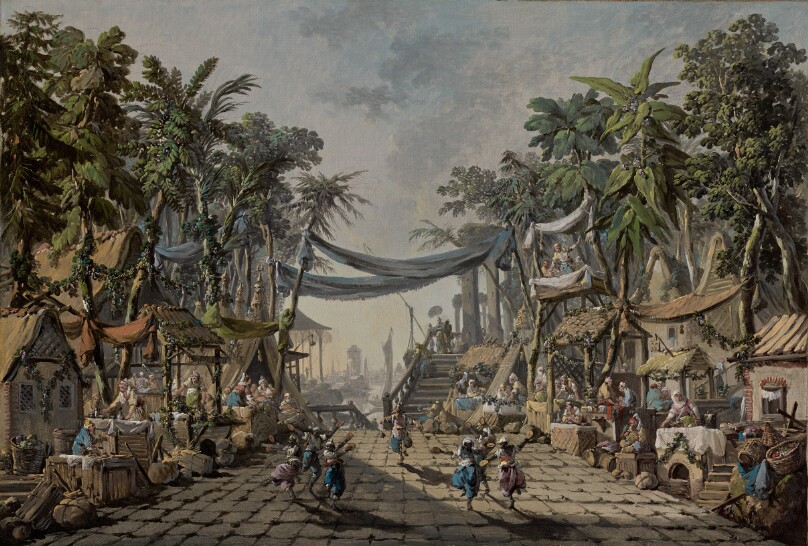
Market Scene in an Imaginary Oriental Port
Creator
Jean-Baptiste PillementFrench Artist · 1728–1808
All works by this person →> Monsieur Pillement, painter, native of Lyon, aged 80, died in this city on the 26th of this month. His country, which he honoured by his talents and mind, will place him among the great men that she has to mourn. > >--Anonymous, April 1808 In his lifetime, Jean-Baptiste Pillement was famous for Rococo landscapes and Asian-inspired subjects. He specialized in romanticized scenes of the Near- and
More on Getty ULAN- Date
- about 1764
- Medium
- Oil on canvas
- Culture
- French
- Department
- Paintings
- Institution
- Getty Museum
- Object ID
- ed639dc4-0904-442a-9b55-9020f06eecf4
From the Getty Museum record
As centers of commercial and cultural exchange, seaports bring together people from distant and diverse places. Here, colorful figures dance amid an exotic port's marketplace, which is lined by tropical-looking trees and European-style homes. This scene does not depict a real location, but rather, a figment of the artist's imagination. It also reflects European fascination with the Orient in the 1700s. In the painting's center, a man who appears to be Chinese dances and plays the bells, flanked by other, dark-skinned performers. Their figures cast long shadows across a flagstone plaza, mimicking the shapes of the garlands and swags draped on nearby trees and buildings. Veiled and turbaned vendors converse among the market stalls. At the back of the square, a Turkish sultana holds court in a tent topped with a crescent moon. The busy port in the distance stretches toward the horizon, creating a sense of deep space. The painting's symmetrical composition implies the setting for a performance. Recent scholarship suggests that Jean-Baptiste Pillement may have made this painting to commemorate a ballet commissioned and performed in Vienna in 1764.
The authoritative record is held by Getty Museum. LinkedCulture surfaces this object and its connections; it does not alter institutional metadata.
Get printable QR codesHide QR codes
Open QR codes for this object page and the museum record. They stay collapsed until needed.
Related across collections
Semantically similar works from Getty Museum and other institutions.