Getty Museum
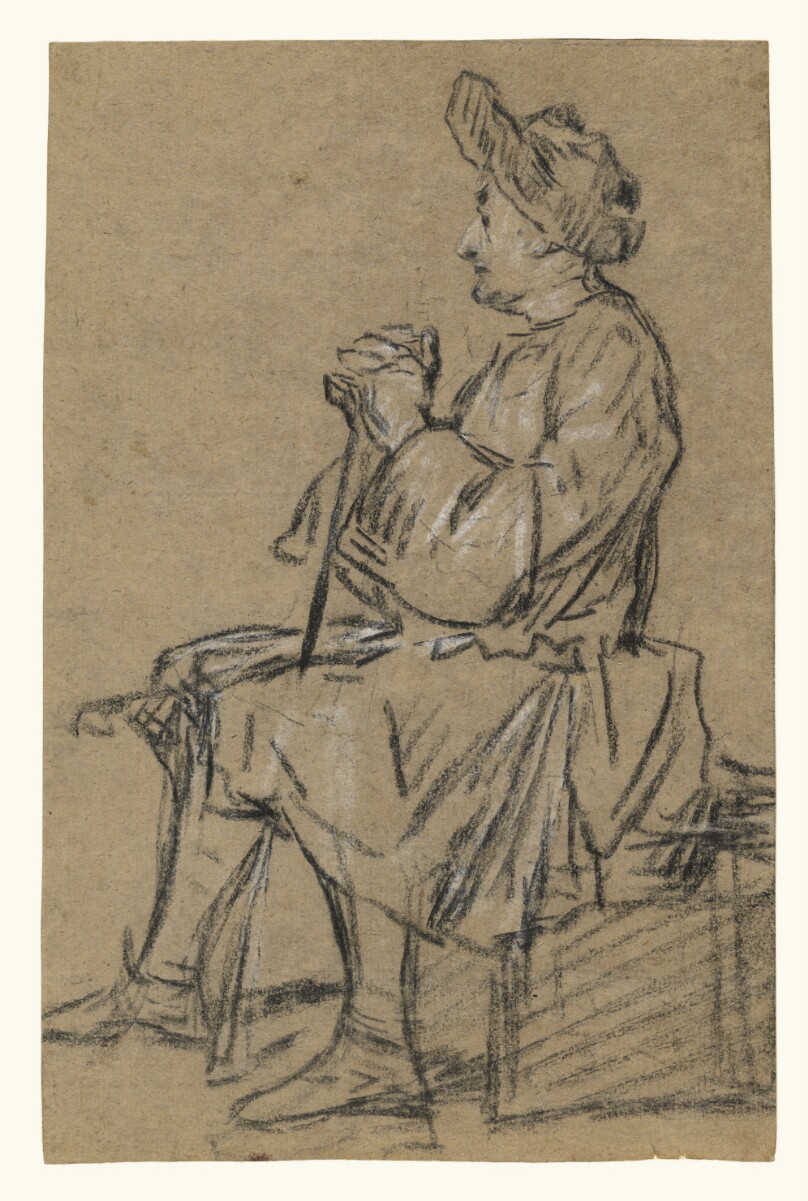
Study of a Seated Man (recto); Study of a Male Nude (verso)
Creator
Jean-Siméon ChardinFrench Artist · 1699–1779
All works by this person →Unlike François Boucher, with whom he shared many patrons, Chardin was not interested in the superficial; it was the very essence of objects and the underlying humanity of his figures that he evoked with tiny slabs of saturated paint. "We use colors," said Chardin, "but we paint with our feelings." A Parisian carpenter's son, Chardin learned from a modest artist and began by painting signposts for
More on Getty ULAN- Date
- about 1720–1725
- Medium
- Charcoal and white chalk
- Culture
- French
- Department
- Drawings
- Institution
- Getty Museum
- Object ID
- efb5f5fd-ea01-403c-b217-d3ac90ebe6fb
From the Getty Museum record
Jean-Siméon Chardin had the ability to infuse the most ordinary scenes of everyday life with an aura of dignity and value. In this simple drawing, a man wearing a large brimmed hat and long frock coat relaxes with his cane in his hands on a square box or stool and looks away over his right shoulder. Chardin built up the forms with a series of rapid, somewhat heavy, black lines, heightened with additional strokes of white chalk that give a sense of immediacy and vibrancy to the otherwise static image. With a few bold strokes, he established a mood of quiet contemplation generated by his own direct observation and that of the seated man, who gazes off into the distance. Chardin made this figure study in preparation for a painting. On the verso, Chardin drew an *académie,* a study of a nude man, probably made during his early artistic training. All of Chardin's known drawings date from his early career, as he gave up draftsmanship by the 1730s.
The authoritative record is held by Getty Museum. LinkedCulture surfaces this object and its connections; it does not alter institutional metadata.
Get printable QR codesHide QR codes
Open QR codes for this object page and the museum record. They stay collapsed until needed.
Related across collections
Semantically similar works from Getty Museum and other institutions.