Getty Museum
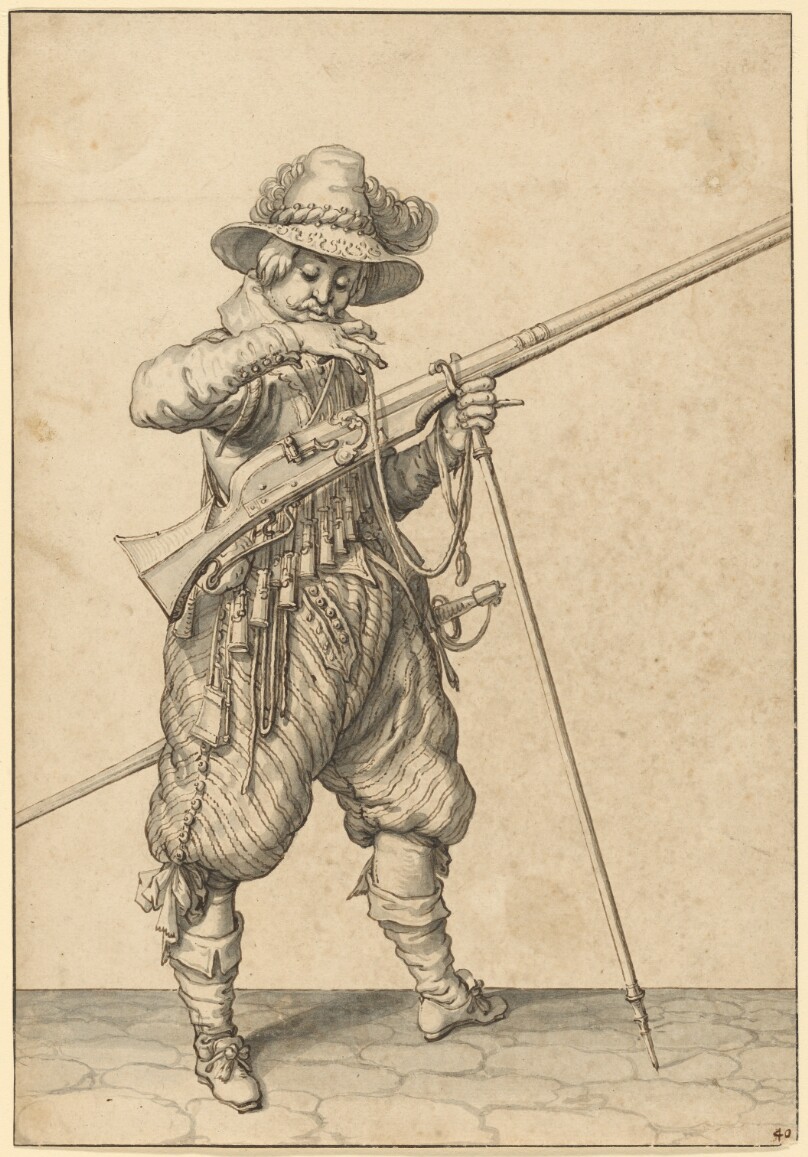
A Soldier on Guard Blowing the Match
Creator
Jacques de Gheyn IIDutch Artist · 1565–1629
All works by this person →Initially trained by his father, Jacques de Gheyn II moved to Haarlem around 1585 to study with Hendrick Goltzius for five years. He absorbed Goltzius's sinuous linear technique, which appeared in de Gheyn's early engravings. He moved to Leiden in the mid-1590s, then gave up engraving around 1600 and began painting and experimenting with etching. By 1605 de Gheyn had settled in The Hague, where he
More on Getty ULAN- Date
- about 1597
- Medium
- Pen and black ink and gray wash, incised for transfer
- Culture
- Dutch
- Department
- Drawings
- Institution
- Getty Museum
- Object ID
- efe4584b-8185-432c-91b2-0e083b583eb1
From the Getty Museum record
"To showe to posteritie the manner of souldiers apparel used in these dayes." So wrote Jacques de Gheyn of his goals for his lavishly illustrated book *The Exercise of Arms,* published in 1607. In this preparatory drawing for the book, de Gheyn strove to create the illusion of a living soldier, carefully modeled in the round and exhibiting a wealth of detail both in costume and weaponry. Focusing on the intricate task of lighting the fuse of his musket, the soldier wears a large plumed hat, billowing striped pantaloons, and high boots, with powder charges strung across his breast. De Gheyn used a simple but imposing pose to create interest, with long, diagonal lines created by the soldier's musket, his sword, and the intersecting angle of his musket rest. Conceived as a military handbook for the infantry, *Exercise of Arms* contained one hundred and seventeen designs illustrating the use of the smallshot, the musket, and the pike. Count Johann II of Nassau-Siegen commissioned the text to give the Dutch army a set of clear and systematic military procedures for training soldiers. In the final edition, each image also contained a description of the action shown and its associated commands.
The authoritative record is held by Getty Museum. LinkedCulture surfaces this object and its connections; it does not alter institutional metadata.
Get printable QR codesHide QR codes
Open QR codes for this object page and the museum record. They stay collapsed until needed.
Related across collections
Semantically similar works from Getty Museum and other institutions.