Getty Museum
Bible
Creator
Stefan LochnerGerman Artist · 1451–1451
All works by this person →- Date
- about 1450
- Medium
- Gold leaf, tempera, and black ink
- Culture
- German
- Department
- Manuscripts
- Institution
- Getty Museum
- Object ID
- f1a0800a-b576-45dc-a02a-bfcfe117f97b
From the Getty Museum record
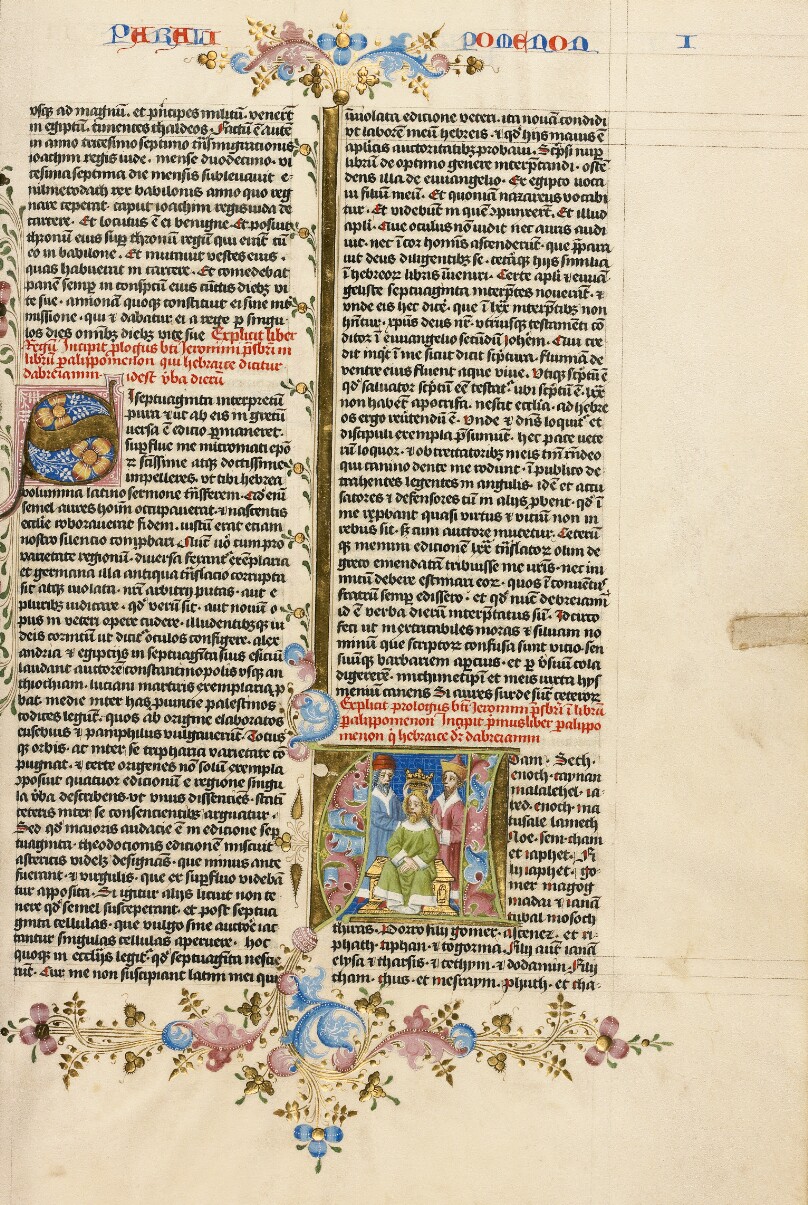
This Bible is a Gothic manuscript with a decorated leather binding that was originally made for the library of the Cathedral of Cologne. The Cathedral’s officials were said to be part of a mystical and pietistic religious movement called the Devotio Moderna (Modern Devotion), an ascetic movement that arose in the late fourteenth century in Holland, and spread rapidly throughout Western Europe. The movement was deeply involved with the book arts, and were the source of similarly decorated manuscripts that came from the scriptorium of Corpus Christi in Cologne, an Augustinian monastery that belonged to the Windesheim congregation. This Latin Bible represents a revised translation by Thomas à Kempis (about 1380-1471) the Windesheim canon who wrote the *Imitation of Christ*, one of the most widely published devotional books of the fifteenth century. Each book of this Bible is introduced by a historiated initial, dividing the manuscript into easily searchable sections and illustrating a pertinent story drawn from the following text, with phrases in red to indicate the beginning and end of each book. Four of the historiated initials have been attributed to artist Stephen Lochner (about 1410-1451), a famous German painter known for his designs of long flowing floral sprays and brilliantly painted scenes. The ornamental pages of this manuscript are characteristic of the organic designs and realistic flowers that are associated with the scriptorium of the Cathedral Library of Cologne and several painters in Lochner’s workshop. The Bible is one of the few manuscripts in the Getty’s collection that retains its original 15th century calf leather binding, a rarity as most medieval manuscripts were later rebound or rehoused in the modern age. The Bible represents a new demand for book production that was in part satisfied by the invention of the German movable type printing press in the second half of the 15th century. The binding of the manuscript is covered in thick wood, which forced the parchment pages to remain flat despite changed in temperature or humidity. Once held in a chained library, the binding of the manuscript still has its metal fittings for the chain that was once secured to it (known as a *liber catenatus*). The chain was a later addition to the manuscript in the later fifteenth century, when it became a part of the library of Cologne Cathedral, where books were considered so valuable that they were not allowed to leave. The iron chain fixture, now located on the lower edge of the front cover, was originally on the upper edge of the back cover, the normal place for such a piece.
The authoritative record is held by Getty Museum. LinkedCulture surfaces this object and its connections; it does not alter institutional metadata.
Get printable QR codesHide QR codes
Open QR codes for this object page and the museum record. They stay collapsed until needed.
Related across collections
Semantically similar works from Getty Museum and other institutions.