Getty Museum
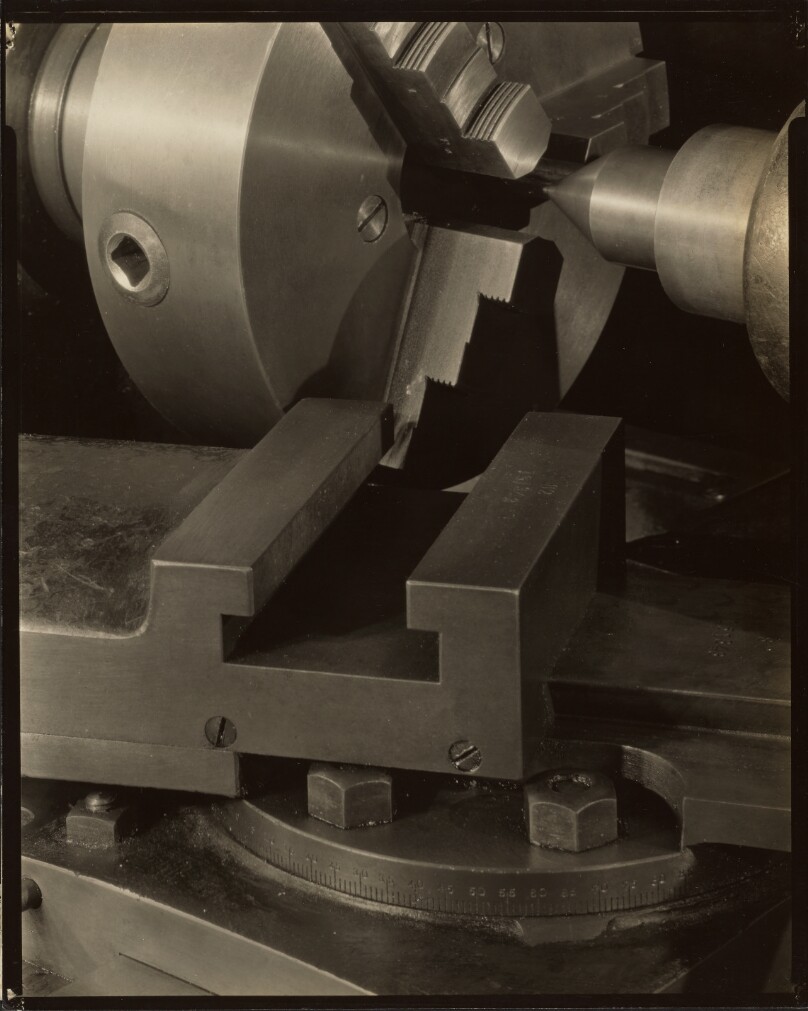
Lathe #1, Akeley Machine Shop, New York
Creator
Paul StrandAmerican Photographer · 1890–1976
All works by this person →Paul Strand began photographing in New York in the 1910s. During the early 1920s he received recognition for both his painting and his photography. He visited New Mexico in 1926 and, beginning in 1930, returned for three consecutive summers, making portraits of artist friends and acquaintances. It was there, amidst a community of visual artists and writers, that Strand began to develop his belief
More on Getty ULAN- Date
- 1923
- Medium
- Gelatin silver print
- Culture
- American
- Department
- Photographs
- Institution
- Getty Museum
- Object ID
- f1cb8186-dbb2-4c97-930d-55cf0ef5e272
From the Getty Museum record
In 1920, Paul Strand, working with fellow photographer Charles Sheeler ([1883-1965](https://www.getty.edu/art/collection/object/1095NE)) and his Debrie camera, created the film _Manhatta_, inspired in part by "Mannahatta" (1860), a poem by Walt Whitman (1819-1892). The movie, a chronicle of life in New York from dawn to dusk, employed title cards that featured select lines from Whitman's _Leaves of Grass_. The motion picture captured such scenes as crowds of workers rushing to their jobs from the ferry terminals ("When million footed Manhattan, unpent, descends to its pavements"), all set against the often dramatic viewpoints of the monumental structures and new architecture that made up the modern metropolis. Considered the first avant-garde film in America, _Manhatta_ opened on July 24, 1921, at the Rialto Theatre on Broadway, where it ran for a week. Inspired by this filmmaking experience, Strand, with financial help from his wife and an inheritance, purchased his own motion picture camera, an Akeley, in 1922. For the rest of the decade he earned a living shooting news footage and documenting college sports. Strand very much admired the Akeley and made a number of photographs of the inner mechanisms of the camera as well as machinery at the Akeley shop. These pictures speak to an inherent strength and beauty found in the highly polished metal objects. Strand continued to favor a near abstract arrangement for his compositions. Like many artists of the time, he was influenced by the machine age, and the close-up details of the machinery, such as this lathe, exaggerated the size and scale of the objects, automatically making them appear more powerful and impressive. Originally published in _Paul Strand_, In Focus: Photographs from the J. Paul Getty Museum by Anne M. Lyden (Los Angeles: J. Paul Getty Museum, 2005), 32. ©2005, J. Paul Getty Trust.
The authoritative record is held by Getty Museum. LinkedCulture surfaces this object and its connections; it does not alter institutional metadata.
Get printable QR codesHide QR codes
Open QR codes for this object page and the museum record. They stay collapsed until needed.
Related across collections
Semantically similar works from Getty Museum and other institutions.