Getty Museum
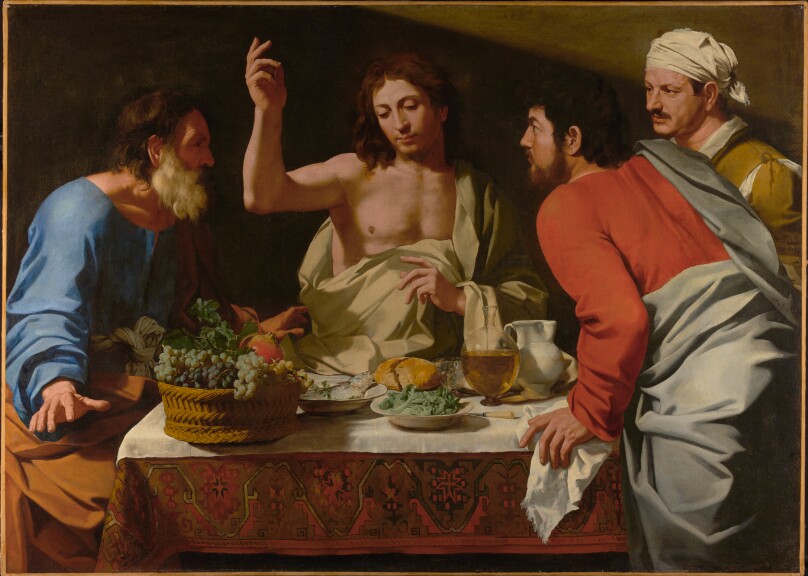
The Supper at Emmaus
Creator
Bartolomeo CavarozziItalian Artist · 1587–1625
All works by this person →Like many European artists of the early 1600s, Bartolomeo Cavarozzi was greatly influenced by Caravaggio's innovative and forceful paintings. Emulating Caravaggio's commitment to realism and use of dramatic contrasts of light and shade, Cavarozzi developed his own variation of "Caravaggism." Cavarozzi spent his formative years in Rome. He lived with an aristocratic family, in their home near the P
More on Getty ULAN- Date
- about 1615–1625
- Medium
- Oil on canvas
- Culture
- Italian
- Department
- Paintings
- Institution
- Getty Museum
- Object ID
- f3471a50-1219-4e83-83d2-ee2d7805ea13
From the Getty Museum record
As the innkeeper looks on, the resurrected Christ reveals himself to his apostles Cleophas and Saint Peter, as described in the Gospel of Luke: "When he was at the table with them, he took bread, blessed and broke it, and gave it to them. Then their eyes were opened, and they recognized him." The artist heightens the scene's tension by positioning the table at the very front of the picture plane, hemming in the substantial figures. It is thought that Bartolomeo Cavarozzi painted this painting, which is after Caravaggio's innovative treatment of the subject that is now in the National Gallery, London. During the 1600s, Caravaggio's original was in Rome, where it was seen and copied by many artists. The Getty Museum's picture follows the original closely, but with several important differences. The positioning of the three figures surrounding Christ has been reversed. These figures are also shown from a slightly lower viewpoint than Caravaggio's, making them more monumental. This painting has less spatial depth and a more symmetrical composition than Caravaggio's original. The artist also enlarged and lavished great attention on the still life, capturing the play of light across a range of textures and surfaces.
The authoritative record is held by Getty Museum. LinkedCulture surfaces this object and its connections; it does not alter institutional metadata.
Get printable QR codesHide QR codes
Open QR codes for this object page and the museum record. They stay collapsed until needed.
Related across collections
Semantically similar works from Getty Museum and other institutions.