Getty Museum
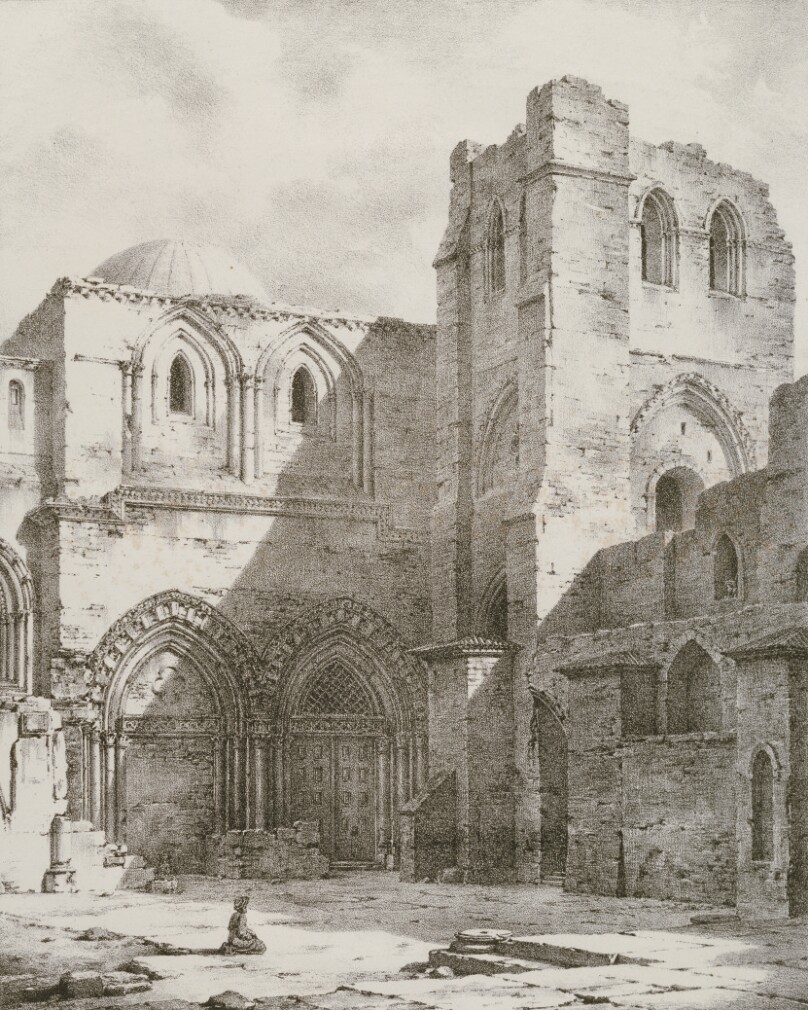
Entrée de l'eglise du St. Sépulcre.
Creator
Louis-Jacques-Mandé DaguerreFrench Photographer · 1787–1851
All works by this person →- Date
- about 1818
- Medium
- Lithograph
- Culture
- French
- Department
- Prints
- Institution
- Getty Museum
- Object ID
- f487b3c4-6d25-401d-8f66-5cb49e0c16db
From the Getty Museum record
> Around 1815, when Louis-Jacques-Mandé Daguerre was completing his art studies, he was introduced to the art of lithography, a relatively new printing process invented in 1796 by Alois Sennefelder. It, no doubt, commanded Daguerre's attention because of the fidelity with which a crayon or ink sketch could be duplicated on paper. While he failed to distinguish himself as a lithographer, prints like *The Entrance to the Church of St.-Sépulcre* do display a remarkable interest in geometry and perspective, as well as in the nuances of how light falls on buildings. Light and geometry would become important to photography two decades later. > > With lithography one could make and distribute many copies of a drawing relatively inexpensively to a much wider audience. These economic attributes would have been of great interest to Daguerre, who must have grown keenly aware of the importance of developing a group of followers when he opened his diorama in Paris in 1822. Embraced as a new form of entertainment, the diorama created impressive visual illusions in a theatre-like space using life-sized paintings and dramatic lighting effects but no actors. Without walking a step, the audience moved between multiple displays that took them from day to night in a church, for example, or from moments before the eruption of a volcano to the fiery lava flows that came after through the use of a mechanical rotational system. Adapted from Weston Naef, *The J. Paul Getty Museum Handbook of the Photographs Collection* (Los Angeles: J. Paul Getty Museum, 1995), 6. © 1995 The J. Paul Getty Museum.
The authoritative record is held by Getty Museum. LinkedCulture surfaces this object and its connections; it does not alter institutional metadata.
Get printable QR codesHide QR codes
Open QR codes for this object page and the museum record. They stay collapsed until needed.
Related across collections
Semantically similar works from Getty Museum and other institutions.