Getty Museum
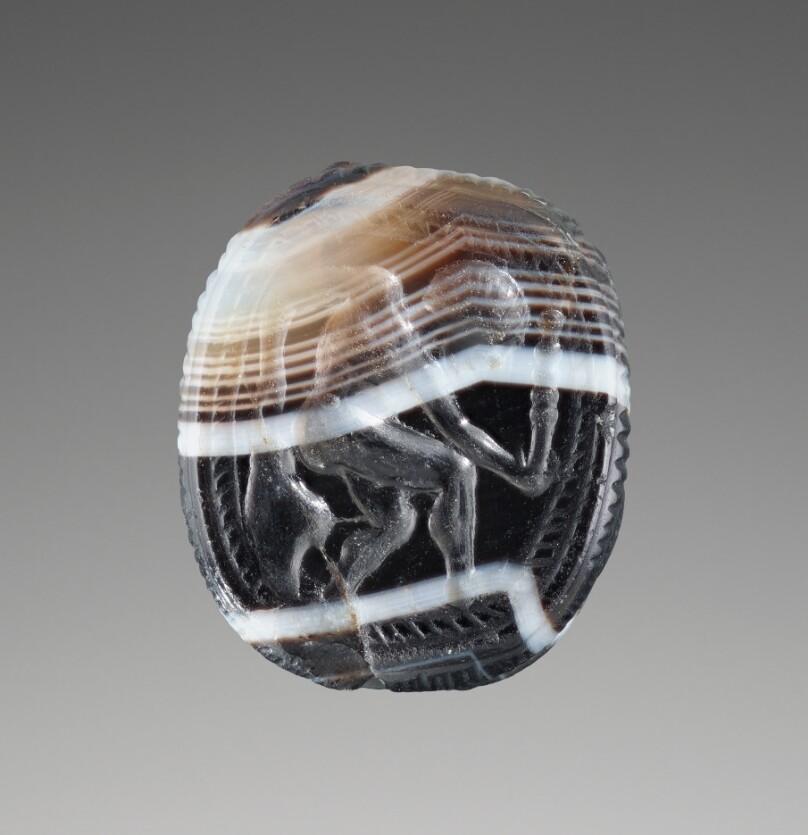
Scarab
Creator
UnknownAll works by this person →More on Getty ULAN- Date
- about 350 B.C.
- Medium
- Banded black and white agate
- Culture
- Etruscan
- Department
- Jewelry
- Institution
- Getty Museum
- Object ID
- f507c740-aeb4-4042-a0ac-ef2db6e0de4b
From the Getty Museum record
Diomedes, one of the great Greek warriors of the mythical Trojan War, holds the stolen Palladion out in front of him on the intaglio of this Etruscan scarab. The Palladion was the sacred statue of the goddess Athena that protected Troy; its theft made the Greek capture of Troy possible. Because the object being carried is rendered only with drilled blobs, its identification is somewhat uncertain, but the pose of the figure indicates running, which would be appropriate for this scene. Scarabs were introduced to Etruria in the later 500s B.C., first through Greek imports and then through emigrant Greek artists. In this period many Ionian artists, including gem carvers, fled Persian aggression in their homeland. Some went to Etruria, which was a stable and wealthy region. In Etruria the jewelry aspect of the scarab was emphasized: the beetle sits on a decorated plinth and its anatomy is carved in detail, usually with incised winglets and stippled heads. The scarab form remained popular into the late 400s and 300s B.C. in Etruria, long after it had gone out of style in Greece.
The authoritative record is held by Getty Museum. LinkedCulture surfaces this object and its connections; it does not alter institutional metadata.
Get printable QR codesHide QR codes
Open QR codes for this object page and the museum record. They stay collapsed until needed.
Related across collections
Semantically similar works from Getty Museum and other institutions.