Getty Museum
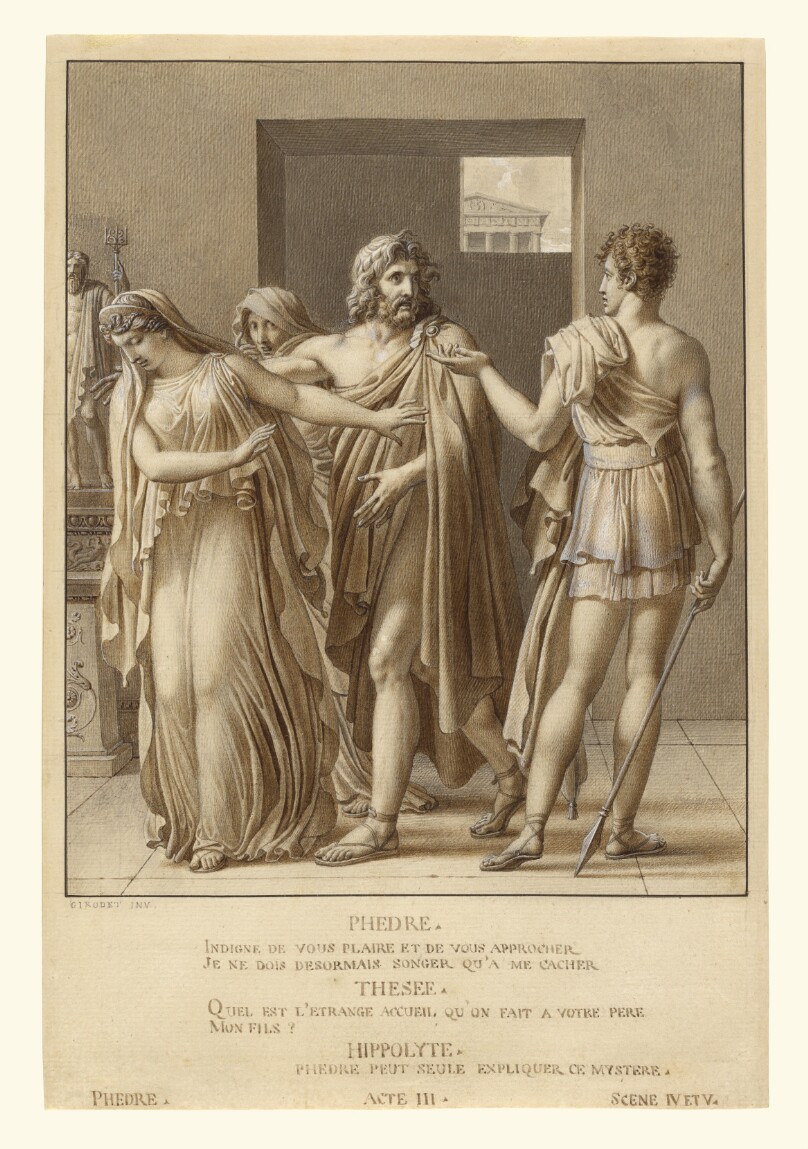
Phaedra Rejecting the Embraces of Theseus
Creator
Anne-Louis Girodet de Roucy-TriosonFrench Artist · 1767–1824
All works by this person →After his father's death in 1784, Anne-Louis Girodet de Roucy-Trioson joined the studio of Neoclassical titan Jacques-Louis David yet became a pioneer of French Romanticism. He won the Prix de Rome in 1789. Girodet's *Endymion Sleeping,* painted in Rome and submitted to the Salon of 1793, showed the influence of Italian artists Antonio Canova and Correggio. Because Girodet's paintings were coldly
More on Getty ULAN- Date
- about 1800
- Medium
- Pencil, pen and brown ink, brown wash, heightened with white gouache
- Culture
- French
- Department
- Drawings
- Institution
- Getty Museum
- Object ID
- f5be3314-7d81-4db4-918b-9c7029f0471b
From the Getty Museum record
Returning home, the bearded Theseus reaches out to greet his wife Phaedra, who shies away from his embrace. Surprised at this cold reception, Theseus looks inquiringly at his son Hippolytus. During his absence, Phaedra had fallen in love with her stepson, and she is now unable to meet Theseus's eyes. The dialogue underneath the picture recounts the verbal exchange. Phaedra says, "I am unworthy of pleasing you or being near you. I can henceforth only hide myself from you." Theseus then turns to Hippolytus, asking, "What is this strange welcome you give your father?" Hippolytus replies, "Only Phaedra can explain the mystery." Anne-Louis Girodet de Roucy-Trioson made this highly finished study as an illustration for a series of deluxe editions of the plays of Racine, a French dramatist from the 1600s. The publisher chose seven artists to illustrate the set, which was dedicated to Napoleon, and retained the original drawings, including this one, after the engravings were made. Girodet displayed such typically Neoclassical characteristics as firm, linear drawing; carefully shaded three-dimensional forms; and a static, ordered composition. Appropriately, his monumental figures--especially the central figure of Theseus silhouetted in front of an open doorway--seem more like Greek statues than living actors.
The authoritative record is held by Getty Museum. LinkedCulture surfaces this object and its connections; it does not alter institutional metadata.
Get printable QR codesHide QR codes
Open QR codes for this object page and the museum record. They stay collapsed until needed.
Related across collections
Semantically similar works from Getty Museum and other institutions.