Getty Museum
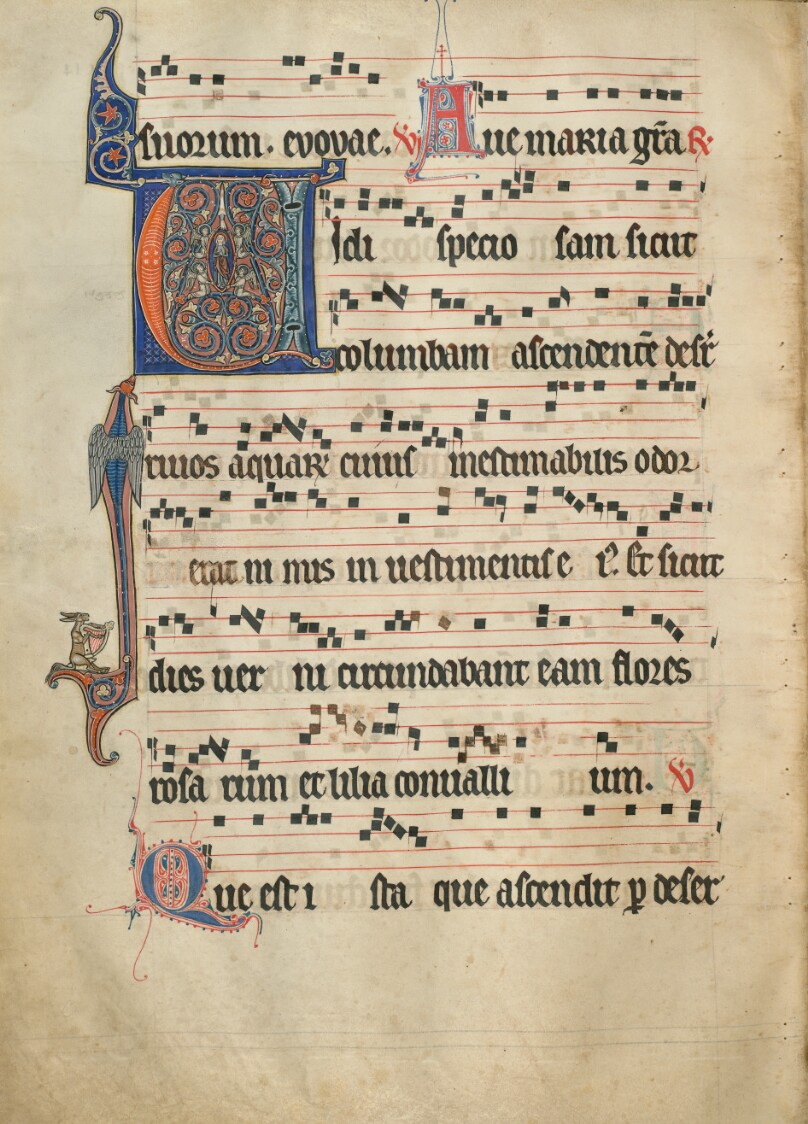
Antiphonal
Creator
UnknownAll works by this person →More on Getty ULAN- Date
- about 1260–1270
- Medium
- Tempera colors, gold leaf, silver, and ink
- Culture
- Franco-Flemish
- Department
- Manuscripts
- Institution
- Getty Museum
- Object ID
- f613d700-face-43c9-9b49-0413cdb3c3f5
From the Getty Museum record
This manuscript was once part of a larger, or perhaps even multi-volume, choir book. Known as antiphonals, these manuscripts were produced for choirs in Christian churches and included the sung portions of the Divine Office, the prayer service for each day of the Catholic calendar. This manuscript is significant for the extent and nature of its illustration, including at least twelve initials that begin the feasts of saints with illuminations that depict scenes from their lives. Such a large narrative program was uncommon in thirteenth-century choir books. This antiphonal was created for an abbey of Cistercian monks or nuns in the Franco-Flemish region (perhaps the Abbey of Cambron in present-day Belgium). At the very end of the eleventh century a group of monks from the Benedictine Order founded their own community in Cîteaux in eastern France, with an aim to return to the monastic ideals of austerity espoused by St. Benedict in the sixth century CE. These monks came to be known as the Cistercians, donning white robes to distinguish themselves from their Benedictine counterparts, who dressed in black. Although the monks were known for their austerity, manuscripts like this one show how they still valued beautifully decorated manuscripts. Nineteen leaves and four illuminated cuttings, all from the same manuscript, were in the original Ludwig collection, but after the Getty attained eighty-three text leaves from the same antiphonal in 1992, conservators were able to bind the eighty-three leaves with the nineteen leaves in an approximation of the antiphonal’s original format. The four cuttings could not be reintegrated into the remade manuscript but are still within the [collection][1]. [1]: https://www.getty.edu/art/collection/object/105SWB
The authoritative record is held by Getty Museum. LinkedCulture surfaces this object and its connections; it does not alter institutional metadata.
Get printable QR codesHide QR codes
Open QR codes for this object page and the museum record. They stay collapsed until needed.
Related across collections
Semantically similar works from Getty Museum and other institutions.