Getty Museum
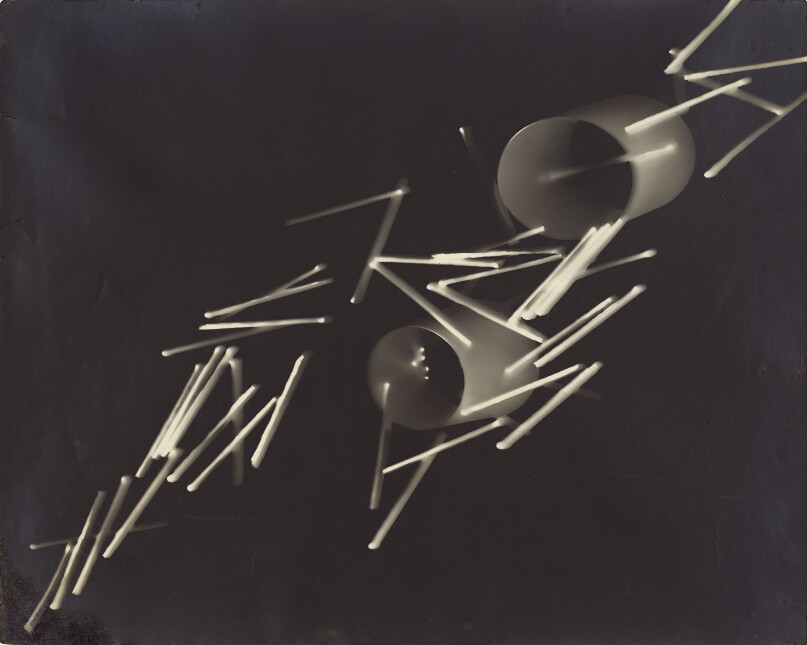
Fotogramm
Creator
László Moholy-NagyAmerican Photographer · 1895–1946
All works by this person →> The reality of our century is technology: the invention, construction and maintenance of machines. To be a user of machines is to be of the spirit of this century. Machines have replaced the transcendental spiritualism of past eras. > > --László Moholy-Nagy > > Perhaps more than any other artist in the Getty Museum collection, László Moholy-Nagy would have delighted in the presentation of his im
More on Getty ULAN- Date
- about 1928–1929
- Medium
- Gelatin silver print
- Culture
- American
- Department
- Photographs
- Institution
- Getty Museum
- Object ID
- f935b996-de92-4d04-ad2b-c992f802c267
From the Getty Museum record
> In the early 1920s László Moholy-Nagy’s Berlin studio was a popular gathering place for artists, including the Russian painter El Lissitzky and the Dadaists. In 1922 Moholy-Nagy attended the Dada-Constructivist Congress in Weimar. It seems likely that he would have heard of the work of Christian Schad, a Zurich Dadaist who in 1918 had made a series of small pictures directly on photosensitive paper (Schadographs), and that of Man Ray in Paris, whose suite of photograms (Rayographs) *Les champs délicieux* (The fields of delight) was published in 1922. Moholy-Nagy was not interested in making identifiable pictures of objects in his photograms; he sought instead to achieve abstract effects with everyday items. On the back of this dynamic image, which once belonged to the Russian poet Vladimir Mayakovsky, Moholy-Nagy identifies the compositional elements as two napkin rings and some wooden matches but also writes: “But is that important in the end? How the light flows in tracks and what becomes of the whole has nothing to do anymore with the original material.” Katherine Ware, *László Moholy-Nagy*, In Focus: Photographs from the J. Paul Getty Museum (Los Angeles: J. Paul Getty Museum, 1995), 12. © 1995 The J. Paul Getty Museum.
The authoritative record is held by Getty Museum. LinkedCulture surfaces this object and its connections; it does not alter institutional metadata.
Get printable QR codesHide QR codes
Open QR codes for this object page and the museum record. They stay collapsed until needed.
Related across collections
Semantically similar works from Getty Museum and other institutions.