Getty Museum
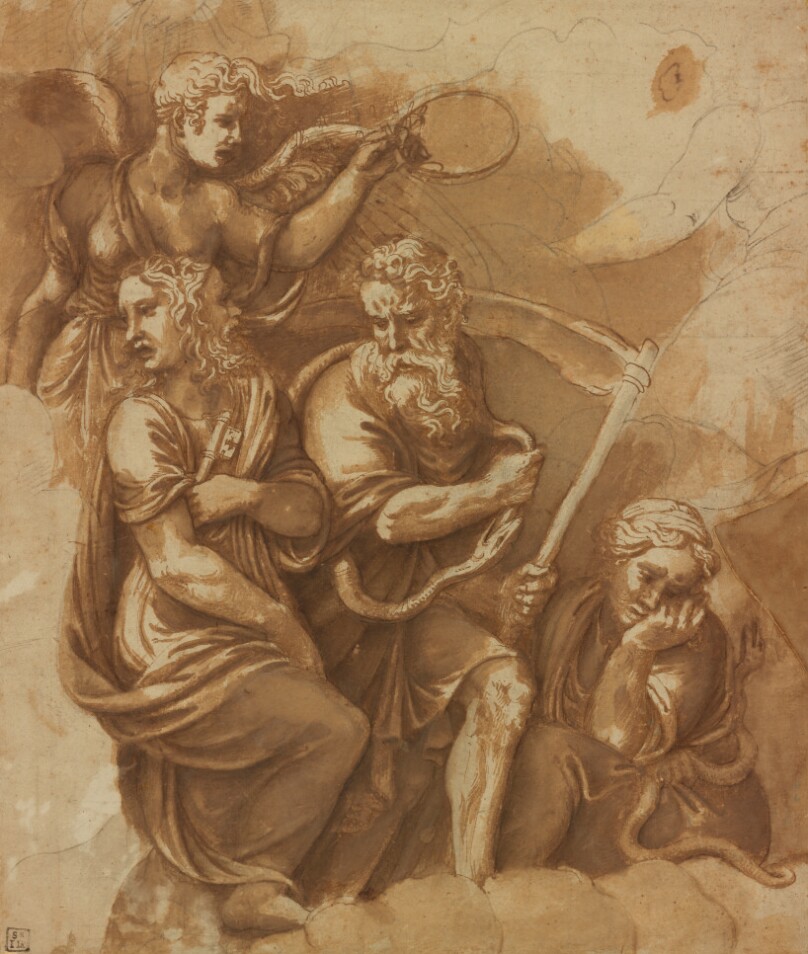
Victory, Janus, Chronos and Gaea
Creator
Giulio Romano (Giulio Pippi)Italian Artist · 1499–1546
All works by this person →Giulio Romano was so famous in the century after his death that he is the only "modern" artist mentioned by Shakespeare in a play. A Roman native, by about 1515 he was working for Raphael in the Vatican, eventually becoming the master's most trusted aide. Raphael's late works indicate the increasing torsion and tension that Mannerist artists like Giulio would bring to full flower, ideas that Giuli
More on Getty ULAN- Date
- about 1532–1534
- Medium
- Pen and brown ink and wash over black chalk
- Culture
- Italian
- Department
- Drawings
- Institution
- Getty Museum
- Object ID
- f97bc6af-13b4-47d3-a6fa-43b6b38b9858
From the Getty Museum record
Two Roman gods and a goddess, accompanied by a Victory, peer down from the edge of a bank of clouds. On the left, holding a large key, is Janus, the guardian of the doorways of houses and city gates. He is traditionally portrayed with two faces, demonstrating his ability to look both ways at once. In the center, the bearded figure of Chronos personifies Time. In one hand he holds a scythe, while a snake gripping its tail in its mouth wraps itself around his neck. Such a snake holding its tail was an ancient Egyptian symbol of eternity. Gaea, the goddess of the Earth, crouches at Chronos's feet with another snake grasped in her right hand. The winged figure of Victory, her hair streaming out to the side, stands behind these three and holds out a crown in her left hand. Giulio Romano made this drawing in preparation for part of the frescoed vault of the Sala dei Giganti (Room of the Giants) in the Palazzo del Te, the summer residence of the court of Giulio's patron, Federico Gonzaga, duke of Mantua. Giulio completed the preparatory drawings for the fresco, and his assistants then squared them for transfer to the ceiling.
The authoritative record is held by Getty Museum. LinkedCulture surfaces this object and its connections; it does not alter institutional metadata.
Get printable QR codesHide QR codes
Open QR codes for this object page and the museum record. They stay collapsed until needed.
Related across collections
Semantically similar works from Getty Museum and other institutions.