Getty Museum
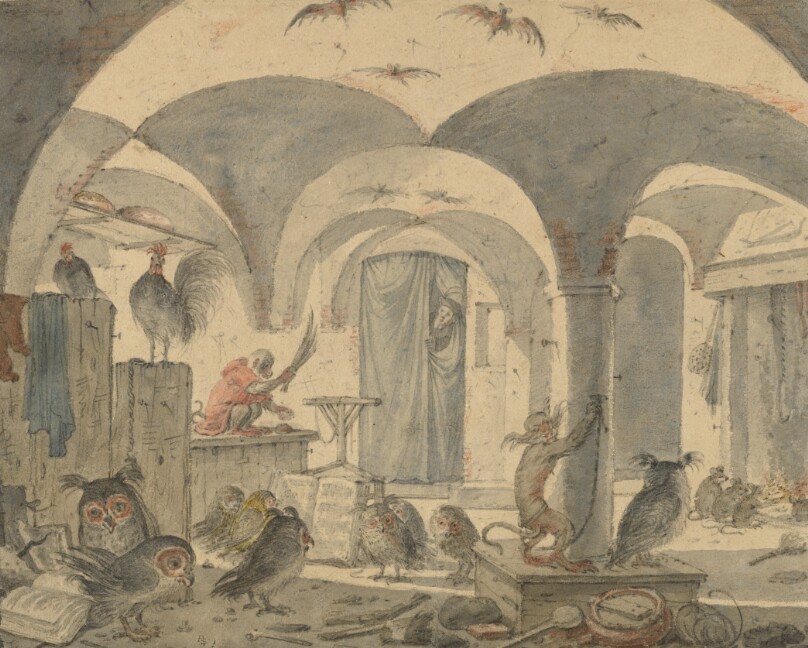
An Enchanted Cellar with Animals
Creator
Cornelis SaftlevenDutch Artist · 1607–1681
All works by this person →Cornelis Saftleven came from a family of artists: his father and two brothers also painted. After training in Rotterdam, possibly with his father, Cornelis traveled to Antwerp around 1632. Among his earliest works are portraits and peasant interiors influenced by Adriaen Brouwer. By 1634 Cornelis was in Utrecht, where his brother Herman Saftleven the Younger was living, and the two began painting
More on Getty ULAN- Date
- about 1655–1670
- Medium
- Brush with gray and brown wash, and watercolor with red chalk over black chalk
- Culture
- Dutch
- Department
- Drawings
- Institution
- Getty Museum
- Object ID
- fe79919d-e747-4241-9d97-546e3a55fc7f
From the Getty Museum record
Scenes of animals performing human actions and taking over human habitats were popular in Cornelis Saftleven's day. Adding color further enhanced the visual appeal and, hence, marketability of such pictures. Saftleven made *An Enchanted Cellar with Animals*, one of the largest and most elaborate animal fantasies he ever created, as a finished work of art in its own right. Saftleven liberally applied lively black chalk and gray wash and intentionally restrained the use of color. The sparing touches of red, yellow, and blue watercolor heighten the comic subject's playful, festive quality. As he typically did, Saftleven included cooking implements and other bits carelessly strewn about and evoked a mood of enchantment by setting the scene in a shadowy vaulted interior with flying bats. The hidden human observer, here peeking out from the curtained doorway, was a stock figure in Netherlandish satirical and moralizing imagery of the 1500s and 1600s.
The authoritative record is held by Getty Museum. LinkedCulture surfaces this object and its connections; it does not alter institutional metadata.
Get printable QR codesHide QR codes
Open QR codes for this object page and the museum record. They stay collapsed until needed.
Related across collections
Semantically similar works from Getty Museum and other institutions.