Getty Museum
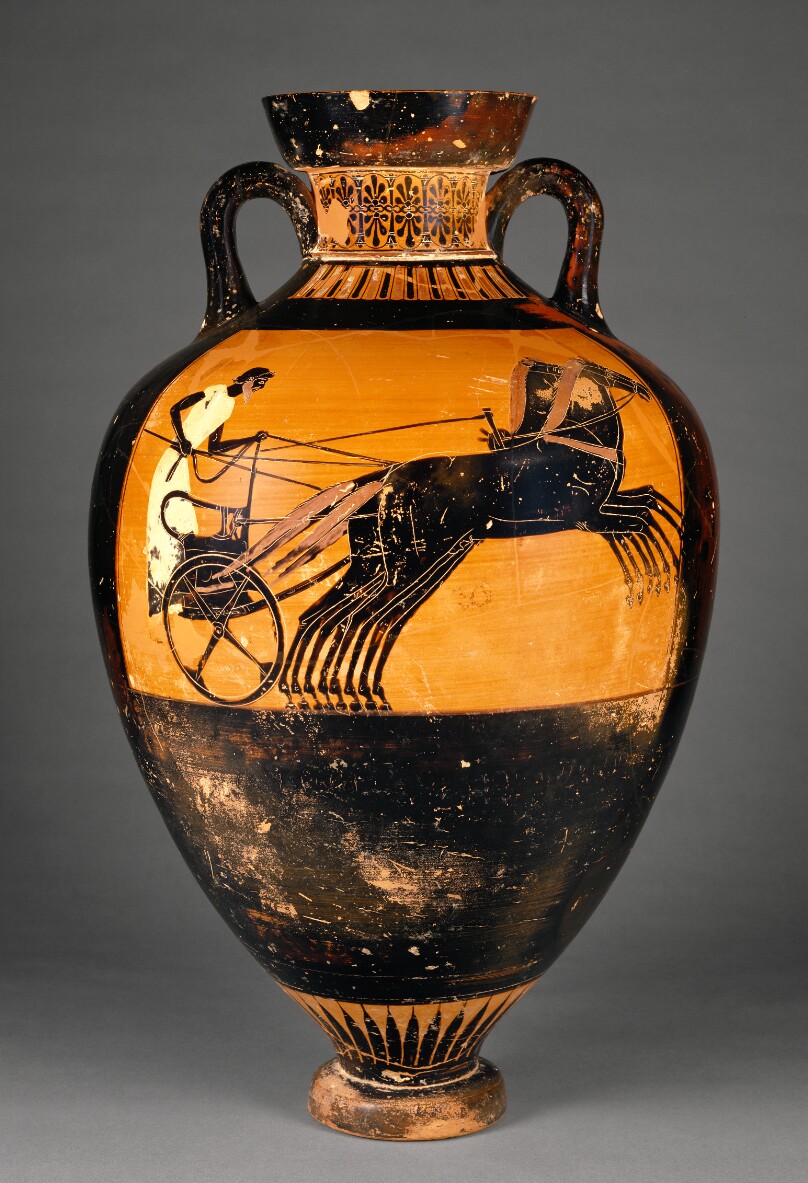
Attic Panathenaic Amphora
Creator
Kleophrades PainterPainter
All works by this person →Working in Athens in the period from about 505 to 475 B.C, the Kleophrades Painter was a prolific vase-painter--more than one hundred vases attributed to him survive. He very likely was the pupil of Euthymides, one of the group of the red-figure Pioneers. He primarily worked in the red-figure technique but occasionally used the black-figure technique with enough facility that he may have been trai
More on Getty ULAN- Date
- 500–480 B.C.
- Medium
- Terracotta
- Culture
- Greek (Attic)
- Department
- Vessels
- Institution
- Getty Museum
- Object ID
- ff31e3db-81d5-4040-b1a4-7996a00770d0
From the Getty Museum record
The Greater Panathenaia, a state religious festival, honored Athena, the patron goddess of Athens. Held every four years, the festival included athletic and musical competitions, and amphorae filled with oil from Athena’s sacred olive trees were given as prizes in the Panathenaic Games. These Panathenaic Amphorae had a distinctive form with narrow necks and feet, and received standard decoration, always in the black-figure technique. On the front, Athena in her guise as “Promachos” – in the frontline of battle - strides forth between columns. Running along one of the columns is the official inscription, "of the prizes from Athens." The back depicts the event for which the vase was a prize, in this case the four-horse-chariot race, one of the most prestigious events in the games. Leading vase-painters decorated these prize amphorae, which were commissioned in large quantities by the state, and their work can often be differentiated by the motif they used to decorate the shield of Athena. For example, the winged horse Pegasos seen here seems to have been typical for the Kleophrades Painter. Though the oil within was the real prize, the vessels that contained it could be highly valued, as lasting symbols of prowess and excellence. This example preserves ancient repair holes at one of the handles.
The authoritative record is held by Getty Museum. LinkedCulture surfaces this object and its connections; it does not alter institutional metadata.
Get printable QR codesHide QR codes
Open QR codes for this object page and the museum record. They stay collapsed until needed.
Related across collections
Semantically similar works from Getty Museum and other institutions.