Research note · July 14, 2026
A Bridge in the Rain: How a Dying Man's Print Crossed the World
Van Gogh's copy of a Hiroshige print is the famous case, and one of three he made that year. Degas's hundred-print collection, Cassatt's turn to a new medium after seeing 700 Japanese prints in one room, and Toulouse-Lautrec's Japanese signature are the same story, several times over, across institutions on two continents.
japonismehiroshigevangoghdegascassatttoulouselautreccrossinstitutionalukiyoe
In the autumn of 1887, in a rented room in Paris, Vincent van Gogh set up a canvas and began copying a print by Utagawa Hiroshige, brushstroke for brushstroke, though he made the colors more intense than the original's. [1] He was painting on a standard-size canvas and wanted to keep the print's own proportions, so he left a border around the image and filled it with Japanese characters copied from other prints. The print was Sudden Shower over Shin-Ōhashi Bridge and Atake, part of Hiroshige's late series One Hundred Famous Views of Edo ("Edo" was the city's name before it became Tokyo, and the setting for centuries of military rule under the Tokugawa shogunate). Van Gogh wasn't guessing at Japan from a distance. He was an obsessive, serious collector of ukiyo-e, the popular Japanese woodblock-print tradition Hiroshige worked in, and spent hours at Siegfried Bing's Paris gallery next door to his apartment, where thousands of Japanese prints were for sale. [2]
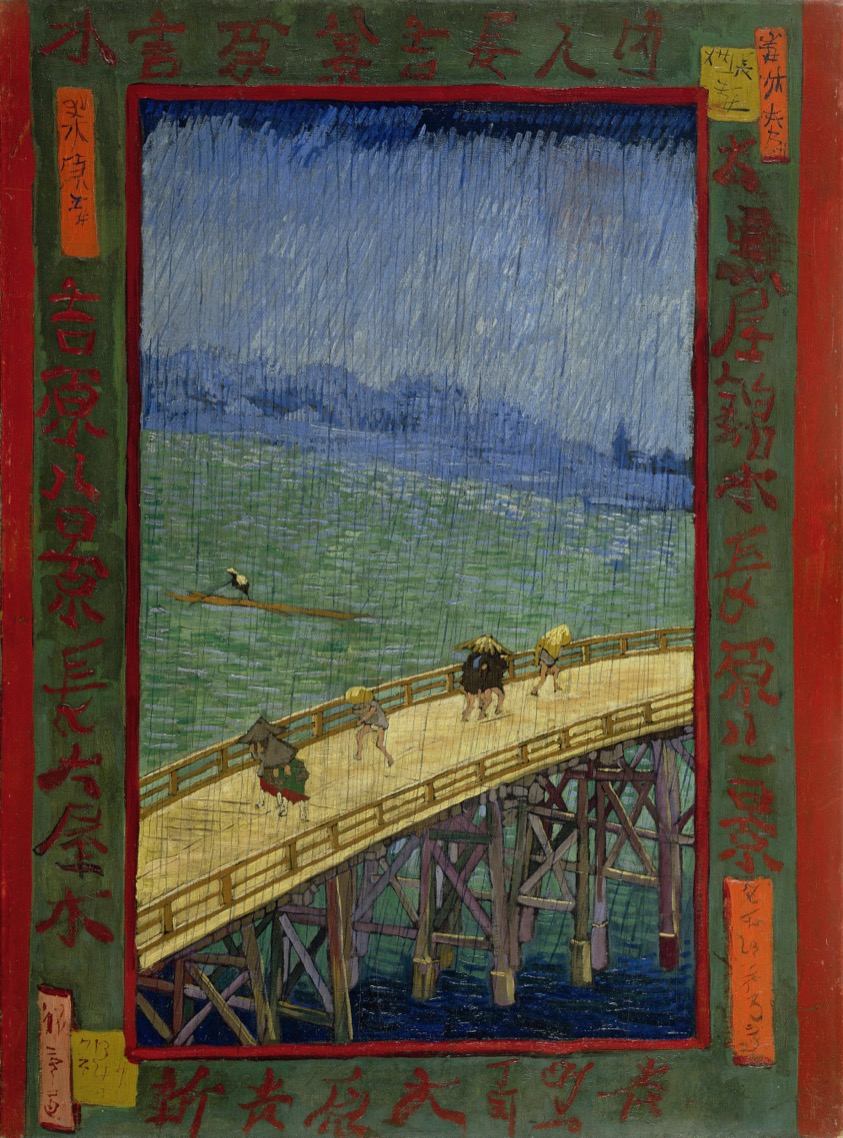
This is the painting he made from it. [1]
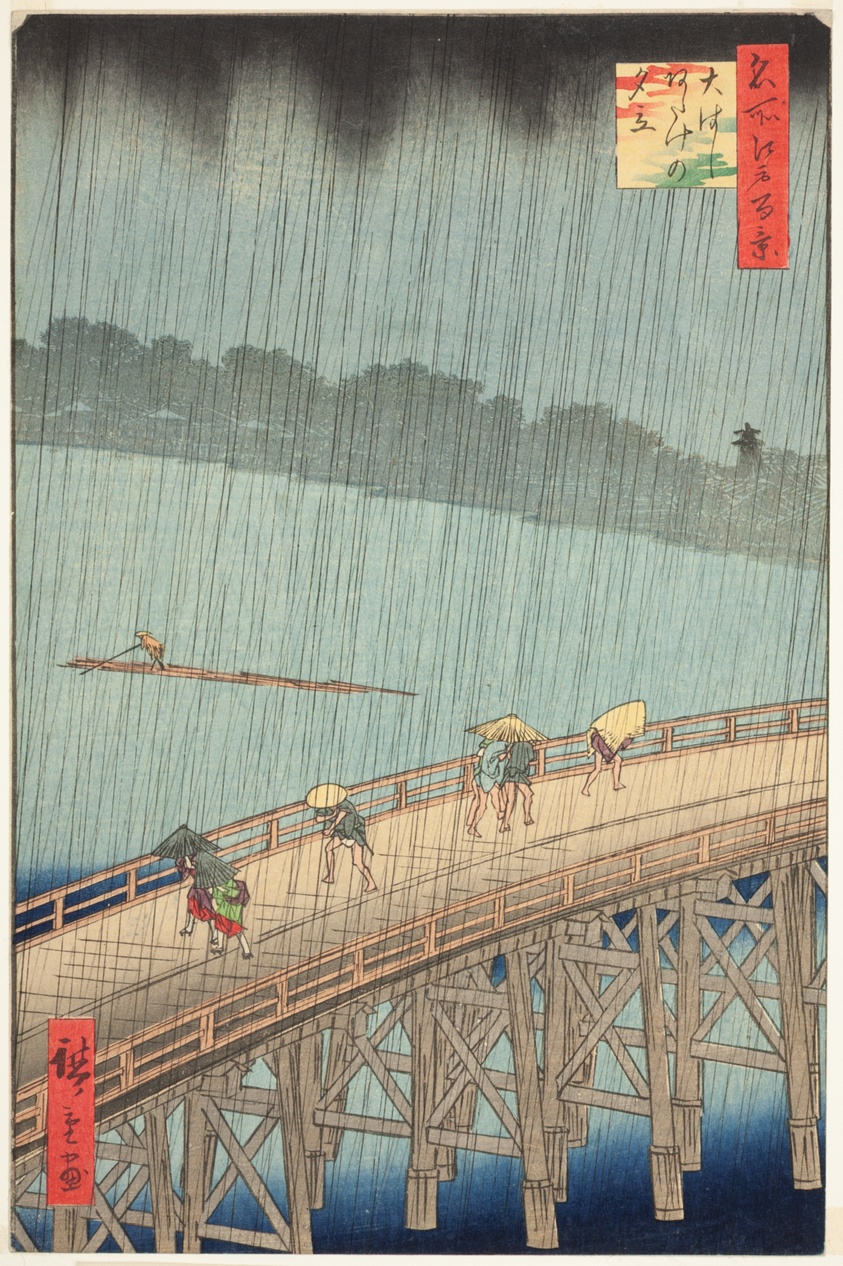
Three separate impressions of the print he copied survive in public collections, each pulled by hand from the same 1857 woodblocks, and LinkedCulture finds all three: one at the Rijksmuseum, one at the Cleveland Museum of Art, whose own catalog record notes it was published two years after the great Edo earthquake and fire of 1855 and shows the city's Great Bridge freshly rebuilt, and the one pictured above, at the Art Institute of Chicago, the one Van Gogh copied. [3] [4]
Van Gogh didn't stop at one copy. That same autumn he painted two more Japanese prints from his own collection directly onto canvas: Flowering Plum Orchard, after Hiroshige's Plum Garden at Kameido, and Courtesan, after a print by Keisai Eisen that he knew only from a magazine cover. [17] The Art Institute of Chicago's own impression of the Hiroshige source print, the tree Edo residents called the sleeping dragon plum, is catalogued with the copy it produced already noted in the museum's record. [18] The Courtesan is the stranger case. Van Gogh never saw Eisen's original: he worked from its reproduction on the cover of a May 1886 issue of Paris Illustré titled Le Japon, copying and enlarging the figure with a grid. [19] He framed her in a pond of his own invention, thick with water lilies, bamboo, cranes, and frogs, borrowed from other prints in his collection. The choice wasn't decorative. Grue and grenouille, crane and frog, were French slang for prostitute. The hidden meaning sits inside a painting about a courtesan copied from a print Van Gogh never actually held. [20]
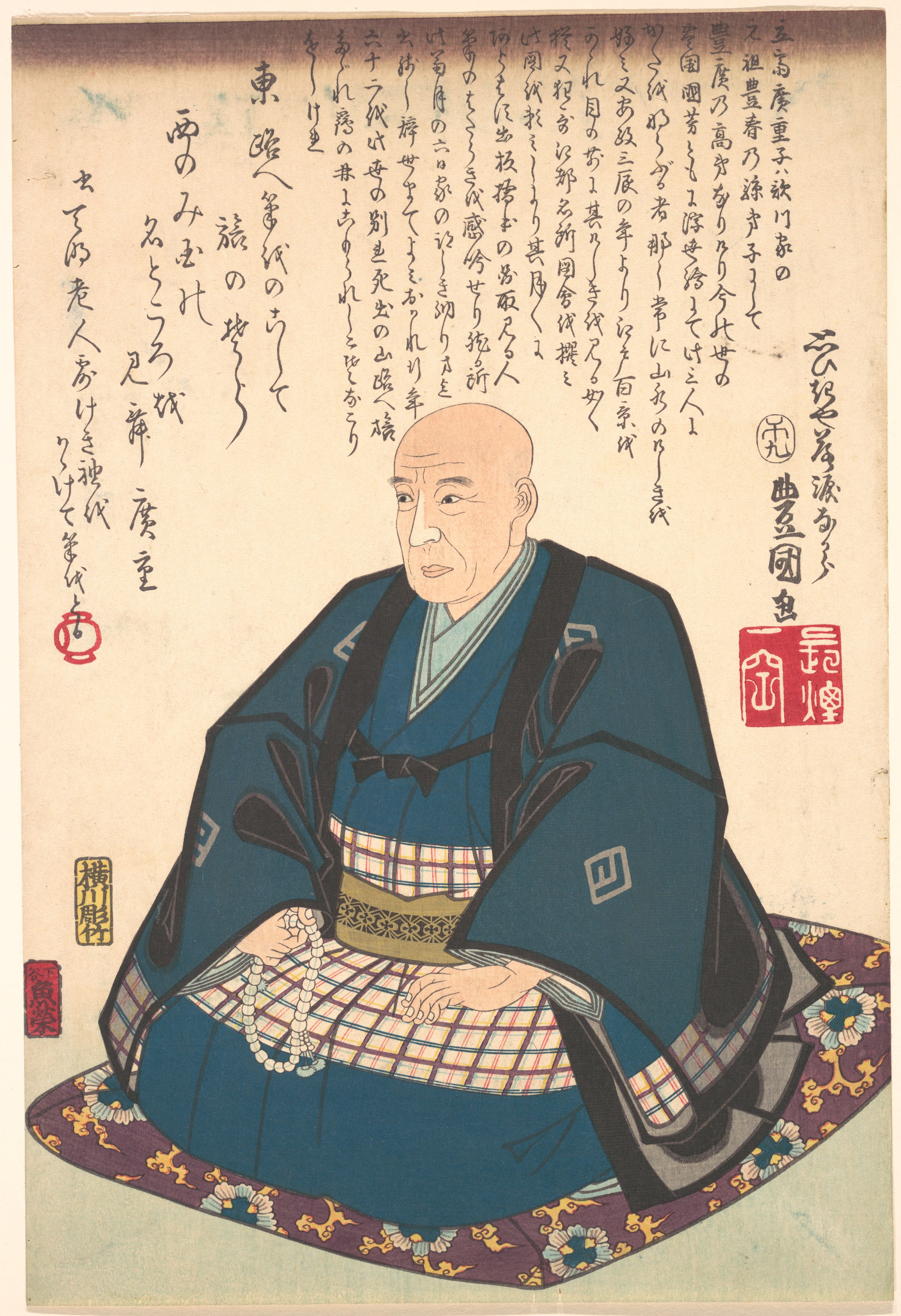
Hiroshige never knew any of what came next. He died in 1858, during the epidemic that killed some 28,000 people in Edo that year, though even his cause of death carries a note of uncertainty in the record, one of the small honest gaps historians still hold open. [5] Three years before he died, he had already retired from the world to become a Buddhist monk, and reportedly left a farewell poem: "I leave my brush in the East, and set forth on my journey." [6] Utagawa Kunisada, a fellow ukiyo-e artist, painted this memorial portrait of him the year he died, in the robes of the monk he had become. [7]
The prints that made him internationally famous were never meant to leave Japan. Ukiyo-e was popular, disposable art: cheap enough for ordinary residents of Edo to buy the way people bought newspapers.
By the 1870s, what had been disposable in Japan had become a name in France. The critic Philippe Burty coined the word *Japonisme* in 1872 to describe what was happening to a generation of painters, among them Monet, Degas, Whistler, and soon Van Gogh, as Japanese prints, ceramics, and textiles flooded into Paris in the years after Japan's forced reopening to the West. [8] Van Gogh's copy is the famous case. The same search turns up three more, from painters who never picked up a brush to imitate Hiroshige, but who absorbed the habit of seeing that Japonisme was actually about.
Degas took it further than admiration. Minneapolis Institute of Art holds what its own catalog record calls his most Japanese-inspired print: a narrow, up-tilted etching of Mary Cassatt at the Louvre, its cropped column, off-center figure, and bird's-eye angle drawn directly from Japanese compositions. It isn't a Japanese subject at all, just a Parisian woman at a museum, seen the way Degas had learned to see. [9]
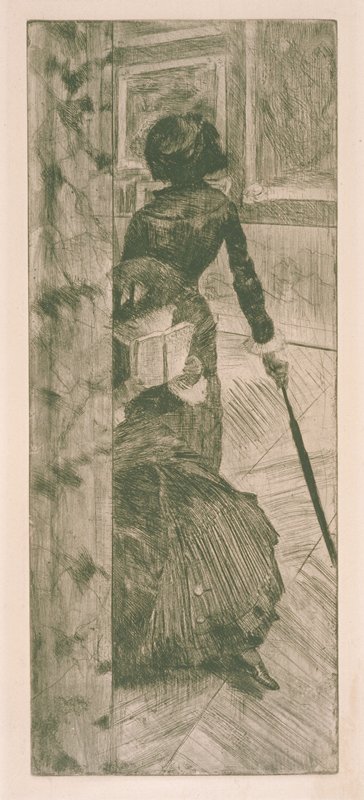
That way of seeing took over a decade to build. It started in 1865, when Degas began frequenting a shop at 220 rue de Rivoli that Parisians nicknamed La Porte Chinoise, where a small circle, among them Édouard Manet, James McNeill Whistler, and the writer brothers Edmond and Jules de Goncourt, gathered to look at Japanese prints newly arriving in the city. [10] He kept collecting for the rest of his life: by the time he died, his studio held more than one hundred ukiyo-e prints. [11]
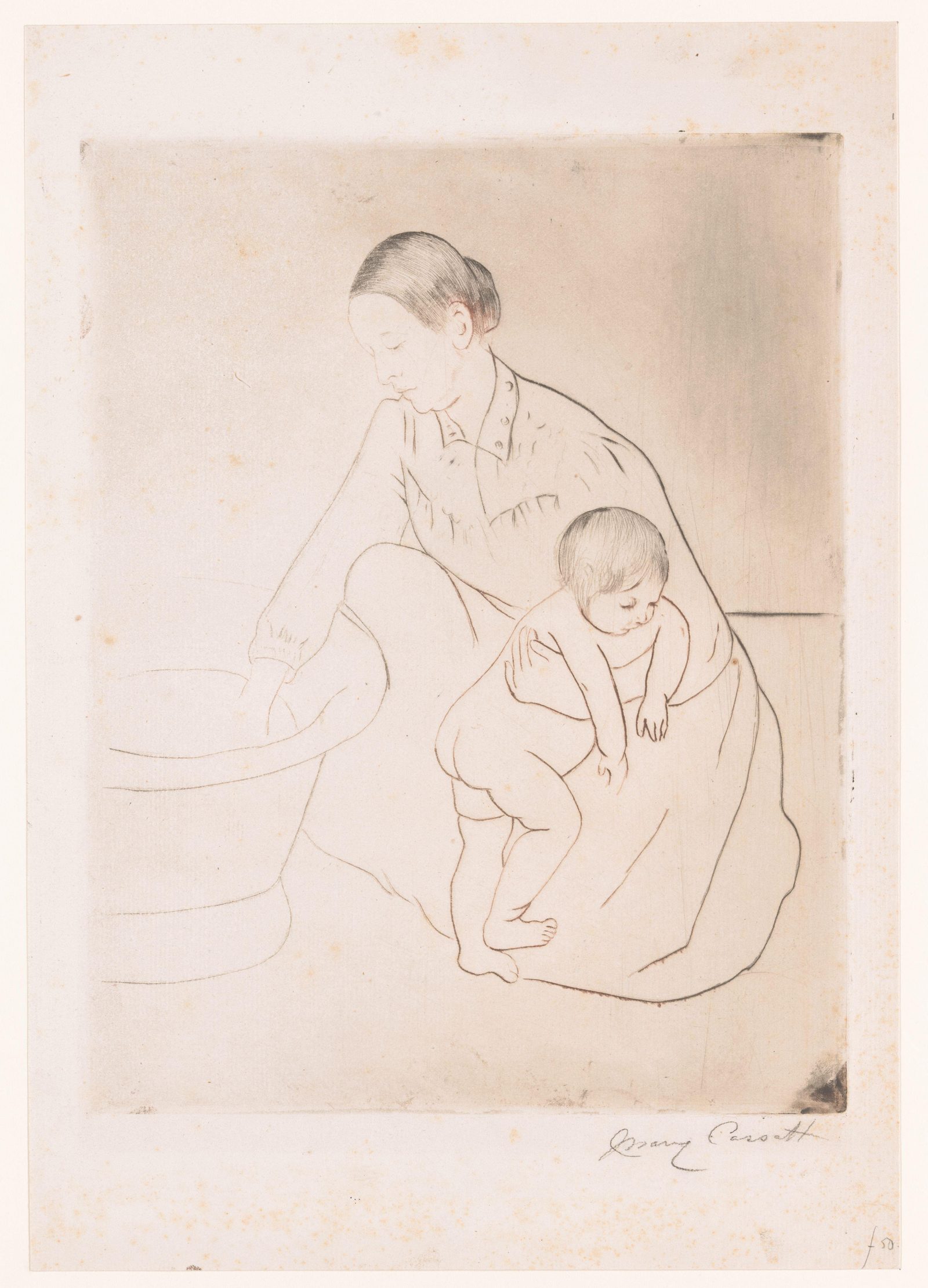
The woman in that etching had her own encounter with Japan, and it didn't stay secondhand for long. In April 1890 Cassatt attended, with Degas, an exhibition of some 700 Japanese prints at the École des Beaux-Arts, then wrote to Berthe Morisot urging her to see it too. [21] Within months she had set painting aside for a technique she had not used before: ten color aquatints, worked in drypoint and burnished aquatint to reach the flat color fields and asymmetric compositions of the ukiyo-e she had just seen, using none of the woodblock process itself. The Art Institute of Chicago holds The Bath from that 1890 to 1891 series, and the Rijksmuseum holds its own impression of the same bathtub scene. [22] [23] Where Van Gogh copied and Degas absorbed, Cassatt answered the same encounter by changing medium.
Toulouse-Lautrec went a step further still. In 1893 he attended the first major Western retrospective of Japanese art held in Paris, and began trading his own paintings for the ukiyo-e prints he wanted, spending entire days at a print dealer's shop teaching himself to read Japanese signatures. [12] The habit changed how he signed his own work: the year before, in 1892, he'd adopted a small circular monogram, his initials compressed into a red seal modeled on the fittings of a Japanese sword hilt. [13] It's a strange, specific kind of homage, borrowing not just a style but the mark that says who made something.
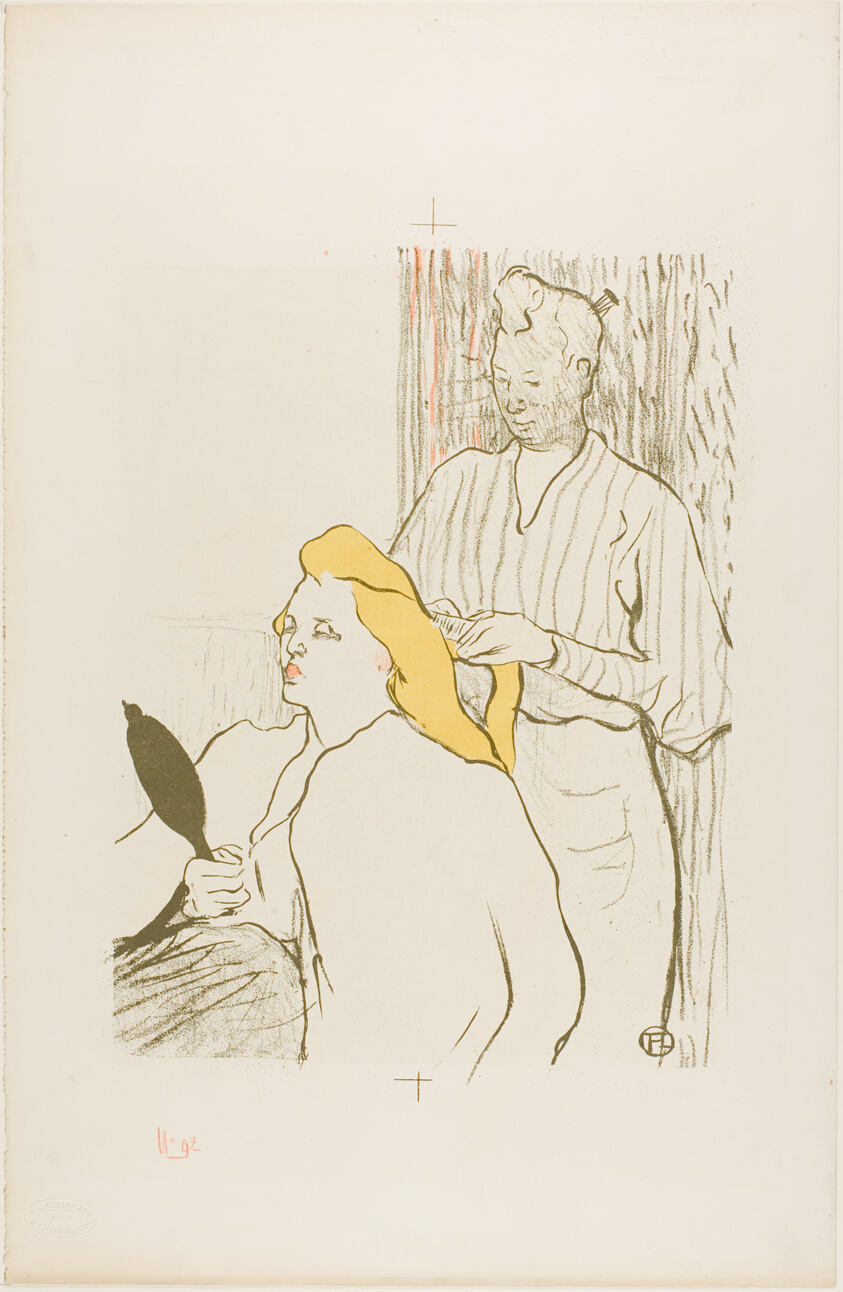
The Art Institute of Chicago holds a lithograph from that same year: a theater program whose flat color and black outlines, per its own record, achieve in color lithography the same effect Japanese woodcut technique gets from carving a separate block per color, and whose subject, women in Parisian theaters and cafes, deliberately echoes how Japanese printmakers had depicted the licensed pleasure quarters of the Yoshiwara. [14]
Eleven years after Burty coined the word, the printmaker Félix Buhot gave it a second life. The ten etchings in his portfolio Japonisme, made after Japanese objects in Burty's own collection, mostly date from 1875, by Buhot's own account. He published them as a set eight years later, in April 1883, timed to Louis Gonse's retrospective of Japanese art that same month at the Georges Petit gallery. [15]
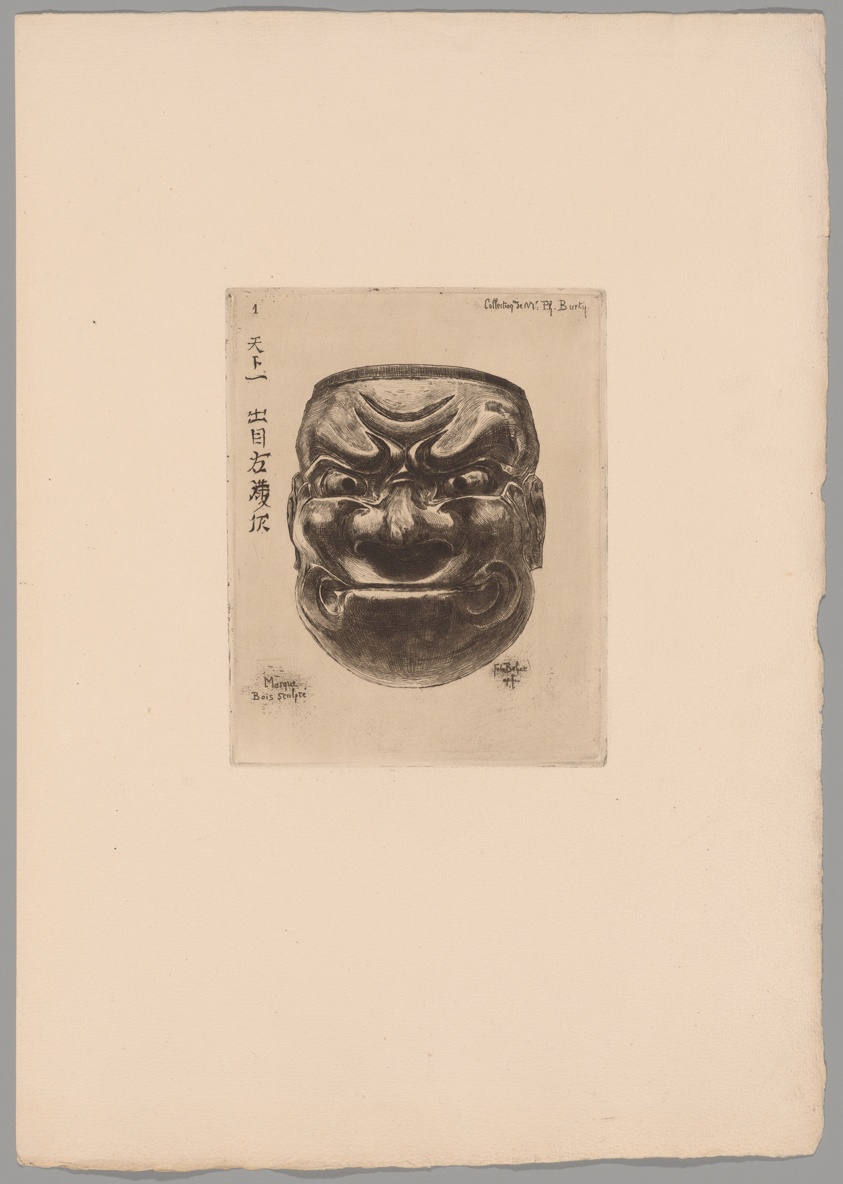
Chicago holds the printed covers of that portfolio, pulled in five different ink states: brownish-black, pure black, red, brown, blackish-blue. The Art Institute's own catalog credits the cover to Buhot. The Bibliothèque nationale de France's catalog credits it to Henri Guérard, rendering tracings Burty had made of the Japanese objects himself. [16]
There's a real irony underneath all of it. The West fell for a version of Japan (flat color, a bridge in the rain, a rebuilt city after a disaster) at almost the exact moment Japan itself was racing to leave that world behind. The same decade Burty named Japonisme, the Meiji Restoration was dismantling the shogunate and building the railways of a modern industrial state. Europe was discovering "old Japan" through prints just as Japan was dismantling it from the inside.
Van Gogh's copy of Hiroshige's bridge is usually told as a story about one artist admiring another. It's really a story about an entire generation working the same seam differently: one painter who copied prints stroke for stroke, sometimes without even the original in hand; one who studied their structure for over a decade without ever imitating them directly; one who saw seven hundred of them in a single room and answered by learning an entirely different medium; and one who borrowed not the image but the signature underneath it. A print made for pocket change in a city recovering from disaster survived its maker by decades and landed in a dozen different studios in Paris the same generation a critic gave the whole phenomenon a name.
References
- [1]Vincent van Gogh, Bridge in the Rain (after Hiroshige), October to November 1887, oil on canvas, 73.3 × 53.8 cm. Painted on a standard-size canvas to preserve the original print's proportions, with a border filled in with Japanese characters copied from other prints; colors made more intense than the original's. Van Gogh Museum, Amsterdam, object s0114V1962. Image via Wikimedia Commons, public domain
- [2]Van Gogh's ukiyo-e collecting and proximity to Siegfried Bing's gallery. DailyArt Magazine and The Collector
- [3]Object records: Rijksmuseum RP-P-1956-752, Cleveland Museum of Art 1921.318, Art Institute of Chicago 26545
- [4]Cleveland Museum of Art curatorial record, object 1921.318
- [5]Hiroshige's death and the 1858 Edo epidemic. Sotheby's
- [6]Hiroshige's retirement as a Buddhist monk and farewell poem. Sotheby's
- [7]Utagawa Kunisada's memorial portrait of Hiroshige, 1858. Donated by the Metropolitan Museum of Art to Wikimedia Commons under its Open Access policy; public domain (CC0)
- [8]Philippe Burty coining "Japonisme," 1872. Tate
- [9]Curatorial description of Mary Cassatt at the Louvre: The Paintings Gallery as Degas's most Japanese-inspired print. Minneapolis Institute of Art, object 8878
- [10]Madame Desoye's shop La Porte Chinoise at 220 rue de Rivoli and its circle of collectors, including Degas, Manet, and Whistler. Minneapolis Institute of Art, object 8878; corroborating account of the shop and its customers: "How Japan Reshaped Western Art"
- [11]Degas's collection of over 100 ukiyo-e prints by the time of his death. Minneapolis Institute of Art, object 8878
- [12]Toulouse-Lautrec's attendance at the 1893 Exposition Rétrospective de l'Art Japonais and his print collecting. "Toulouse-Lautrec and His Japanese Influences," Pen
- [13]Toulouse-Lautrec's 1892 circular monogram signature, modeled on Japanese sword-hilt fittings (tsuba). "The artist's signature: Toulouse-Lautrec," OUP Academic
- [14]Art Institute of Chicago, object 67134, "The Hairdresser, Program for the Théâtre Libre"
- [15]Félix Buhot's Japonisme portfolio, its source in Philippe Burty's own collection, and the 1875 execution date behind the 1883 publication. Art Institute of Chicago, Palmer Museum of Art exhibition, Bibliothèque nationale de France catalog
- [16]Art Institute of Chicago object 262015, part of the "Japonisme" portfolio, objects 262014–262021. Cover attributed to Henri Guérard by the Bibliothèque nationale de France catalog
- [17]Van Gogh's three 1887 copies after Japanese prints. Elizabeth Mix, exhibition review of Van Gogh & Japan, Nineteenth-Century Art Worldwide 17, no. 2 (Autumn 2018), DOI: 10.29411/ncaw.2018.17.2.21
- [18]Art Institute of Chicago, object 26577, "Plum Garden at Kameido (Kameido Umeyashiki)". The museum's own catalog record describes the tree as "said to resemble a sleeping dragon" and states the image "was famously copied by Vincent van Gogh in 1887 in his painting Flowering Plum Orchard (After Hiroshige)"
- [19]Van Gogh's copy of Eisen's Oiran from the May 1886 cover of Paris Illustré, titled Le Japon, and his use of a grid to enlarge the figure. Van Gogh Museum, object s0116V1962, "Courtesan (after Eisen)"
- [20]The crane and frog (grue, grenouille) slang meaning in Courtesan (after Eisen). Van Gogh Museum, object s0116V1962
- [21]Cassatt and Degas's attendance at the April 1890 École des Beaux-Arts exhibition of Japanese prints, and Cassatt's letter urging Berthe Morisot to attend. National Museum of Women in the Arts; Saint Louis Art Museum
- [22]Art Institute of Chicago, object 13527, "The Bath", color aquatint with burnishing, drypoint, and softground, 1890 to 1891
- [23]Rijksmuseum, object RP-P-1944-2742, "Moeder en kind bij badkuip", 1891. Image via the Rijksmuseum, public domain


In this note
People
Records
8 objects in the LinkedCulture index. Each page links on to the holding museum.