Research note · September 4, 2026
Describing 5,228 museum objects from the photograph alone.
I generated a description for every image in the Museo Egizio's online collection using only the photograph, no title and no catalog record. For about 900 objects the museum had already written something better. For 3,310 there was nothing at all.
linkedcultureaccessibilitywcagmuseumsculturalheritagecollections
If you manage a collection that is online, you have probably had some version of this conversation: the images are published, the catalog records are good, and the alt text is either missing or says the object's title. Everyone agrees it should be fixed. Nobody can find the staff time to fix it at the scale of the collection.
I wanted to know how far a vision model gets you, so I ran one over a complete collection and looked closely at what came back. The Museo Egizio in Turin publishes 5,228 objects online, which is small enough to finish in an afternoon and coherent enough that the mistakes would be legible to me. I gave the model the photograph and nothing else. No title, no date, no catalog record.
It took about four hours on a rented RTX 3090 and cost roughly fifty cents, using Qwen2.5-VL-7B-Instruct, an open-weights model that runs on a consumer graphics card.
Why I withheld the metadata
My first instinct was the opposite. It seemed obvious that a model would do better if it knew what it was looking at, so an early version passed the object title in as context.
That turned out to be a bad idea, and the way it failed is worth knowing if you try this yourself. Given a record titled Medal to Commemorate the Treaty of Versailles, the model wrote that the medal bore the inscription "TREATY OF VERSAILLES". It had not read anything of the sort. It had been handed the title and handed it back as a claim about what was visible on the object.
A model this size cannot reliably hold the difference between "here is some background" and "here is what you can see". Once I removed the title the problem stopped, so everything here comes from the image alone.
What came back
Two descriptions, picked at random:
A small bronze figurine of a bearded figure wearing a tall conical hat.
A stone statue of a bird-like creature with a human face and raised wings.
In a sample of a hundred, the median ran 69 characters and the longest 92, so none of them push past the point where screen readers start handling alt text badly. They lead with the subject and stay with what is visible, which is more or less the brief.
For a first pass over a collection that had nothing, I think that is a reasonable result.
The review screen
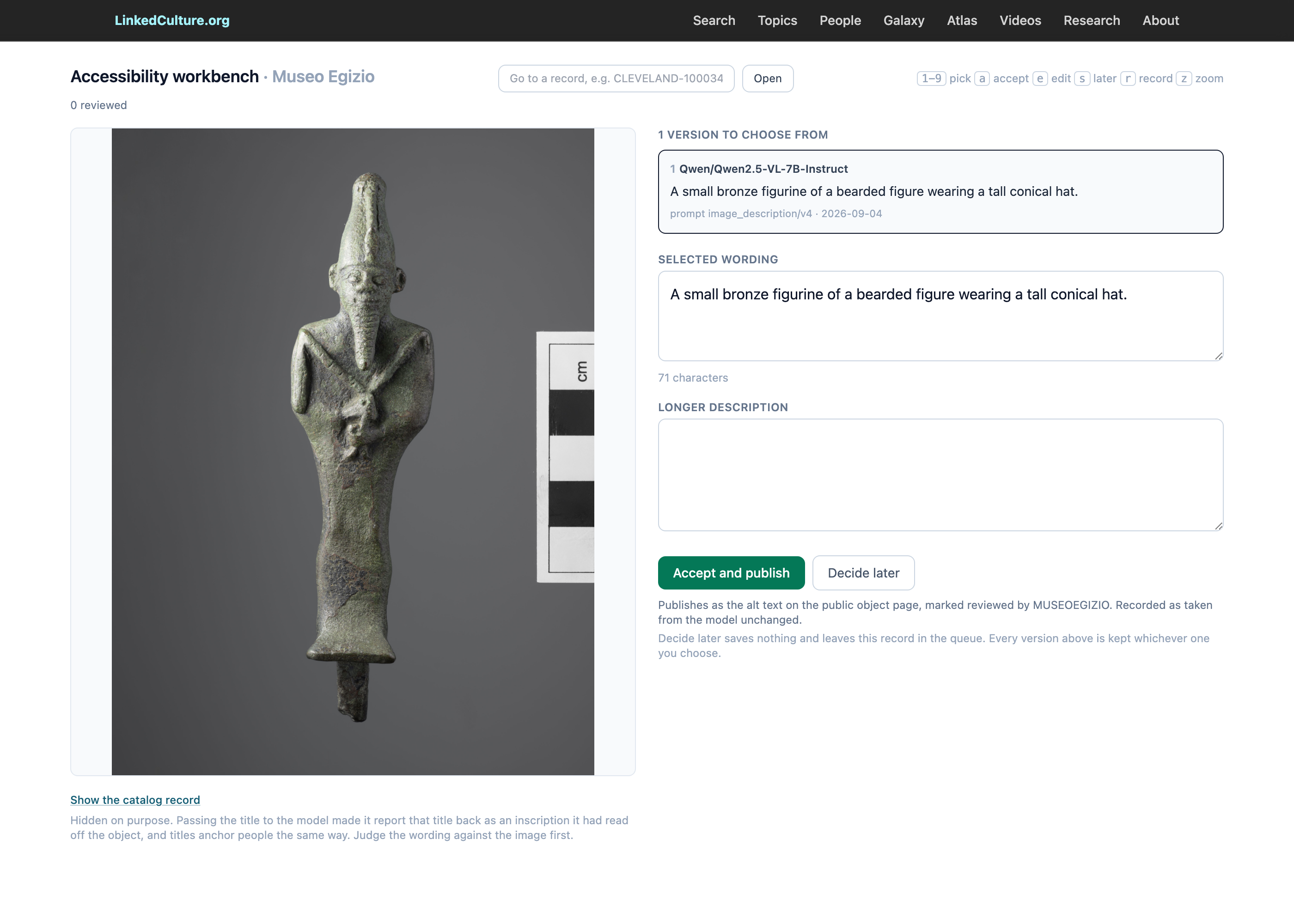
The image takes half the window because a reviewer has to be able to see detail before agreeing that a description is accurate, and a thumbnail will not do. The model and prompt version sit beside the text they produced, so nobody has to go looking for where a sentence came from.
The catalog record is hidden until you ask for it, for the same reason the model never saw it. If you read "Osiris figurine" first, you are more likely to nod along with a description that mentions Osiris. I would rather a reviewer look at the photograph first and the record second.
Then I compared it against the museum's own descriptions
Partway through, I went and read what the Museo Egizio's catalog actually says about these objects, and the comparison did not go the model's way.
Here are both, for one small bronze:
The museum: Standing, mummiform figure of Osiris, wearing a tight-fitting dress which leaves the wrists and hands uncovered. He is wearing an atef-crown with ram horns and uraei flanking each feather. Osiris has a false beard. The arms are bent and the fists, resting side by side on the chest, hold the nekhekh and the heqa-sceptres.
The model: A bronze figure with a headdress and wings holds a staff.
The model read ram horns as wings and a crook and flail as a staff. Whoever wrote the museum's version knew what they were looking at, and it shows in every clause.
About 900 of the 5,228 objects have a description of that quality already. The other 3,310 have nothing in that field except "Museum location: Not on display" and a set of dimensions.
The ratio is what I would take away from this. Roughly one object in six has been described by a person, and the rest have not. Where a curator has already done the work, a model this size is worse and has no business competing. Where nobody has, the model's description is the only one that exists, and something plain and imperfect beats silence.
The catch is that a model cannot tell you which of its own descriptions is the one that says wings instead of ram horns. Catching those is the job I would want a person doing, and it is a much smaller job than describing five thousand objects from scratch.
A problem you can check on your own site in two minutes
There is a second issue here, separate from the descriptions, and I would encourage you to look for it in your own collection.
The Museo Egizio's object images are published like this:
<img src="ph-gallery.png" alt="" style="background-image: url('/public/objects/images/001R6V_....jpg')">Every one of the eight images on the page I checked follows the same pattern. The photograph you see is a CSS background image, and the element carrying it has an empty alt attribute.
Both halves cause trouble. An empty alt attribute is not the same as a missing one: it tells a screen reader the image is decorative and should be passed over without comment. And a background image is treated as presentation by assistive technology no matter what the alt attribute says, so even a good description sitting on that element would struggle to reach anyone.
The effect is that the photographs are outside the accessibility tree, including the 900 or so that the museum has already described well. The descriptions exist. They are simply not attached to anything a screen reader will announce.
I should say that I got this wrong myself on the first pass. I saw placeholder images with empty alt attributes, assumed they were loading skeletons, and concluded I had not managed to measure anything. They were not skeletons, they were the objects. An automated accessibility audit would reach the same conclusion and cheerfully report a page with no images on it, which is why it took someone opening the inspector to find it.
If you want to check your own site, that is the test: open an object page, right-click the image, inspect, and see whether the picture is in the src or in a style attribute.
Where the descriptions go next
Alt text is why I started. The second use may end up mattering more to you.
LinkedCulture searches eleven museums at once, with a keyword index and a semantic index. Both of them read the museum's cataloging: title, maker, material, culture, department, date. Every one of those fields records what an object is. None of them records what it looks like.
So you can search half a million objects for "a figure with crossed arms holding a crook and flail" and get almost nothing back, even though the corpus is full of them. Catalogs are not written that way, and there is no reason they should be. A catalog record exists to identify an object, not to picture it.
The generated descriptions become a third index alongside the other two, carrying their own attribution so a result can say which index matched and whether the text behind it was machine-written or checked by the museum.
Which means a bad description costs you twice. A model that decides an object contains a boat will make that object findable under "boat", for everyone, until somebody notices. If you needed a second argument for having a person review this, this is it.
What I would offer the Museo Egizio, or you
The descriptions are of their objects, so they can have all of them in whatever format is useful, whether or not they want anything else to do with me.
If they do want to review them, there is an account on the workbench scoped to their records: the screen above, with their collection in it. Staff accept a description, edit it, or write their own, and anything they approve exports as CSV or JSON with the provenance on every row, so it can go back into their own system without losing track of where each sentence came from.
I would like the review to happen for a reason beyond the alt text, and this is where I would genuinely welcome collaborators. Every decision a reviewer makes gets recorded: whether they took the machine's wording, edited it, or threw it out, and how far the published text moved from what was offered. Published evaluations of machine descriptions compare them against reference descriptions, which really only tells you whether one machine sounds like another. As far as I can find, nobody has published how often a museum professional, looking at the image, accepts what the machine wrote. Five thousand objects reviewed by the people who cataloged them would answer that question for the first time, and the museum would be an author of the result rather than a subject of it.
Why one collection rather than a sample
I worked smallest first, on purpose. A corpus that is forty percent described is not a claim anyone can act on. A finished collection is one you can check: every image the Museo Egizio publishes now has a description, and you are welcome to go and look.
It also meant the first result arrived in an afternoon instead of a month, on a collection small enough that a person could realistically read through it. The larger institutions are running now, and I expect them to be less tidy.
---
Descriptions generated 2026-09-04 with Qwen2.5-VL-7B-Instruct on rented hardware, from the photograph alone. All are marked machine-generated and unreviewed. If you work at the Museo Egizio, or at any museum in the collection, and would like your records or an account to review them, write to contact@EdwardMonk.com. Costs across different collection sizes are in What automated image descriptions cost.