Research note · November 1, 2026
One road, five museums: Hiroshige's Tokaido on the Atlas
Hiroshige's Tokaido prints are held by five museums. The Atlas puts them on one road, station by station: 40 of 55 stops have prints from two or more collections. How they were matched, and where the matching ran out.
linkedcultureatlashiroshigeukiyoegeocodingculturalheritageprintseries
Hiroshige's Fifty-three Stations of the Tokaido is spread across museums that do not link to each other. Chicago has most of it, Harvard, Cleveland, the Met and Minneapolis have more, and every sheet is its own record. None of those catalogs holds the road. I rebuilt it for the Atlas from the titles, so the prints from all five museums now sit on one trail, station by station.
One trail, several museums
Forty of the 55 Tokaido stops have prints from two or more museums, and 13 have three or more. Okazaki, stop 39, has four: Chicago, Cleveland, Harvard and Minneapolis. Open it and you can compare each museum's impression of the same station side by side.
The Kisokaido is thinner. Only 4 of its 30 covered stops have more than one museum.
What is live
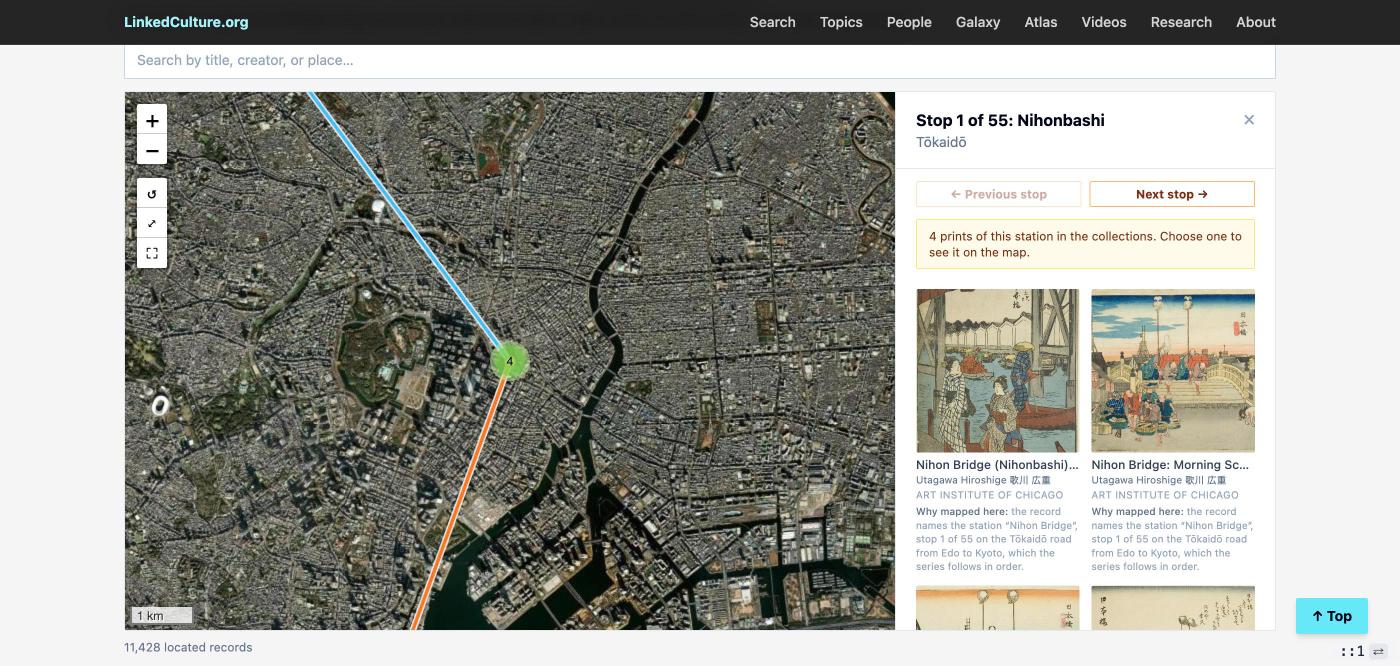
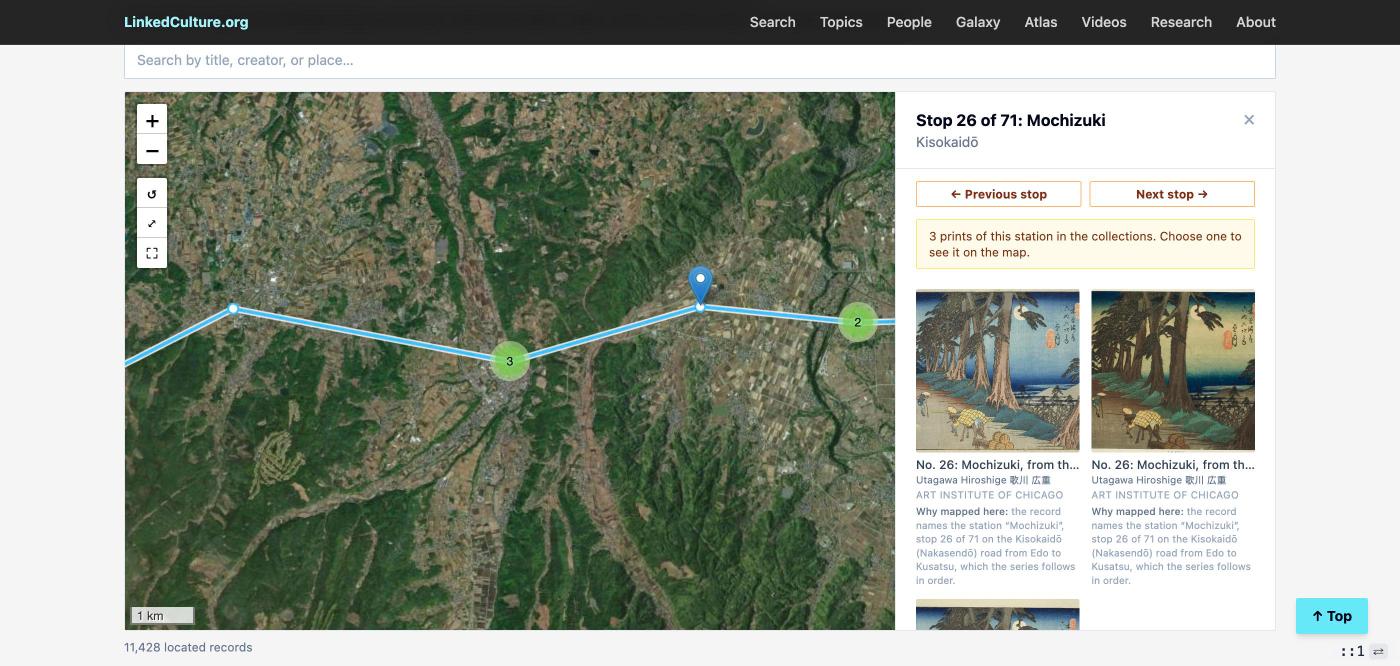
The Atlas has a filter called Journeys in order. It draws two roads, the Tokaido from Edo to Kyoto and the Kisokaido through the mountains, with a dot for each stop. Select a dot and a side panel lists every print of that station, with Previous stop and Next stop buttons. Choose a print and the map moves to it.
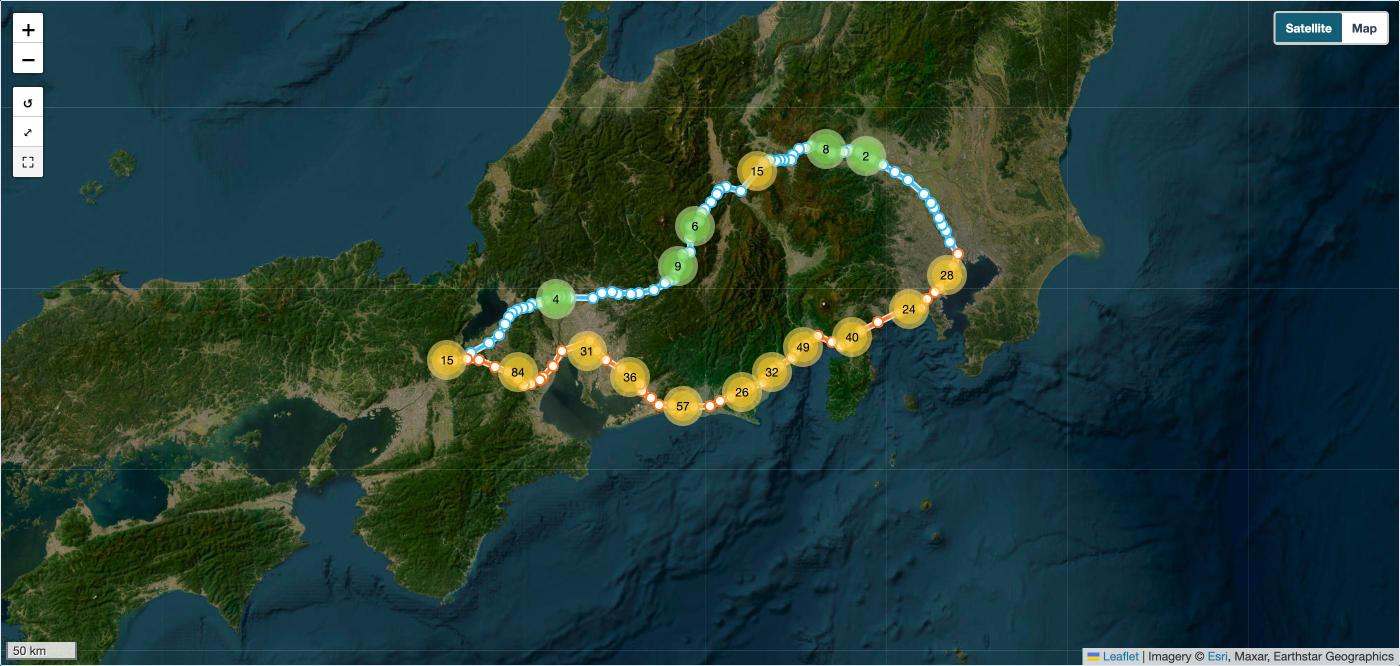
Each road and each stop has its own address, so you can link to the one you want. Three places to start:
- Stop 1 of the Tokaido, Nihonbashi, the bridge in Edo where the road begins, with four prints
- Okazaki, stop 39, the stop with the most museums
- Kutsukake, stop 20 of the Kisokaido, where the two prints are by Keisai Eisen and not Hiroshige
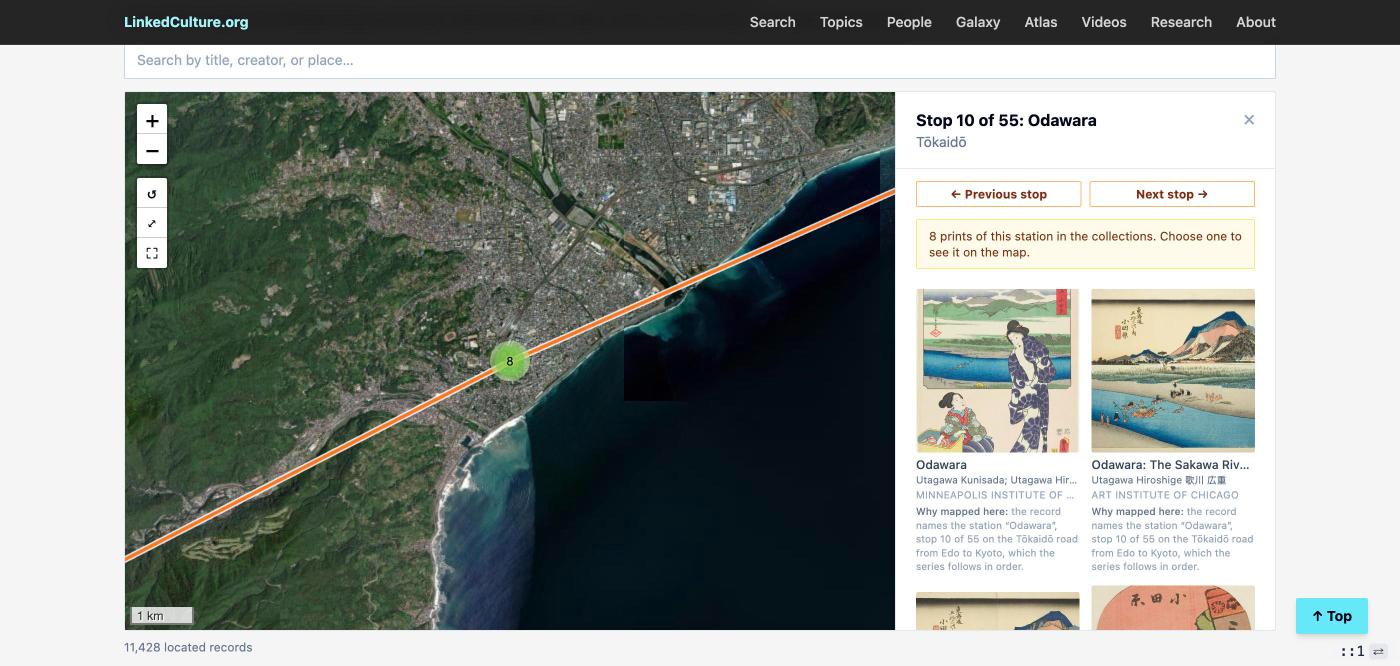
A stop is the post town, not the spot the artist drew from. A print of the Sakawa River at Odawara sits on the town, not on the river.
Some history
The Tokaido was the main road between Edo and Kyoto. Hiroshige's Hoeido edition, published in 1833 and 1834, has 55 prints: one for each of the 53 post stations, plus Nihonbashi where the road starts and Kyoto where it ends. The publisher was Hoeido. The first print was issued jointly with Senkakudo, and Hoeido handled the rest alone. Hiroshige travelled the road in 1832 with an official delegation escorting horses presented to the imperial court. Scholars still argue over whether he drew every station from life. His view at Ishibe is almost identical to an illustration in a guidebook from 1797, the Tokaido meisho zue. [1]
That edition is one of about 30 Tokaido series Hiroshige made, in different sizes, designs and numbers of prints. If you open a stop and wonder why you see a vertical print, a cut-out sheet and a Hoeido print side by side, this is the reason.
The Kisokaido, also called the Nakasendo, was the alternative route between the same two cities, a mountain road through central Honshu with 69 post stations. The print series followed Hiroshige's Tokaido. Keisai Eisen began it. He designed the first 11 prints, from Nihonbashi to Honjo, and a number of later stations, 24 in all, and Hiroshige designed the other 47. There are 71 prints in total: the 69 stations, Nihonbashi, and a second print for Nakatsugawa. The publisher changed partway, from Takenouchi's Hoeido to Iseya Rihei's Kinjudo. [2]
The signature on an Eisen sheet is a cataloging question. A Museum Wales record for his Itahana print says that in the first edition, sold as a single sheet, it carried his signature, and when the series was later issued as a complete set his name appeared only on the outer wrapping. [3] If you catalog a later impression, check the creator against the design and not only the signature. On the Atlas, Eisen is named on four stops with prints: Itabana, Kutsukake, Shiojiri and Nojiri. Everything else on the Kisokaido is credited to Hiroshige. The Tokaido is his alone.
How prints were matched to stops
The station names, their order and their positions come from Wikipedia's lists of the prints and of the post stations. [1] [2] A few positions had no coordinates there, and I filled those in by hand. Each record is placed at the station its title names. Museums romanize the names differently (Sakanoshita and Sakashita, Futakawa and Futagawa, Kambara and Kanbara), so the match allows for those spellings. Records that do not name one station, such as whole albums, volumes and title pages, are left out.
| Road | Stops | Stops with a print | Prints |
|---|---|---|---|
| Tokaido | 55 | 55 | 418 |
| Kisokaido | 71 | 30 | 48 |
The Tokaido has 53 stations plus Nihonbashi and Kyoto at the ends. The 418 prints come from the Art Institute of Chicago (353), Harvard (32), Cleveland (14), the Met (13) and Minneapolis (6). The 48 Kisokaido prints come from Chicago (42), Cleveland (5) and the Met (1).
What the counts mix
The busiest stop is Okazaki with 14 prints, then Okitsu and Yoshiwara with 12 each. A stop's list combines different series (the Hoeido Tokaido, the vertical Tokaido, the cut-out sheets) and several impressions of one design. Chicago alone has three impressions of "Odawara: The Sakawa River" under three accession numbers, for example ARTIC-18253. [4] Each is a separate object, so each is listed.
Where the matching ran out
Forty-one of the 71 Kisokaido stops have no print, and the panel says so. The first 11 are among them, Nihonbashi to Honjo, the run Eisen designed. That may be a coincidence of what the nine collections hold, or the sheets may be cataloged under titles my matching did not read. I have not checked. Beyond that run, I have not worked out how many are sheets none of the nine collections hold and how many are titles my matching missed. Chicago's 42 prints cover 30 stations, so I suspect the first for most of them, but that is a guess.
Stop numbers follow the road, with Nihonbashi as stop 1. Print numbers in titles do not always agree with that or with each other. ARTIC-25850 calls Okazaki "No. 39", while a Harvard record for the same station reads "No. 38". [4] [5] I matched on the place name for that reason.
On the artist's page
The roads also appear on the artist's page now. Utagawa Hiroshige lists both journeys with their counts and a link to stop 1, and the page's Written about section lists this note. Keisai Eisen has the Kisokaido. I had not connected an artist's page to the writing and the maps about the same artist before. Seeing them together on one page is useful.
Hiroshige is split across several person records on LinkedCulture (variant spellings, publisher credits, the second and third Hiroshige). I attached the roads to the main one. Merging the rest is a separate job.
If you have a series of your own
Pull 20 records from the series and check whether each title carries the place name in a form you could match without the sheet number. If it does, an ordered route is mostly a list of stations with coordinates. If it does not, the sequence has to come from a field your catalog does not have yet. Find that out before promising anyone a walkthrough.
If you would like to talk about building something similar with your collections, get in touch at contact@EdwardMonk.com. No obligation.
The method for placing records on the Atlas is in the earlier note.
References
- [1]Wikipedia, The Fifty-three Stations of the Tōkaidō. Hōeidō edition 1833 to 1834, 55 prints, the 1832 journey with the horse delegation, the doubts about drawing from life, the Ishibe view and the 1797 Tōkaidō meisho zue, about 30 Hiroshige Tōkaidō series, and the list of stations used for the Atlas
- [2]Wikipedia, The Sixty-nine Stations of the Kisokaidō. Publishers, 71 prints, Eisen's first 11 prints and the 24 and 47 split, and the list of stations used for the Atlas
- [3]Museum Wales, Sixty-Nine Stages of the Kisokaido: Itahana. Eisen's signature on the first single-sheet edition and the later complete set
- [4]Object records: Art Institute of Chicago 18253, Art Institute of Chicago 25850
- [5]Harvard Art Museums, object 101838, numbered 38 for Okazaki
In this note
Records
4 objects in the LinkedCulture index. Each page links on to the holding museum.