Research note · November 3, 2026
Matching museum creators to people, with a person making the final call
Most creators in the museum records I index carry a name and no identifier. This is how LinkedCulture splits credit strings, cleans names, searches Wikidata, scores the evidence, and shows both records side by side so a person decides.
linkedculturereconciliationwikidataauthoritymuseumsculturalheritagecollections
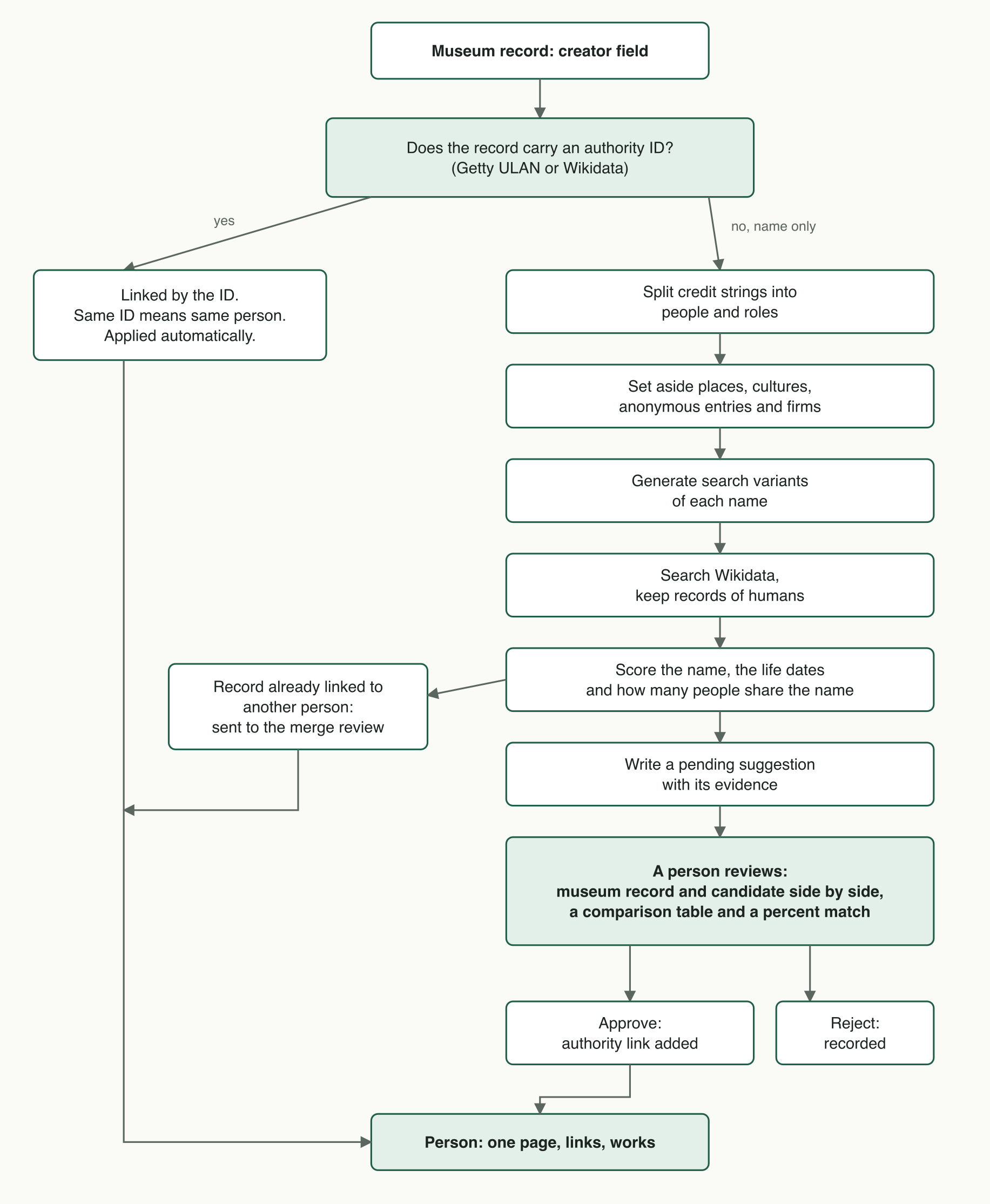
If you manage a collection online, the creator field probably holds three different kinds of thing. Some records carry an identifier, a Getty ULAN or Wikidata ID. Some carry a bare name. Some carry a credit string such as "Gauguin, Paul, Graveur" or "Utagawa Kunisada; Publisher: Fujiokaya Keijirō", which names more than one person and gives each a role. Which of the three you get depends on the museum, and sometimes on the year the record was written.
In LinkedCulture, 30,877 of the 44,342 people in the directory come from records with no identifier, about 70%. A shared ID settles identity for the rest, and I apply those matches automatically. For the 70%, a name is all there is, and a name is weak evidence: many people share one, and the same person is spelled several ways. I wanted to find the right Wikidata record for these creators without letting a name search decide anything by itself.
The flow
Splitting credit strings
In a sample of 300 creators without an ID, about one in five was a credit list, not a name. If your creator field was filled by several catalogers over several decades, expect the same. The splitter reads the forms I found in the data: "Last, First, Role" repeated, as the Paris Musées records write it, "Role: Name" labels, attribution words such as "possibly" and "attributed to", and dates in brackets. It returns one credit per person with the role.
You will want to decide for your own data which credits to skip. "After Rubens" names the model for the work, not its maker. A credit joined with "et", "&" or "and" is probably a firm, and you can set those aside the same way. A string the splitter cannot divide with confidence is searched whole.
Cleaning the name
"Carle (Charles André) Vanloo" is the known name outside the brackets and the real name inside. "Johann Hegi (I)" carries a generation marker, "Capt. Linnaeus Tripe" a title, and "Kawamura Bunpō 河村文鳳" two scripts in one string. Wikidata returns nothing for many of these as written, and you may have noticed your own search box does the same.
For each name I generate a short list of search strings: with the brackets read, the title dropped, the order flipped, the diacritics folded, the scripts separated. On 400 creators whose Wikidata ID I already held, the right record appeared among Wikidata's top results for 89.5% of names searched as written and 94.2% searched this way. It recovered 19 and lost none.
Scoring
Only records that Wikidata classes as human are kept. A label or alias equal to a searched name is the base signal. Birth and death years within three years of the record raise the score. Years more than ten apart remove the candidate. When several different people share the name, each one is lowered. The score is capped at 90%, so a name match never looks as certain as a shared ID.
I tested the whole chain on the same 400 creators with their IDs hidden and no dates supplied. The right record was among the suggestions for 354 of them (88.5%) and ranked first for 326 (81.5%). When exactly one person on Wikidata had the name, the top suggestion was right 240 times out of 250. When several people shared it, the top suggestion was right 86 times out of 131. If you are tempted to apply matches on a name alone, the lower number is the reason I did not.
The review screen
The screen sits behind a login, so here it is as it appears for one real suggestion.
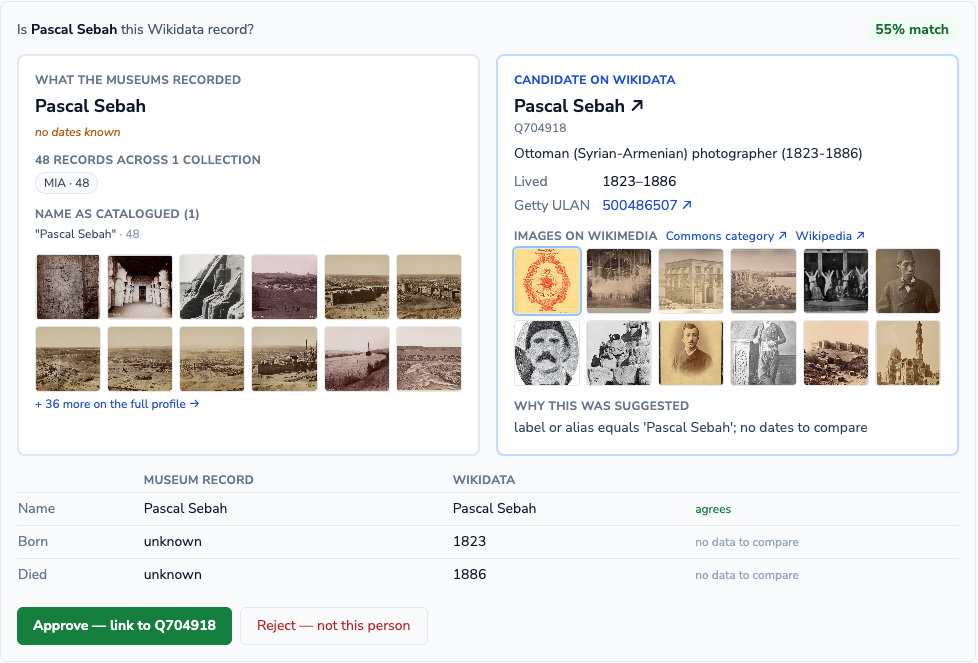
Each suggestion opens as a question you can answer at a glance: is this person this Wikidata record? The left panel shows what the museums recorded: the name as cataloged, with every spelling and how many records use it, the collections involved, up to twelve works as thumbnails, and any life dates. Here that is Pascal Sebah, 48 photographs from the Minneapolis Institute of Art, with no dates on the records.
The right panel shows the candidate: its label and description, life dates, the Getty ULAN record if Wikidata has one, a link to the Wikidata page, and the plain-text evidence for the score. Under that are images from Wikimedia. The first, outlined, is Wikidata's own image for the record. The rest are files Wikimedia Commons credits to that Wikidata item as creator, and when there are too few of those, files from the works sub-categories of its Commons category. I added this after looking at my first version, which had thumbnails only on the museum side and left the reviewer comparing a name to a name. With images on both sides you can see whether the Commons photographs and the museum's photographs look like one body of work. If Wikidata and Commons have no images for the record, the screen says so. Other candidates for the same person are listed underneath.
A table between the two compares name, birth year and death year and marks each as agreeing, differing, or having nothing to compare, so you see where the evidence is thin before you decide. The percent match sits in the corner of the card. This one is 55%. The museum's records carry no dates, so the score rests on the name alone, and the images are what a reviewer has left to go on.
Approving writes the link, and fills in life dates the person lacked. It also closes the other candidates for that person. Rejecting records the decision and the candidate is not offered again. Every decision keeps who made it and when. The people table is rebuilt from the museum records each time reconciliation runs, and the rebuild re-applies approved links. Without that step the next run would have erased them.
If the Wikidata record is already linked to another person in the directory, approval is blocked. The two directory entries may be one person, so the pair goes to the merge review, which shows both with their works side by side. The first trial turned up several of these, a well-known printmaker listed under three separate rows among them.
What I tried and did not keep
I ran a published reconciliation model from a university library group. It picked the right record 91% of the time when the answer was among its candidates, barely above Wikidata's own top hit, and it was confidently wrong on some. I also ran a general name-recognition model as a person-or-not filter. It found about 7% of non-persons my word lists missed and called most of the firms and cultures people. The rules stayed. I use the recognition model offline to find gaps in the word lists.
Try it on your own catalog
Pull 100 creator values from your own catalog at random and sort them: how many carry an identifier, how many are credit lists, how many are places, cultures or firms. Then search twenty of the bare names in Wikidata by hand and count how many give one human record whose dates fit. That count is the share a reviewer could clear in a few seconds each, and the rest is where a side-by-side screen earns its place.
Status on 3 November 2026: the people with ten or more works are being searched and the review queue is filling. One suggestion has been approved so far, the Pascal Sebah one above, so that is the only link in the directory that comes from this process. The test figures above come from 400 creators and skew toward well-known artists.