Research note · July 19, 2026
Museo Egizio joined LinkedCulture.
Museo Egizio is now live in LinkedCulture: 5,228 image-backed Egyptian archaeological records indexed across Postgres, Qdrant, and OpenSearch.
linkedculturemuseoegizioegyptologyopenaccessmuseumtechsemanticsearchopensearchqdrant
Museo Egizio joined LinkedCulture today.
That adds 5,228 image-backed records from the Museo Egizio in Turin to the live search system: archaeological objects, funerary material, amulets, papyri, textiles, sandals, kohl tubes, Osiris statuettes, and many other Egyptian objects that do not sit naturally beside the mostly art-museum collections already in the index.
That last part matters. LinkedCulture is not only trying to make one larger museum search box. It is testing whether a shared retrieval layer can hold different kinds of cultural heritage records together without flattening the institutional record that produced them.
Museo Egizio was a good next test because it was not just another clean JSON API. There does not appear to be a documented public collection API. The public collection site renders an empty search into a useful result set, with structured result data embedded in the page and object detail pages behind each result. That meant writing a small source adapter that respectfully fetches the search page, extracts the embedded result list, and then fetches each object page slowly enough not to punish the museum's site.
The source search returned 5,483 object entries. LinkedCulture loaded 5,228 of them into Postgres. The 255 skipped records were not ingestion failures; they were filtered by policy because this public interface did not expose a usable image for them. Of those, 231 had no thumbnail in the search result data, and 24 had a thumbnail but did not produce a usable primary full image during transformation.
The mapped fields are unusually useful for archaeological search. The adapter preserves title, object type, period, date, material, provenance, acquisition, image URL, and source URL. Acquisition was important enough to become its own field in Postgres instead of being folded into provenance or description. "Purchase Bernardino Drovetti, 1824" and "Excavation Ernesto Schiaparelli, 1906" are not the same kind of information as where an object was found or how it is described.
The final coverage was strong:
total records: 5,228
title:         5,228
object type:   5,228
culture:       5,228
description:   5,228
image URL:     5,228
source URL:    5,228
period:        5,226
medium:        5,227
provenance:    5,226
acquisition:   5,219
date:          5,060
The data path is now deliberately two-phase. Postgres is the source of truth for normalized museum records. Qdrant receives the semantic vectors. OpenSearch receives the keyword documents. That separation became visible during this ingest: the existing keyword build path could rebuild from Qdrant payloads, but that is the wrong dependency direction for incremental collection work. So this ingest also added a source-scoped Postgres-to-OpenSearch indexer.
The result is cleaner operationally. Museo Egizio was loaded once into Postgres, embedded once into the multilingual v2 Qdrant collection, and indexed once into the OpenSearch keyword index directly from Postgres. No full rebuild was needed.
The live counts after indexing:
Postgres museum_records:        5,228
Qdrant multilingual v2 points:  5,228
OpenSearch keyword v2 docs:     5,228
LinkedCulture institutions:        10
LinkedCulture total records:   525,298
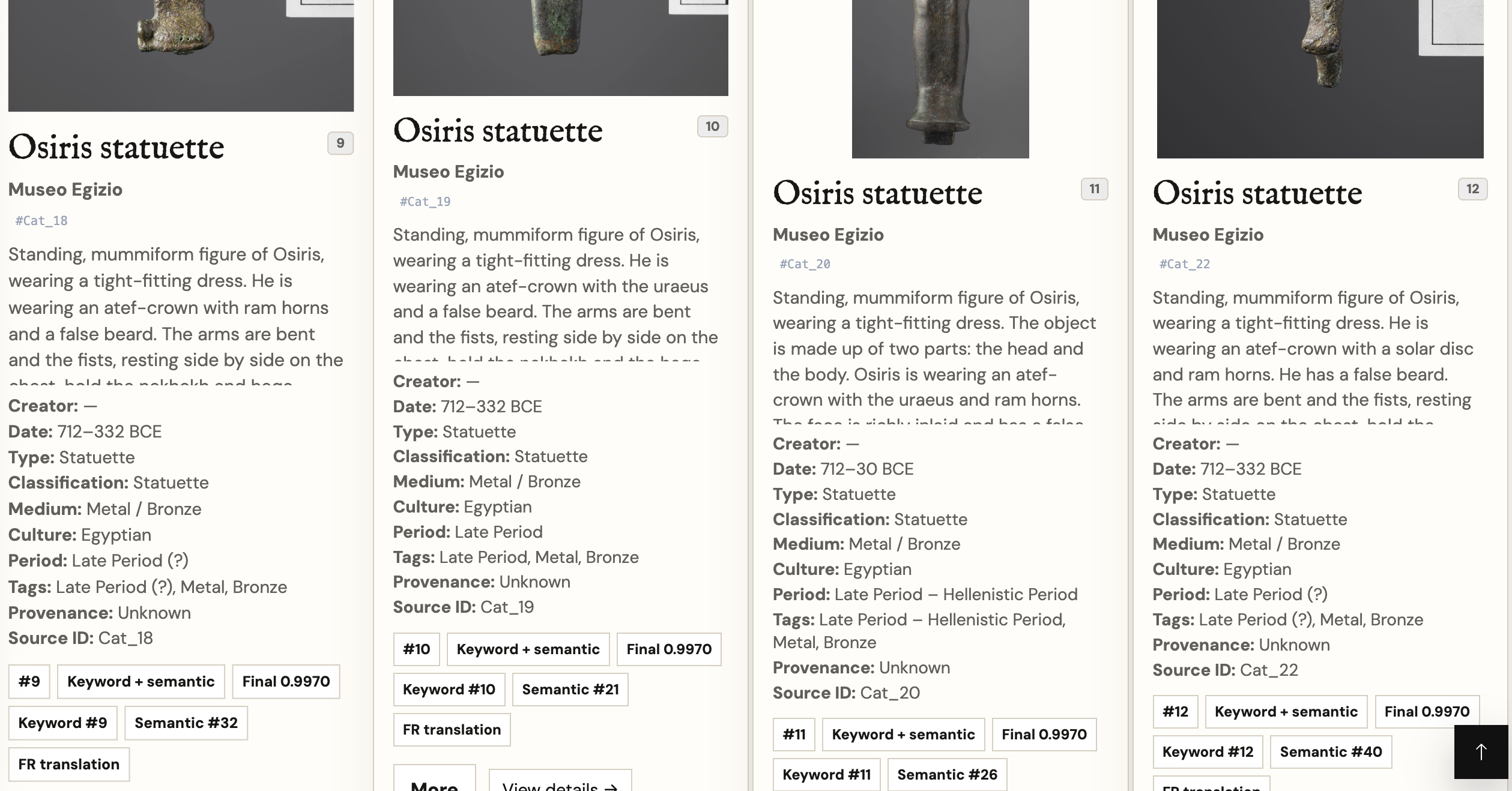
The validation query was deliberately plain: bronze Osiris statuette.
The live hybrid service returned Museo Egizio records at the top, matched by both keyword and semantic search. The first result was MUSEOEGIZIO-Cat_45, an Osiris statuette dated 712-332 BCE, medium "Metal / Bronze", with the source record still linking back to Museo Egizio.
That is the point of the architecture. The object remains Museo Egizio's record. LinkedCulture does not replace the museum catalogue. It creates a retrieval layer where that bronze Osiris statuette can appear beside Egyptian, Mediterranean, funerary, ritual, and material-culture objects held elsewhere, using both exact metadata and semantic proximity.
This also changes the shape of the collection. LinkedCulture now includes ten institutions and more than 525,000 records. Museo Egizio is not the largest source by count, but it adds a distinct archaeological center of gravity. A search for "linen tomb clothing", "Late Period bronze", "Deir el-Medina", or "objects made for the dead" now has a richer set of possibilities.
That is what international retrieval should feel like: not a single aggregator voice, but many institutional records made searchable together without hiding where they came from.
Explore it: https://linkedculture.org/