Research note · August 14, 2026
The Blue Bird probe.
A Jean Paul Gaultier dress from Paris Musées revealed that multilingual embedding and cross-lingual retrieval are not the same thing. This is how that finding changed LinkedCulture.
linkedculturesemanticsearchculturalheritagemultilinguallanguagepartitioningdigitalhumanitiesopenaccess
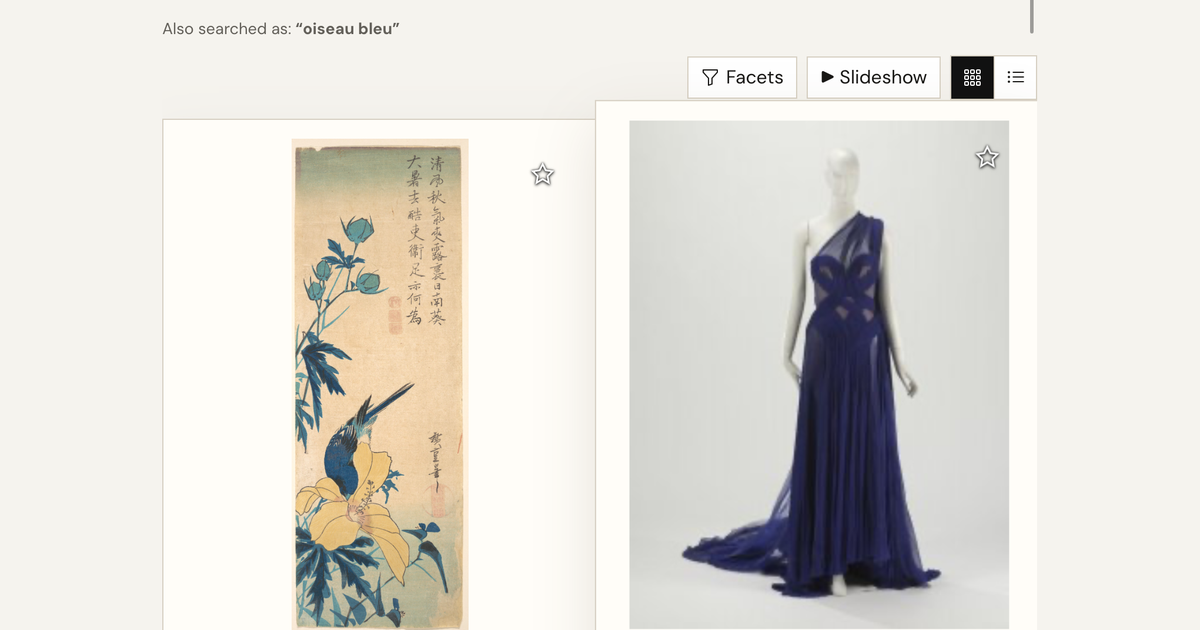
Search results for "blue bird" in LinkedCulture with multilingual retrieval enabled. The system also searched "oiseau bleu," surfacing the Hiroshige print from the Met alongside the Gaultier dress from the Palais Galliera. Try it yourself.
The finding that became Paper 3 began with a dress.
When LinkedCulture expanded to include Paris Musées, a large French-language collection entered the index for the first time. Among the records was a Jean Paul Gaultier gown from the Palais Galliera titled L'Oiseau Bleu. The record was exactly the kind of discovery LinkedCulture was built to surface: an object from a museum the researcher had not known to look in, surfacing through exploratory search, connecting to a broader cross-institutional environment.
L'Oiseau Bleu means "blue bird" in English. The language differs. The concept does not.
Under the assumption built into the system at that point, a multilingual embedding model should have placed a French record titled L'Oiseau Bleu close enough to an English query for "blue bird" that the two would find each other. That is what multilingual embeddings are understood to do.
That did not happen.
A French query for "oiseau bleu" reached the French record at 0.45 cosine similarity. An English query for "blue bird" reached only 0.23. The model reached the French record far better from French than from English. And this was not an isolated quirk of one query or one dress. It was the surface of a systematic finding.
What the probe revealed
The observation became a research question: does a multilingual embedding model create a unified semantic space for cultural heritage metadata, or does it create a space that remains partitioned by cataloging language?
The answer, documented in detail in Paper 3, is the latter.
Using nearest-neighbor analysis over 302,798 records, French records' nearest neighbors were 99.9% French, despite French records comprising only 17.0% of the corpus. English records showed the inverse. The cross-language cost was substantial: within-language nearest neighbors averaged around 0.91 to 0.93 cosine similarity, while cross-language nearest neighbors averaged around 0.70 to 0.84. That gap is large enough that cross-language links rarely become strong enough to form shared neighborhoods.
The language partition is visible in the galaxy visualization. The French-language institutions appear as a detached continent rather than as integrated regions of the broader corpus. Paris Musées and Joconde sit close to each other. English-language institutions, despite substantial differences in subject matter, sit closer to one another than to the French bloc. The partition is language, not content.
What a model swap could and could not fix
The natural response was to try a better model. Five candidate multilingual embedding models were tested: e5-small, e5-base, e5-large, bge-m3, and qwen3-0.6b.
Initial pairwise tests looked promising. Several models showed 81 to 94 percent pairwise cross-lingual reach, suggesting that they moved records closer across languages in controlled comparisons. e5-base narrowed the cross-language cosine gap substantially, raising French-to-nearest-English similarity from 0.665 to 0.868.
But within-language similarity rose in parallel to 0.963. Same-language neighbors remained closer. The cluster partition held. And in full retrieval ranking over the test corpus, every candidate model scored between 0 and 1 relevant French documents in the top 10 for English-to-French queries.
Under e5-base, the top results for the English query "blue bird" remained entirely English-source records from the Art Institute of Chicago, the Cleveland Museum of Art, the Met, Harvard, and the Getty. L'Oiseau Bleu remained outside the top 50. English-to-French recall at 10 was 0 of 94 relevant judgments.
Nearer is not the same as retrievable.
What actually worked
The solution was simpler than the model bake-off suggested.
Translate the query.
When an English query for "blue bird" failed to surface L'Oiseau Bleu, translating the query into French and searching for "oiseau bleu" moved the query into the French-language region of the embedding space. The French query reached French records directly. When the English and French result sets were merged, the system returned a complete cross-language result.
This does not fix the document space. The corpus remains partitioned. French records remain close to French records. English records remain close to English records. Query translation simply asks the question again in the language of the relevant region of the corpus.
The practical lesson is that cross-lingual discovery is an orchestration problem, not a representation problem. The system does not need a smarter map alone. It needs to ask the question again in the languages of the map and merge the answers.
LinkedCulture now translates queries across the cataloging languages present in the corpus and runs retrieval in each language before merging the result sets. A search in English reaches French and Dutch records. A search in French reaches English and Dutch records.
Try it with L'Oiseau Bleu: search "blue bird" with multilingual retrieval enabled.
Why this matters beyond LinkedCulture
The broader implication is direct. Multilingual is not cross-lingual.
A model that can search in many languages does not necessarily connect them in the way that cross-institutional cultural heritage discovery requires. Cultural heritage collections are multilingual by nature, and the conceptual relationships between objects do not respect cataloging language boundaries. A system that appears to work at the interface may remain partitioned underneath.
That partition matters because it determines what kinds of connections the system can surface without intervention. A French fashion object and an English fashion object may describe visually and culturally related material. In a language-partitioned embedding space, they will not neighbor each other. The connection will not be surfaced unless the system actively compensates.
This finding also points toward the next direction for LinkedCulture. If text embeddings remain language-partitioned, one possible path is not better text. It is image. Visual similarity may cross language boundaries in ways that cataloging text cannot, and multimodal representation offers a route that Paper 3 identifies as future work.
The full analysis, with all measurements, model bake-off tables, and retrieval evaluation details, is in Paper 3: Semantic Clusters and Language Partitioning in a Multi-Institutional Cultural Heritage Index. DOI: 10.5281/zenodo.20827946.
This is part of a short series responding to the Met's semantic search launch: the first note covered what changes when that same capability spans ten institutions instead of one, and the second note covered building spelling correction on top of it.
Explore it: https://linkedculture.org/
In this note
Papers cited
Records
1 object in the LinkedCulture index. Each page links on to the holding museum.