Research note · September 17, 2026
The print that every museum owns.
Hokusai's Great Wave sits in at least four LinkedCulture institutions at once, and Rembrandt's Three Crosses in five. That is not redundant collecting. It is what a print actually is, and the record says less about it than it should.
linkedcultureprintmakingculturalheritageprovenancedigitalhumanitiesopenaccessmuseumcollections
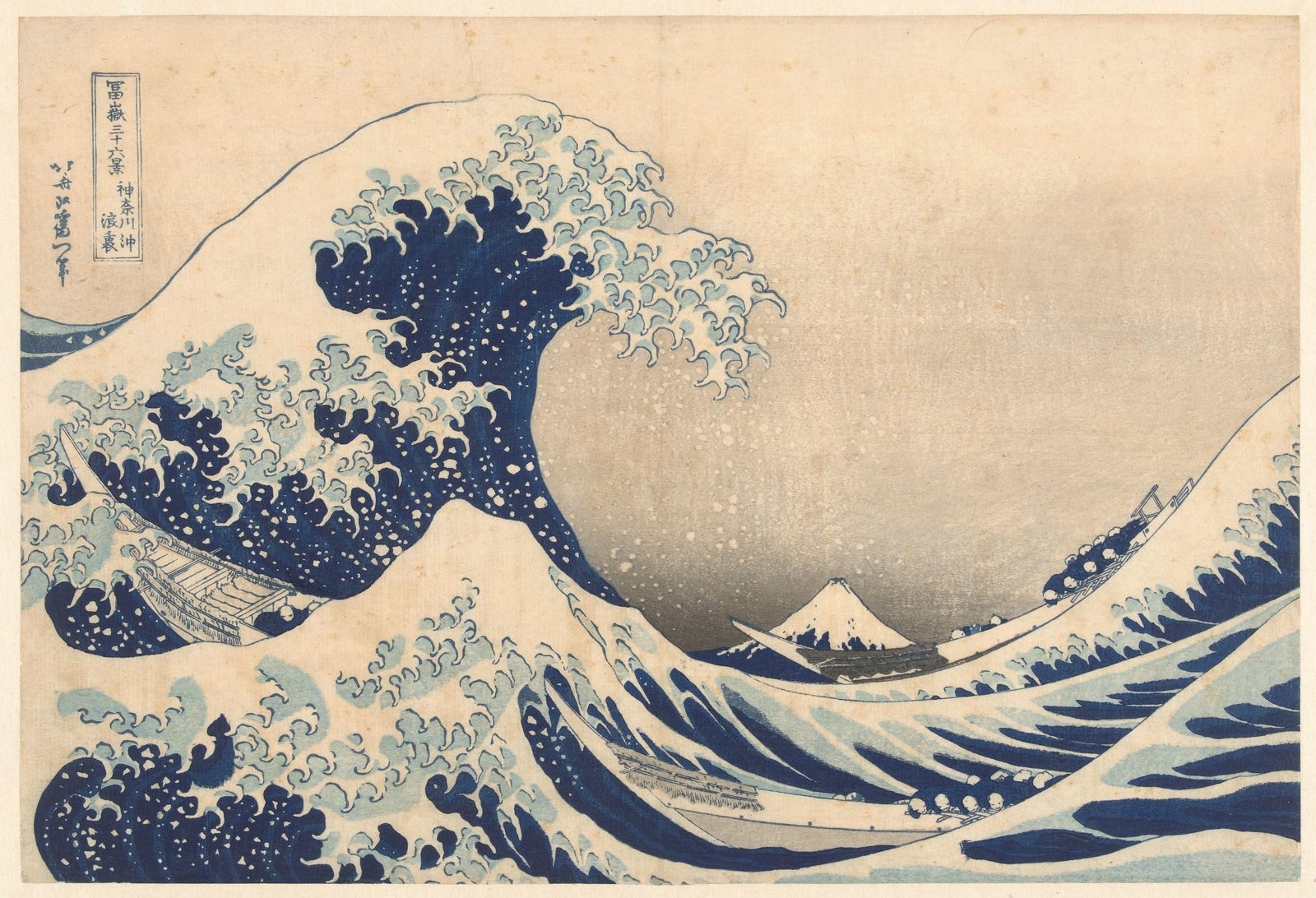
Under the Wave off Kanagawa, ca. 1829-33. This particular sheet belongs to the Rijksmuseum. Three other LinkedCulture institutions hold their own: the Met (twice over), the Art Institute of Chicago (three times), and the Minneapolis Institute of Art.
Search LinkedCulture for Hokusai's Under the Wave off Kanagawa and you do not get one result. You get seven, across four institutions: two at the Met, three at the Art Institute of Chicago, one at the Minneapolis Institute of Art, one at the Rijksmuseum. Search Rembrandt's Three Crosses and the count is six, across five institutions. Search Dürer's Melencolia I and it is six again, across four. Search Goya's Los Caprichos plate one, Self-Portrait, and it turns up five times, across three institutions: twice at the Met, twice at the Art Institute of Chicago, once at the Rijksmuseum.
Several separate museums, none of them lending to each other, each apparently owning the same picture.
That is a fair thing to notice, and worth taking seriously rather than explaining away. But the explanation is not that curators were careless or that acquisition budgets were wasted. It is that a print is not a painting, and the corpus is a good instrument for showing exactly what a print is, and a bad one for showing what actually differs between the copies.
A plate is a machine for making the same image many times
A painting is one object. A print is the output of a matrix, a block or plate or stone, that was built to produce an edition. Hokusai's Great Wave was cut around 1830 for a run historians estimate reached roughly 8,000 impressions before the blocks wore down; only around 110 to 115 impressions from that first edition are thought to survive anywhere today. [1] [2] Museum collections gathering an impression or two at a time were never in competition for a single scarce object the way they would be with a Vermeer. Owning an impression of the Great Wave is closer to owning a first-edition book than owning a unique painting: many institutions can hold a copy of the same edition without any of them holding a redundant one, in the way a dozen research libraries all holding a first edition of On the Origin of Species are not duplicating each other's mistake.
Rembrandt's Three Crosses sharpens this rather than softening it, because the six LinkedCulture impressions are demonstrably not the same object. The Art Institute of Chicago holds two impressions of the drypoint and burin state on paper, dated 1653. The Rijksmuseum's impression of the same title is a different object in a more literal sense than the title suggests: it is not printed on paper at all.
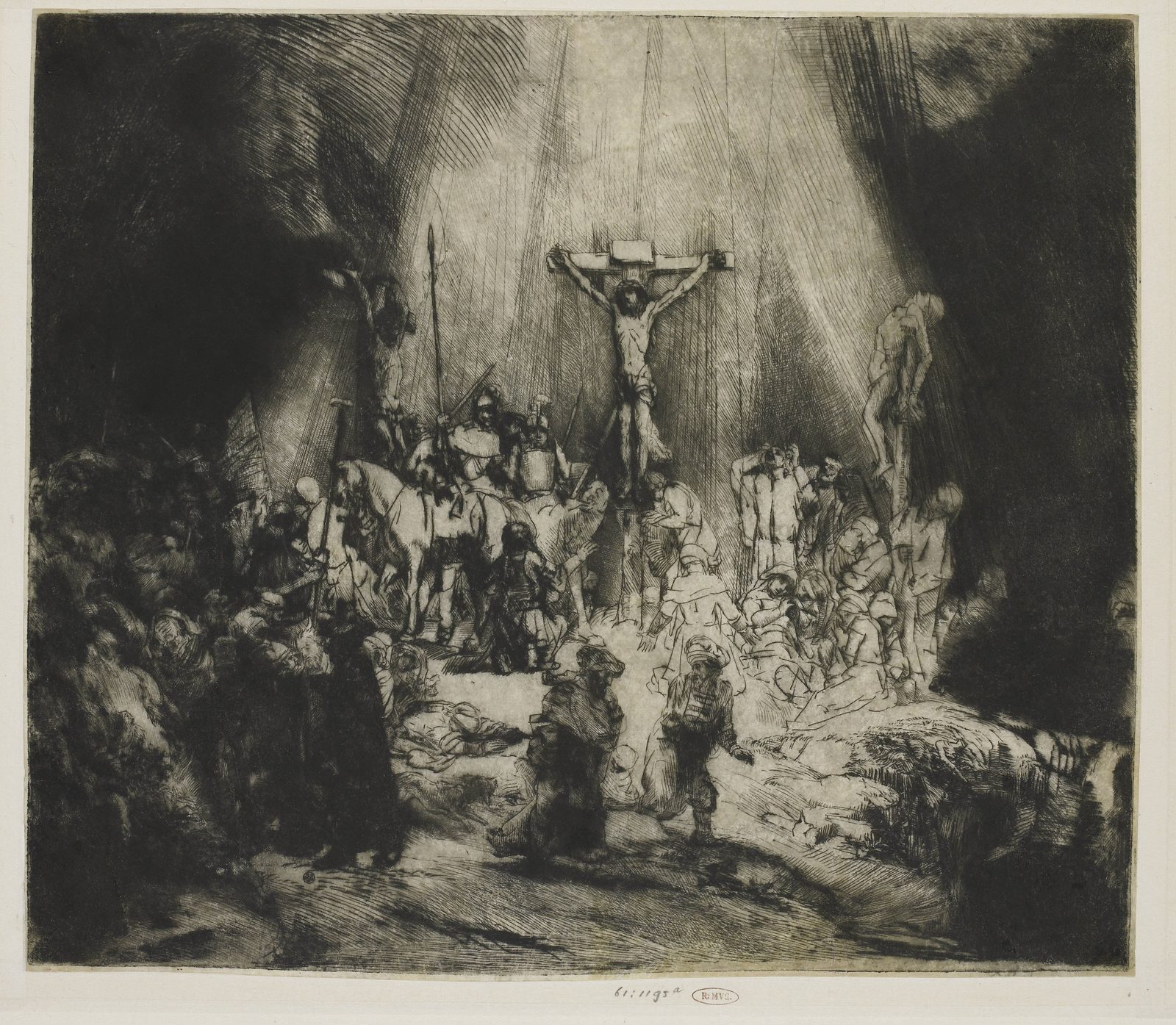
Christ Crucified between the Two Thieves: "The Three Crosses," 1653, printed on parchment, Rijksmuseum. The Art Institute of Chicago holds two further impressions of the same title, both on paper. [5]
Rembrandt reworked the copper plate across four documented states: scraping away a figure moving toward the tomb, repositioning a centurion on horseback in a tall hat, remodeling the group of figures around the Virgin Mary, and casting the right third of the scene into near-total darkness. The changes were so extensive that later print scholars were not certain the early and late states came from the same plate until the following century. [3] Drypoint made this costly to repeat: the technique's burr, the ridge of displaced copper that gives drypoint its soft, velvety line, wears down within about sixty pulls, so a late-state impression is not only compositionally different from an early one, it is printed from a plate already losing the quality that made the first pulls distinctive. [4] A museum holding an early-state impression and a museum holding a late-state impression are not holding the same thing twice. They are holding two different moments in one plate's short working life, and LinkedCulture's own metadata is where that distinction currently goes missing: "print," "1653," "Rembrandt van Rijn," with the state and the support sitting in free-text fields the search treats no differently than an accession stamp.
The same pattern, twice more
Dürer's Melencolia I belongs to a small group art historians call his Meisterstiche, three engravings made within two years of each other: Knight, Death, and the Devil in 1513, then Melencolia I and St. Jerome in His Study both in 1514. [6]
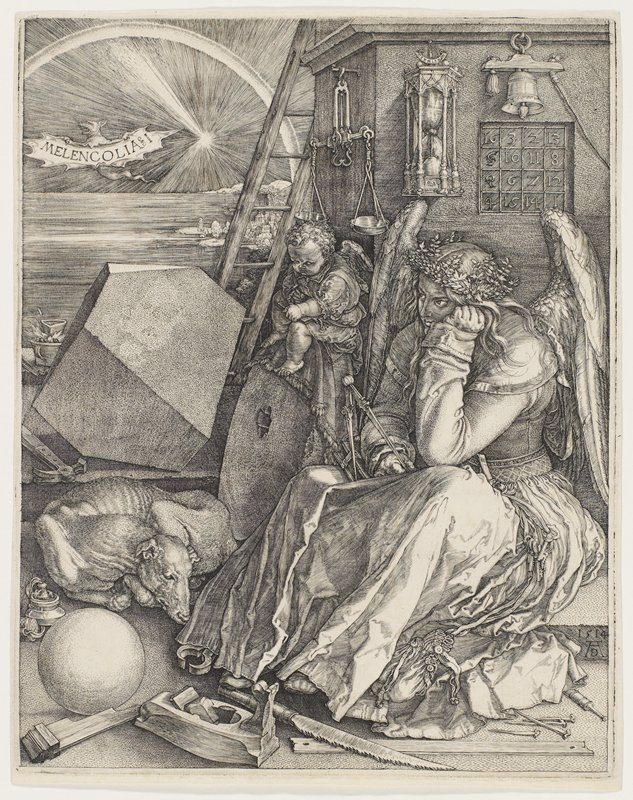
Melencolia I, 1514, engraving on paper, Minneapolis Institute of Art. The Met, Cleveland, and the Art Institute of Chicago, three times over, each hold their own impression.
The engraving shows a winged figure seated among the tools of geometry and craft, a compass, a sphere, a truncated polyhedron, a magic square on the wall behind her, all set down and unused. Four centuries of scholarship have not settled what exactly is being diagnosed: a Renaissance humoral category of intellectual temperament, a portrait of creative paralysis, an allegory of art reaching the edge of what geometry alone can accomplish. The plate has outlasted every reading of it, which may be closer to the point than any single reading is. It has also outlasted any single collection: the same 1514 plate produced impressions that a researcher today can find in four institutions at once, decades or centuries apart in when each one entered a collection, with nothing in any record explaining whether they are early, crisp pulls or later ones already losing detail.
Goya's Los Caprichos is the odd case, because here the duplication is not really about the print. It is eighty etchings satirizing Spanish superstition, vanity, and clerical corruption, and Goya announced the first edition for sale in the Diario de Madrid on February 6, 1799. He had planned to open the series with an image titled The Sleep of Reason Produces Monsters. He swapped it at the last moment for something drier and more dangerous: a sardonic self-portrait of himself in a top hat, captioned only with his own name and title, "Fran.co Goya y Lucientes, Pintor." [7]
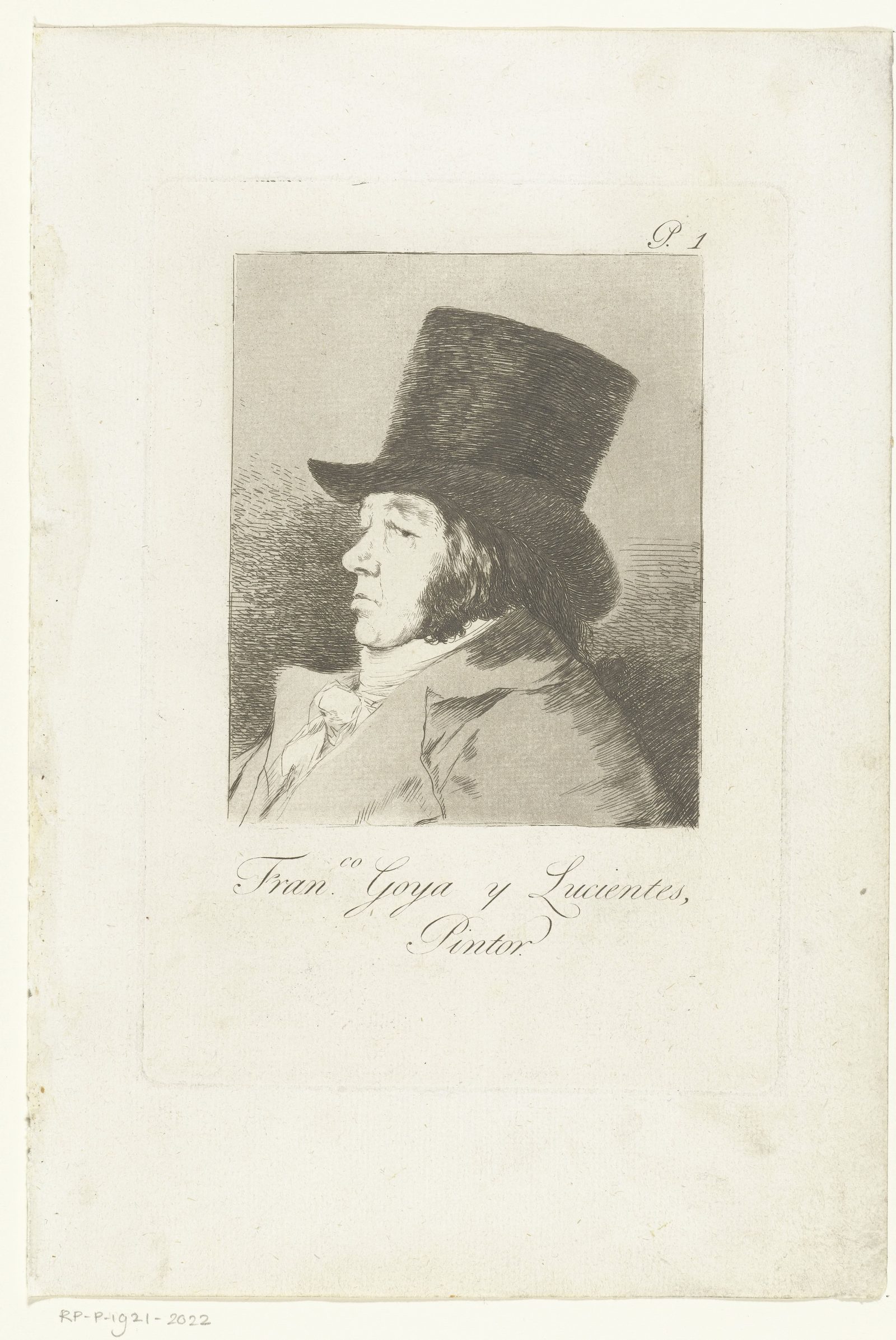
Zelfportret van Francisco Goya, plate one of Los Caprichos, 1797-99, Rijksmuseum, cataloged there by its own series number, 1/80. [8] The Met and the Art Institute of Chicago each hold two further impressions of the same plate.
The set was withdrawn from sale after two days. Goya wrote decades later that he had been reported to the Inquisition, though no surviving trial record says by whom or for what. [7] In 1803, rather than keep trying to sell the remaining stock, he handed the copperplates and 240 unsold sets to King Charles IV. [7] What LinkedCulture shows is not that a self-portrait exists five times by coincidence. It is that a print its own maker all but withdrew from the market, unable to sell more than a fraction of the run, still made it into three separate public collections on two continents, two centuries away from the shop where the Inquisition first heard about it.
What the corpus actually contains
Prints are not a curiosity in this index. Across the roughly 506,000 records LinkedCulture has classification data for, works tagged "print" or "prints" total 24,962, the largest named classification after an unlabeled AAT code that covers a similar bucket. Drawings, by contrast, run under 3,400. The corpus is disproportionately built from a medium whose entire premise is that the same image exists in more than one place, held by more than one institution, on purpose.
That matters, because it means the "why does everyone have this" observation is not an edge case that shows up if you go looking for Hokusai. It is close to the default condition of a twentieth of the collection. Query almost any canonical printmaker who worked in an edition medium, Rembrandt, Dürer, Goya, Piranesi, and the cross-institutional overlap will be the norm rather than the exception.
Where the record actually falls short
None of this means every museum acquisition of a duplicate impression was optimally reasoned, and it does not mean the overlap is costless. It means the interesting question is not "why do several museums own the Great Wave," which has an answer, but "which of these impressions are actually distinguishable, and does the record say so." On that second question, LinkedCulture's current data does not just fall short, it falls short inconsistently, and the inconsistency is the finding.
The corpus classifies prints under two separate labels, "print" and "prints," clearly the product of two different institutions' cataloging conventions rather than two different kinds of object. The two labels behave almost like opposite data sources. Records tagged "print" carry a description 12.6 percent of the time and a provenance field 19.5 percent of the time. Records tagged "prints" carry a description 99.9 percent of the time and a provenance field 0.0 percent of the time, not once across 10,191 records. Combined across both labels, provenance is present on roughly 11.5 percent of everything classified as a print, the field that would say whether an impression passed through a documented print dealer, a known Japanese collection, or an undocumented later reprint run. None of the fields aggregated across either label, edition, state, or impression-generation, exist as a structured value anywhere in the schema. A late, worn impression of the Great Wave, pulled after the blocks had already begun to fade and break in the sky, reads identically in the record to an early, crisp one. [2] Whether an institution even wrote a sentence about its impression depends on which internal cataloging convention produced the record, not on what is actually known about the object.
So the honest version of the starting observation is not "these museums duplicated each other." It is that a handful of independent acquisition histories, made across two centuries by curators who mostly never coordinated with each other, converged on the same canonical prints, for a genuinely edition-scaled medium where that convergence is expected, and the metadata that would let a researcher tell a meaningfully different impression from a genuinely redundant one was never standardized to begin with.
What this is good for
This is exactly the kind of pattern that only shows up once several collections sit in one index. A single museum's catalog tells you nothing about whether its Melencolia I is one of six in reach or the only one a researcher will ever see. Cross-institutionally, the pattern becomes a dataset: which canonical prints cluster across the most institutions, which states and supports those clustered impressions actually carry when you read past the title field, and where the metadata itself is the limiting factor rather than the object. That is close kin to the language-partitioning finding behind Paper 3: the interesting result was never that French and English records used different words, it was what the corpus revealed about what the record does and does not capture once you can query across all of it at once.
The next useful step is not a bigger sample of duplicate titles. It is pulling state and support out of description fields where they already sit, semi-buried, across enough Rembrandt and Dürer records to say something real about how much of the apparent duplication in LinkedCulture is genuine redundancy versus documented print history that the schema was never built to hold.
There is a second-order version of the same finding worth naming. The gap here is not really a data problem inside any one museum's records. It is a coordination problem across records built by different museums, using different classification labels, for the same kind of object. LinkedCulture is not positioned to fix any institution's own cataloging, and does not want to be: the canonical record stays with the institution that holds the object. But indexing ten collections in one place is exactly what makes a pattern like "print" and "prints" behaving as opposite data sources visible at all, something no single museum's own database would ever surface. A shared, even informal, convention among print-holding institutions on how to record state, support, and edition, closer to what library cataloging already does with print runs and editions, would not require centralizing anything. It would just mean the record kept pace with what the object already shows anyone who looks closely at it. That is a case for coordination among institutions, not consolidation of their collections: comparing notes on what fields to keep, not handing catalogs over.
Explore it: https://linkedculture.org/
References
- [1]Original print run for The Great Wave off Kanagawa, estimated at up to 8,000 impressions across its edition. Wikipedia
- [2]Capucine Korenberg, "The making and evolution of Hokusai's Great Wave": a survey of 111 surviving impressions worldwide, and early wear first visible in the print's pink and yellow sky. British Museum
- [3]Compositional changes across the four documented states of The Three Crosses, including the reworked tomb figures, the added mounted figure, the remodeled group around the Virgin Mary, and the darkened right third of the scene. Mildred Lane Kemper Art Museum
- [4]Drypoint burr wear and the roughly sixty-impression working life of a drypoint plate, discussed in the same essay. Mildred Lane Kemper Art Museum
- [5]LinkedCulture object records for the impressions compared: Rijksmuseum, RP-P-1961-1195A, Art Institute of Chicago, 80077
- [6]The three Meisterstiche and their dates. Wikipedia
- [7]The 1799 Diario de Madrid announcement, the swapped frontispiece, the two-day withdrawal from sale, Goya's later account of being reported to the Inquisition, and the 1803 transfer of plates and unsold sets to the crown. National Gallery of Victoria
- [8]Rijksmuseum catalog entry identifying RP-P-1921-2022 as plate 1, series number 1/80, of Los Caprichos. Rijksmuseum
In this note
Records
6 objects in the LinkedCulture index. Each page links on to the holding museum.