Research note · July 18, 2026
Why LinkedCulture exists.
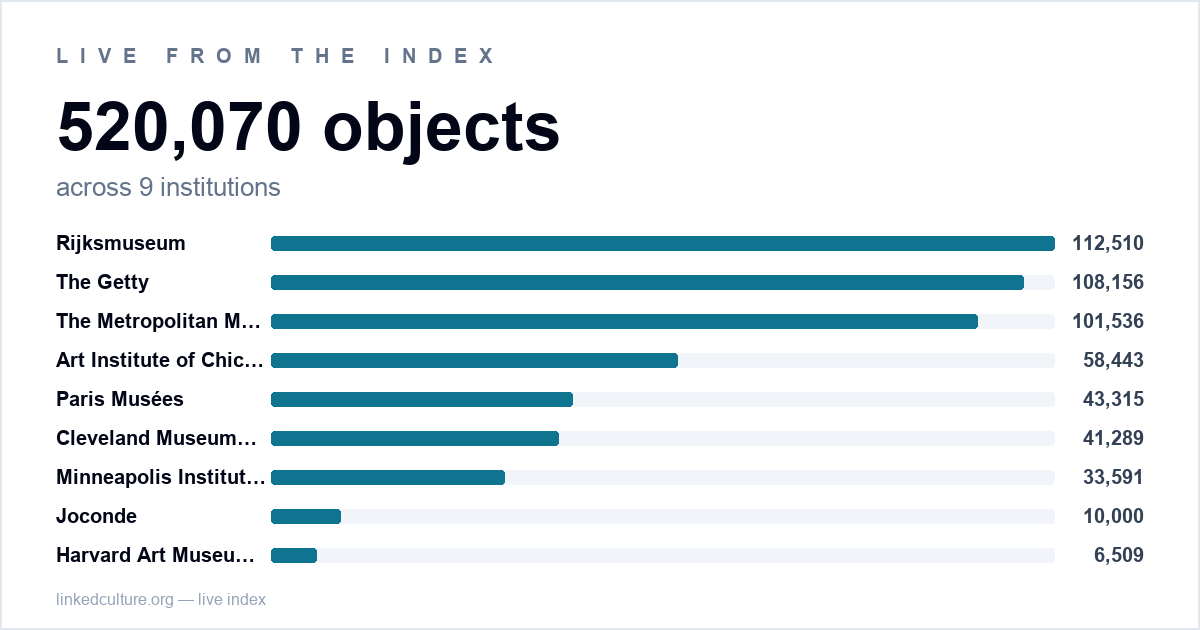
LinkedCulture has crossed 500,000 objects across nine institutions. This is why it exists, what it is trying to do, and who it is for.
linkedcultureculturalheritagemuseumtechopenaccessdigitalhumanitiessemanticsearchmission
LinkedCulture has crossed 500,000 open-access objects across nine institutions. This is a good moment to say plainly what this project is for.
The world's great museums, libraries, archives, and cultural institutions hold an extraordinary record of human civilization. Much of it is now digitized. Much of it is openly licensed. Each institution has its own search, and many have built excellent tools for exploring what they hold.
What has never existed is a way to ask a single question and receive an answer drawn from all of them at once, across institutions, across countries, across the boundaries of how each institution chose to describe what it holds.
Cross-institutional discovery is not a new idea. The Digital Public Library of America aggregates metadata across U.S. collections [1]. Europeana does the same across Europe [2]. Both are significant achievements. What LinkedCulture adds is the semantic layer across both, and across the boundary between them. A query does not stop at a national border. A Persian textile does not stop at a national border. The connections between what institutions hold have never respected those boundaries, and neither does this system.
There is also Linked Art, the CIDOC-CRM based data model [3][4] behind projects like Yale's LUX [5], which connects collections through explicit, curated relationships: this object was made by this person, who was influenced by this movement. That is a different and valuable kind of connection. It also asks institutions to first model their holdings as structured linked data before anything can be joined, a significant curatorial investment that so far only a small number of institutions have made at the scale of a full cross-collection platform [5]. LinkedCulture starts from the metadata institutions already have, however inconsistent, and asks a different question. Not what is this formally connected to. What does this mean.
The deeper problem is the kind of questions people actually bring to cultural heritage: not "Nataraja" but "a deity in motion." Not "funerary object" but "things made for the dead." Not "Dutch Golden Age portraiture" but "the way grief looks when it is performed for an audience."
These are not exotic queries. They are the natural language of anyone trying to think seriously about human culture across time. Keyword search, however well implemented, was not designed for them. LinkedCulture is an attempt to build the layer that is.
The system works by embedding every object record as a vector, a mathematical representation of its meaning, and indexing those vectors in a unified cross-collection store. When you search, you are not matching keywords. You are finding objects whose meaning is close to the meaning of your query, across nine institutions at once, regardless of how each institution chose to describe what it holds.
The result is that a Persian textile at the Art Institute now sits beside its kin at the Met and the Rijksmuseum, discoverable together for the first time. That Van Gogh works from Amsterdam, New York, and Chicago appear in the same search. That the iconography of Durga crosses from a 2nd-century Kushan relief to a 10th-century Angkor bronze in a single result set.
Every object still links back to its home institution. The canonical record always stays with the museum that holds it. LinkedCulture does not replace any institution's catalogue. It surfaces the relationships between what they collectively hold.
This project is independent, open source, and free. It is funded by nothing yet beyond the time of one person and a modest infrastructure budget. The goal is to keep it that way, supported by grants and institutional partnerships rather than subscriptions or paywalls.
The next step is building the partnerships that let this grow: more institutions, more languages, more kinds of collections. Your metadata does not have to be clean, complete, or already modeled as linked data. That is the point. LinkedCulture is built to work with collections as they exist today, not as they would need to become first. If you work in cultural heritage, digital humanities, library science, or archival research and you see what this is trying to do, I want to hear from you.
Explore it: https://linkedculture.org/
The research behind this project is documented in a growing paper series:
Paper 1: Discovery architecture for cultural heritage: layered retrieval, institutional authority, and the limits of keyword search https://linkedculture.org/research/discovery-architecture-for-cultural-heritage
Paper 2: Embedding cultural heritage metadata https://linkedculture.org/research/embedding-cultural-heritage-metadata
Paper 3: Semantic Clusters and Language Partitioning in a Multi-Institutional Cultural Heritage Index https://linkedculture.org/research/semantic-clusters-language-partitioning
Learn more about LinkedCulture and the work behind it: https://linkedculture.org/
References
- [1]Digital Public Library of America. n.d. About DPLA. Accessed 2026. https://dp.la/about
- [2]Europeana Foundation. n.d. About Europeana. Accessed 2026. https://www.europeana.eu/en/about-us
- [3]Linked Art Community. n.d. Linked Art: A Linked Data Model for Cultural Heritage. Accessed 2026. https://linked.art/model/
- [4]CIDOC CRM Special Interest Group. n.d. CIDOC Conceptual Reference Model. Accessed 2026. https://cidoc-crm.org/
- [5]Yale University Library. 2023. LUX: Yale Collections Discovery. Accessed 2026. https://lux.collections.yale.edu/