Art Institute of Chicago
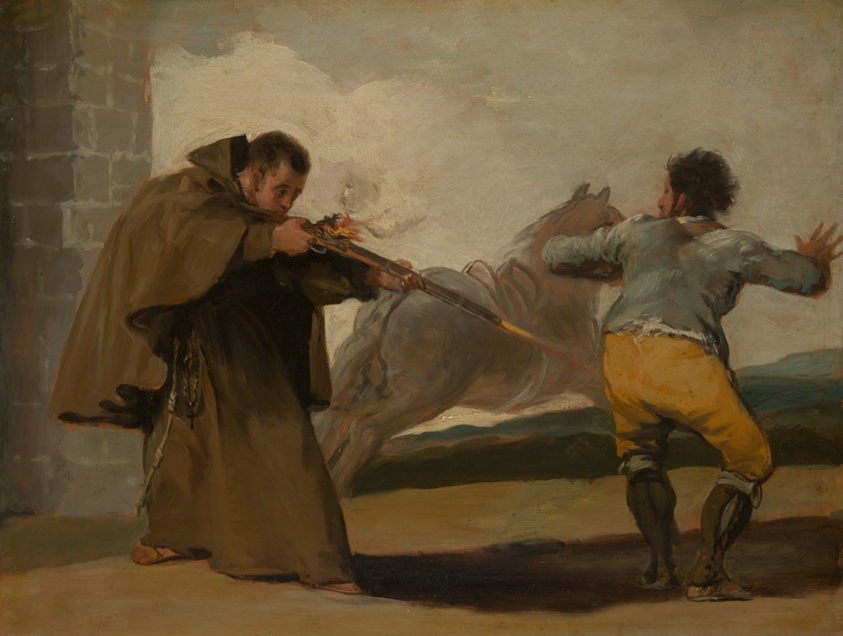
Friar Pedro Shoots El Maragato as His Horse Runs Off
Francisco José de Goya y Lucientes (Spanish, 1746–1828)LinkedCulture matchlcp-996a1e74ef53
- Date
- c. 1806
- Medium
- Oil on panel
- Culture
- Spain
- Department
- Painting and Sculpture of Europe
- Institution
- Art Institute of Chicago
- Object ID
- 16362
From the Art Institute of Chicago record
In the summer of 1806 in Spain, on the run after a prison escape, the dreaded bandit El Maragato overtook a family in their home and held them hostage. Among the family members was Pedro de Zaldivia, a lay Franciscan brother who stopped by the house to beg for alms. The humble monk ended up turning the tables on his captor, seizing El Maragato’s rifle and shooting him in the thigh to subdue him before he could grab another gun from his horse. The story of the heroic friar swept through Spain, not only via reports in newspapers and pamphlets but also in ballads and prints. Although at the time Francisco Goya was chief painter to the Spanish king, he was interested in the range of human experience, including current events, and the tale of Zaldivia and El Maragato evidently captured his imagination. This small, lively painting belongs to a series of six at the Art Institute, which, like a modern-day comic strip, dramatically illustrates the story. The climactic scene here presents the bandit’s degrading and humorous downfall. As in all the panels, Goya’s broad, quick brushwork dispenses with unnecessary detail to pinpoint the essential drama of the moment. This narrative series stands in marked contrast to the portraits of royalty and nobility that make up much of Goya’s painted works. His other small-format paintings similarly treat traditional pastimes, superstitions, and scenes from daily life with a popular realism that is oft en darkly comic in tone. Goya may have created the El Maragato series for his own amusement rather than as a commission, since they were still listed among his possessions in an 1812 inventory.
The authoritative record is held by Art Institute of Chicago. LinkedCulture surfaces this object and its connections; it does not alter institutional metadata.
Get printable QR codesHide QR codes
Open QR codes for this object page and the museum record. They stay collapsed until needed.
Provenance & credit
As published by the source institution. Coverage varies — not every institution's open-data feed includes ownership history.
- Credit line
- Mr. and Mrs. Martin A. Ryerson Collection
- Provenance
- One of a series of six small paintings in an inventory of Goya’s collection, Madrid, taken in 1812 for the division of property between the artist and his son Javier following the death of the artist's wife; the group of small paintings marked X8 being allotted to the son: "Seis quadros del Maragato señalados con el número ocho, en 700 [reales]" (the inventory mark has been removed from the painting and is no longer visible) [see Gassier and Wilson 1971]; presumably Javier Goya after 1812. Lafitte collection, Madrid; sale, Paris, Hôtel Drouot, March 7, 1861, bought in together with other paintings from the series for 590 francs [see Hippolyte Mireur, Dictionnaire des ventes (Paris, 1914), vol. 3, p. 360 and Despartment Fitz-Gerald 1928-1950]. Julius Böhler, Munich by 1911; sold to Martin Ryerson (died 1932), Chicago in May 1911 [see purchase receipt dated May 13, 1911]; bequeathed to the Art Institute, 1933.
Linked open data
Authority identifiers that link this record into the wider web of cultural data — stable references you can follow to the source.
- Object type
- AAT300033618
Related across collections
Semantically similar works from Art Institute of Chicago and other institutions.