Art Institute of Chicago
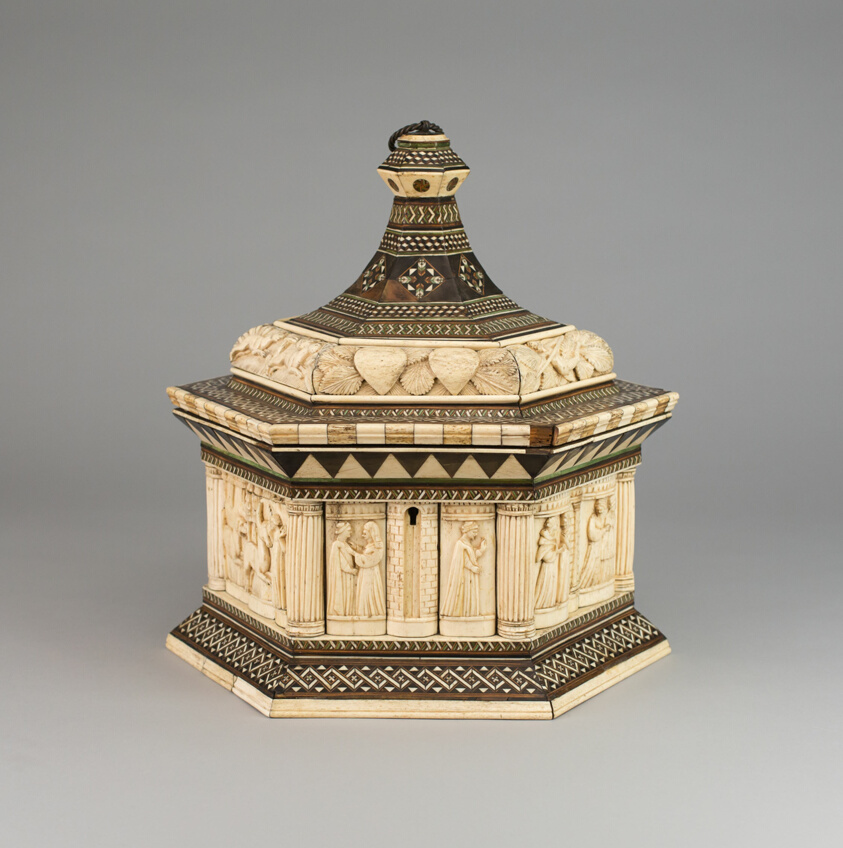
Casket
Embriachi Workshop (Florence, Italy, c. 1370-1395 and Venice, Italy, 1395-c. 1420)LinkedCulture matchlcp-24f45769c31f
- Date
- c. 1390-c. 1410
- Medium
- Bone, cow horn, wood, iron, and silk velvet
- Culture
- Venice
- Department
- Applied Arts of Europe
- Institution
- Art Institute of Chicago
- Object ID
- 107681
From the Art Institute of Chicago record
Given to noble or merchant-class brides in honor of a betrothal or wedding, small caskets such as this were used as keepsake boxes to house jewelry and other important mementos. The sides were often carved with emblematic scenes to entertain the recipient bride. The narratives portrayed on this casket are haphazardly mixed including a stag hunt, an abducted maiden, and a scene with a figure crawling out of an eagle. Some of these are taken from popular contemporary romances Mattabruna and Il pecorone (The Golden Eagle) among other sources. This incoherent mix of stories is due to modern restoration that has haphazardly adapted plaques from another casket or caskets by the same workshop to fill losses. On the lid are two kite-shaped shields—though blank, these were meant to be painted with the coats-of-arms of the two families joined in marriage, a means of personalizing the object after purchase. Beginning in the 1370s, caskets like this, as well as private altarpieces, were manufactured in numbers at a workshop owned by a noble Florentine entrepreneur and diplomat, Baldassare degli Embriachi. After about 1395, the Embriachi family and its workshop moved operations to Venice where they continued to produce pieces into the second quarter of the fifteenth century. Benefitting from a rising economy for luxury goods, the family business was apparently a success. The workshop designed their product toward economic measures. Pieces were generally made on spec for the open market rather than for special commissions. Relative to price, a variety of forms, sizes, and degree of detail were available to the buyer. And, instead of costly ebony and ivory from Africa, the workshop’s craftsmen used common cow and horse bone, horn, and hooves. The carved segments on this casket partially retain the outer shape of the animal bones used.
The authoritative record is held by Art Institute of Chicago. LinkedCulture surfaces this object and its connections; it does not alter institutional metadata.
Get printable QR codesHide QR codes
Open QR codes for this object page and the museum record. They stay collapsed until needed.
Provenance & credit
As published by the source institution. Coverage varies — not every institution's open-data feed includes ownership history.
- Credit line
- Bequest of Mrs. Gordon Palmer
- Provenance
- Mrs. Potter Palmer, early twentieth-century [according to notes in curatorial files]; by descent through the Palmer family until 1985, when it was given to the museum.
Linked open data
Authority identifiers that link this record into the wider web of cultural data — stable references you can follow to the source.
- Object type
- AAT300411641
Related across collections
Semantically similar works from Art Institute of Chicago and other institutions.